







Question: . A, the strongest, knocks out the opponent it attacks with probability 1/2, . B knocks out the opponent it attacks with probability 1/3, .
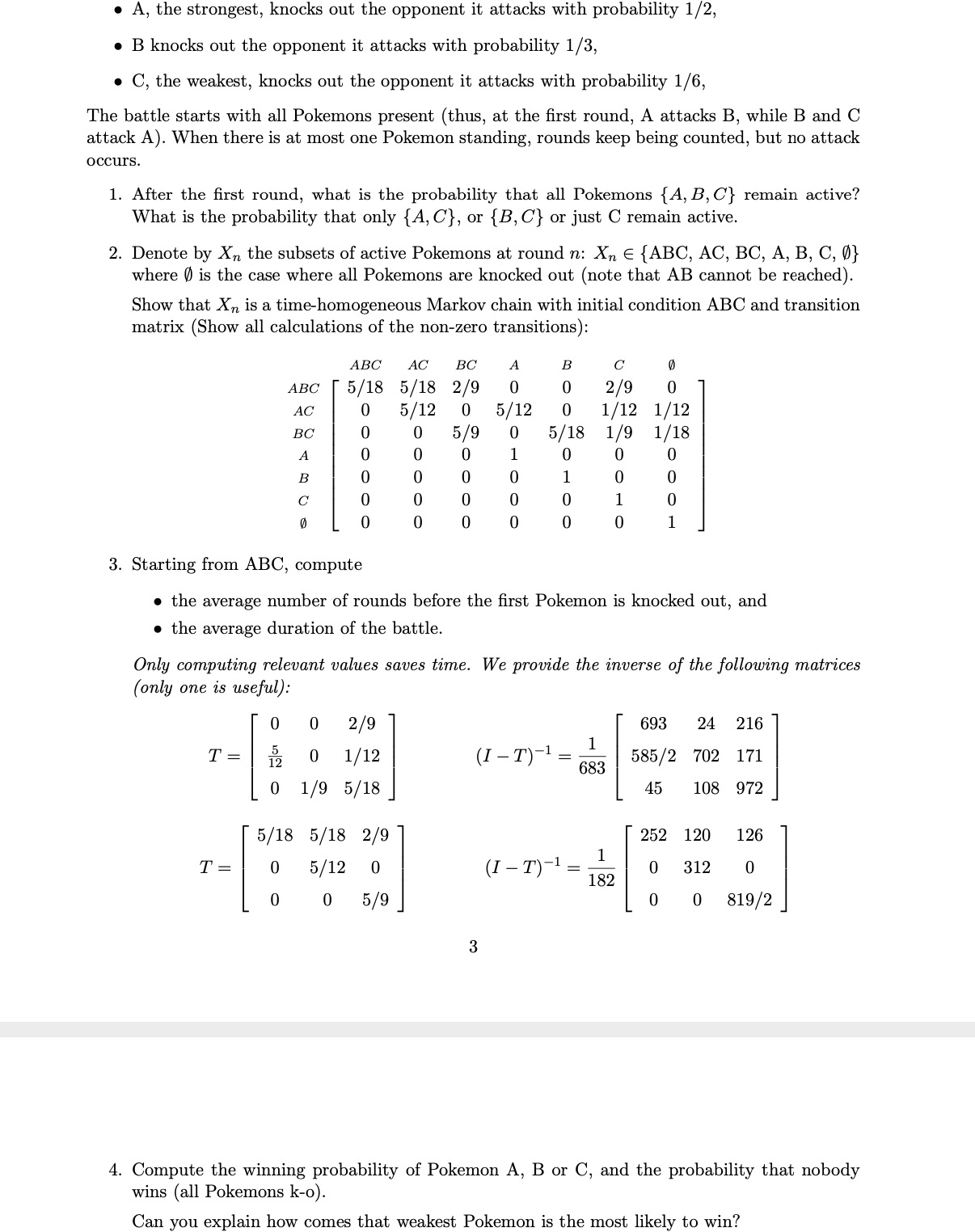
. A, the strongest, knocks out the opponent it attacks with probability 1/2, . B knocks out the opponent it attacks with probability 1/3, . C, the weakest, knocks out the opponent it attacks with probability 1/6, The battle starts with all Pokemons present (thus, at the first round, A attacks B, while B and C attack A). When there is at most one Pokemon standing, rounds keep being counted, but no attack occurs. 1. After the first round, what is the probability that all Pokemons {A, B, C} remain active? What is the probability that only {A, C}, or {B, C} or just C remain active. 2. Denote by Xn the subsets of active Pokemons at round n: Xn E {ABC, AC, BC, A, B, C, (} where O is the case where all Pokemons are knocked out (note that AB cannot be reached). Show that Xn is a time-homogeneous Markov chain with initial condition ABC and transition matrix (Show all calculations of the non-zero transitions): ABC AC BC A B C ABC 5/18 5/18 2/9 0 0 5/12 0 O 2/9 AC 5/12 0 1/12 1/12 BC 0 0 5/9 0 5/18 1/9 1/18 A 0 0 0 0 0 0 B 0 Q 0 0 0 1 0 0 0 0 0 O 0 0 O 1 3. Starting from ABC, compute . the average number of rounds before the first Pokemon is knocked out, and . the average duration of the battle. Only computing relevant values saves time. We provide the inverse of the following matrices (only one is useful): 0 0 2/9 693 24 216 T = 0 1/12 ( I - T) = 1 683 585/2 702 171 0 1/9 5/18 45 108 972 5/18 5/18 2/9 252 120 126 T = 0 5/12 0 (I- T)-1 = 1 182 312 0 0 0 5/9 0 819/2 3 4. Compute the winning probability of Pokemon A, B or C, and the probability that nobody wins (all Pokemons k-o). Can you explain how comes that weakest Pokemon is the most likely to win
Step by Step Solution
There are 3 Steps involved in it

Get step-by-step solutions from verified subject matter experts
 Study Help