







Question: - = (a) The subgraph isomorphism problem is as follows. Given two graphs G1 = (V1, E1) and G2 = (V2, E2), does G have
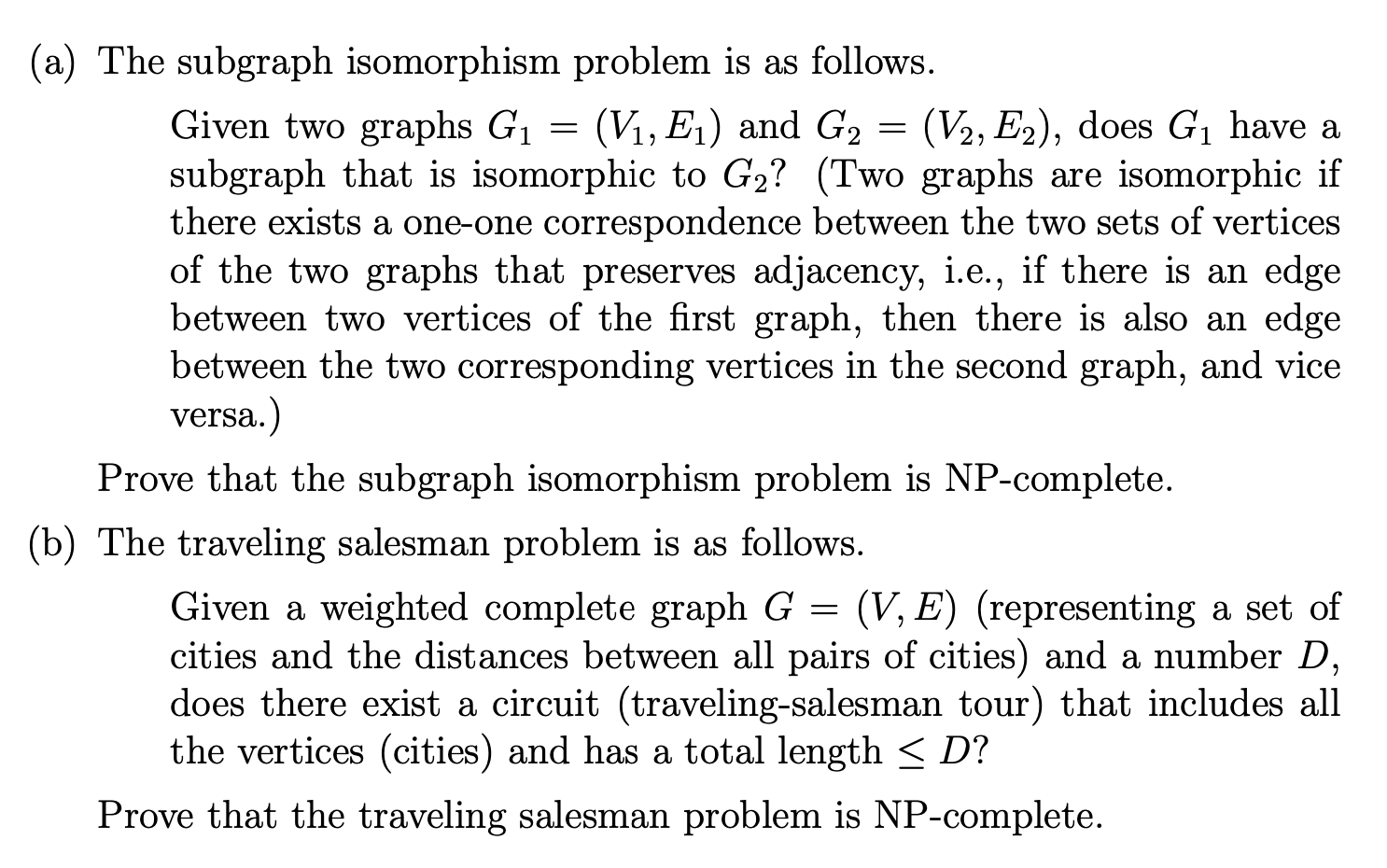
- = (a) The subgraph isomorphism problem is as follows. Given two graphs G1 = (V1, E1) and G2 = (V2, E2), does G have a subgraph that is isomorphic to G2? (Two graphs are isomorphic if there exists a one-one correspondence between the two sets of vertices of the two graphs that preserves adjacency, i.e., if there is an edge between two vertices of the first graph, then there is also an edge between the two corresponding vertices in the second graph, and vice versa.) Prove that the subgraph isomorphism problem is NP-complete. (b) The traveling salesman problem is as follows. Given a weighted complete graph G = (V, E) (representing a set of cities and the distances between all pairs of cities) and a number D, does there exist a circuit (traveling-salesman tour) that includes all the vertices (cities) and has a total length
Step by Step Solution
There are 3 Steps involved in it

Get step-by-step solutions from verified subject matter experts
 Study Help