







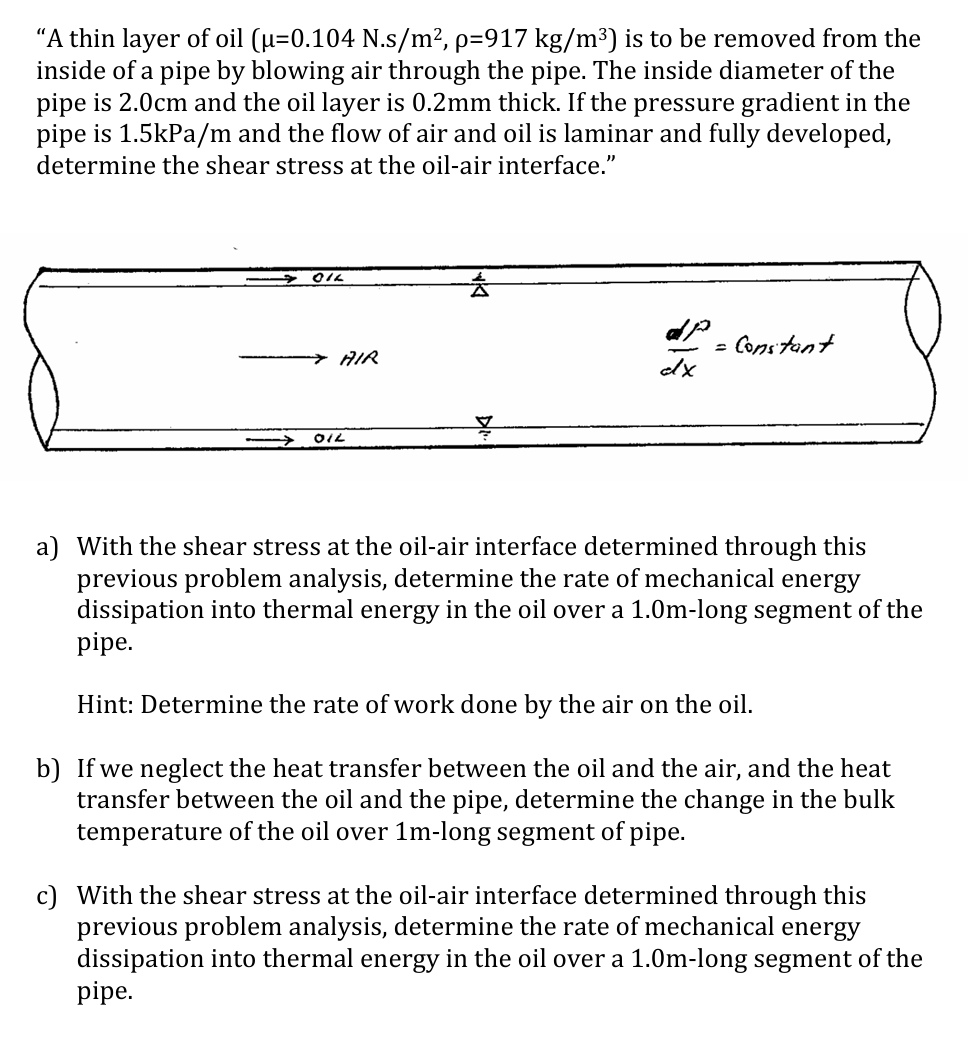
Question: A thin layer of oil ( ( left . mu = 0 . 1 0 4 mathrm { ~N } .
"A thin layer of oil leftmumathrm~Nmathrmsmathrmmrhomathrm~kgmathrmmright is to be removed from the inside of a pipe by blowing air through the pipe. The inside diameter of the pipe is cm and the oil layer is mm thick. If the pressure gradient in the pipe is mathrmkPamathrmm and the flow of air and oil is laminar and fully developed, determine the shear stress at the oilair interface."
a With the shear stress at the oilair interface determined through this previous problem analysis, determine the rate of mechanical energy dissipation into thermal energy in the oil over a mlong segment of the pipe.
Hint: Determine the rate of work done by the air on the oil.
b If we neglect the heat transfer between the oil and the air, and the heat transfer between the oil and the pipe, determine the change in the bulk temperature of the oil over m long segment of pipe.
c With the shear stress at the oilair interface determined through this previous problem analysis, determine the rate of mechanical energy dissipation into thermal energy in the oil over a mlong segment of the pipe.
Step by Step Solution
There are 3 Steps involved in it
1 Expert Approved Answer
Step: 1 Unlock

Question Has Been Solved by an Expert!
Get step-by-step solutions from verified subject matter experts
Step: 2 Unlock
Step: 3 Unlock
 Study Help