







Question: A third harmonic wave can be generated by cascading two x(2) processes in series. Here we consider second harmonic generation (SHG) followed by sum-frequency generation
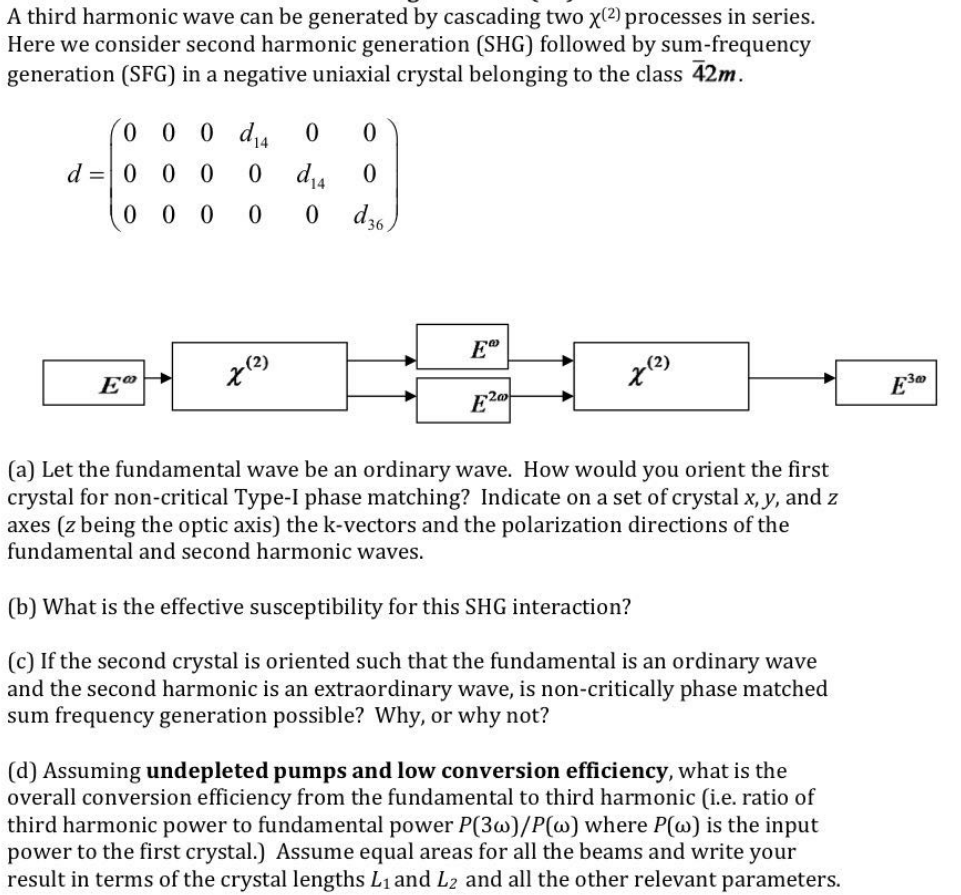
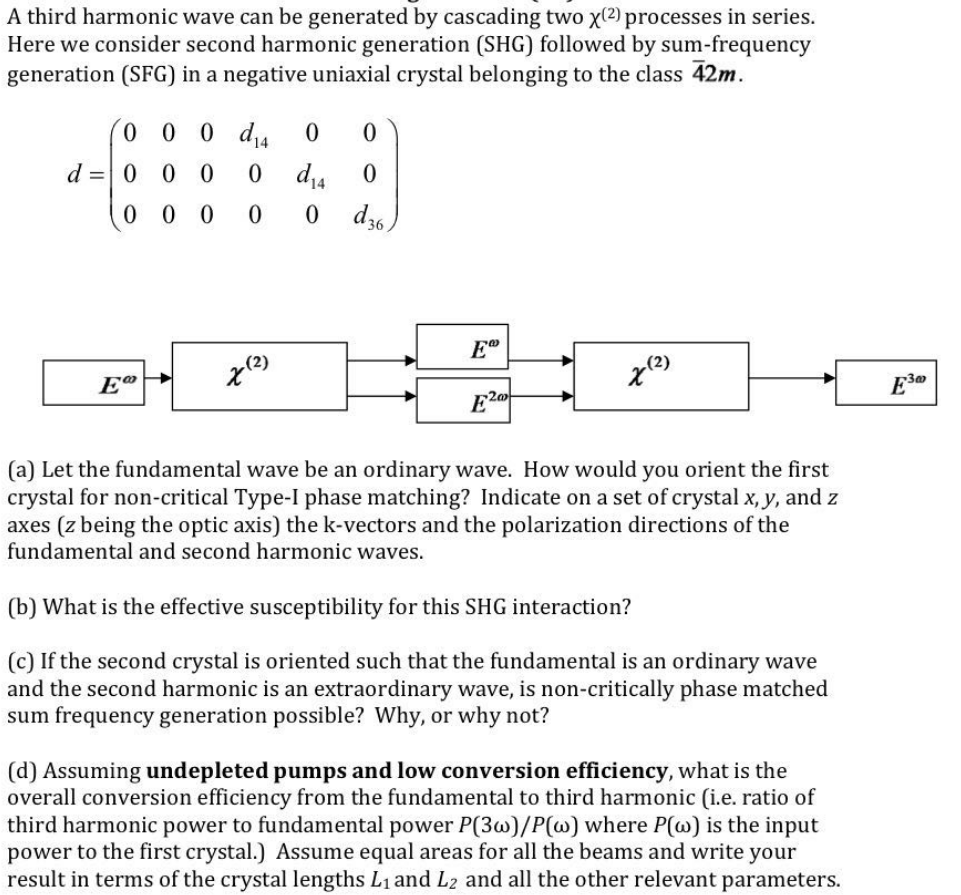
A third harmonic wave can be generated by cascading two x(2) processes in series. Here we consider second harmonic generation (SHG) followed by sum-frequency generation (SFG) in a negative uniaxial crystal belonging to the class 42m. 0 0 0 d 4 0 0 d = 0 0 0 0 4 C 00 0 0 0 d36 Fo 2 (2) * (2) F30 F20 (a) Let the fundamental wave be an ordinary wave. How would you orient the first crystal for non-critical Type-I phase matching? Indicate on a set of crystal x, y, and z axes (z being the optic axis) the k-vectors and the polarization directions of the fundamental and second harmonic waves. (b) What is the effective susceptibility for this SHG interaction? (c) If the second crystal is oriented such that the fundamental is an ordinary wave and the second harmonic is an extraordinary wave, is non-critically phase matched sum frequency generation possible? Why, or why not? (d) Assuming undepleted pumps and low conversion efficiency, what is the overall conversion efficiency from the fundamental to third harmonic (i.e. ratio of third harmonic power to fundamental power P(3w)/P(w) where P(w) is the input power to the first crystal.) Assume equal areas for all the beams and write your result in terms of the crystal lengths Li and L2 and all the other relevant parameters
Step by Step Solution
There are 3 Steps involved in it

Get step-by-step solutions from verified subject matter experts
 Study Help