







Question: A tray-type distillation tower is to be used for separating a propane/propylene mixture. The multi-component feed to the tower is completely vapor at a
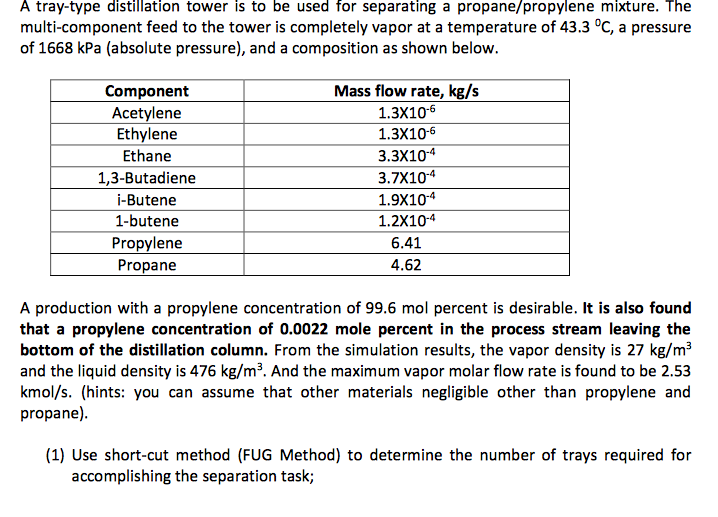
A tray-type distillation tower is to be used for separating a propane/propylene mixture. The multi-component feed to the tower is completely vapor at a temperature of 43.3 C, a pressure of 1668 kPa (absolute pressure), and a composition as shown below. Component Acetylene Ethylene Ethane 1,3-Butadiene i-Butene 1-butene Propylene Propane Mass flow rate, kg/s 1.3x10⁻⁶ 1.3X10⁻⁶ 3.3X10⁻⁴ 3.7X10⁻⁴ 1.9X10⁻⁴ 1.2X10⁻⁴ 6.41 4.62 A production with a propylene concentration of 99.6 mol percent is desirable. It is also found that a propylene concentration of 0.0022 mole percent in the process stream leaving the bottom of the distillation column. From the simulation results, the vapor density is 27 kg/m and the liquid density is 476 kg/m. And the maximum vapor molar flow rate is found to be 2.53 kmol/s. (hints: you can assume that other materials negligible other than propylene and propane). (1) Use short-cut method (FUG Method) to determine the number of trays required for accomplishing the separation task;
Step by Step Solution
3.33 Rating (150 Votes )
There are 3 Steps involved in it
To determine the number of trays required using the FenskeUnderwoodGilliland FUG method well follow these steps Step 1 Calculate the Relative Volatili... View full answer

Get step-by-step solutions from verified subject matter experts
 Study Help