







Question: A tutorial question about Inventory Control Theory (Please look at the question clearly, because the number is different, there has some similar question in these
A tutorial question about Inventory Control Theory (Please look at the question clearly, because the number is different, there has some similar question in these website!)
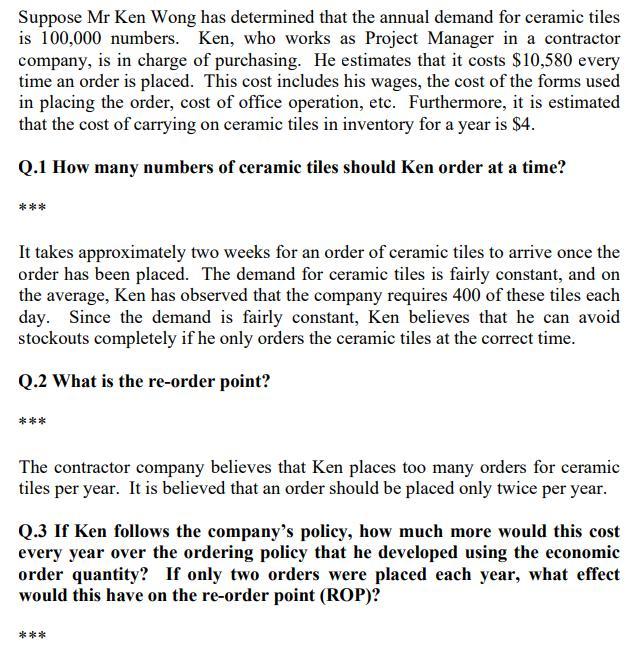
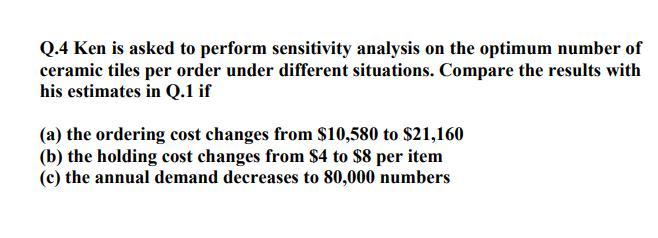
Suppose Mr Ken Wong has determined that the annual demand for ceramic tiles is 100,000 numbers. Ken, who works as Project Manager in a contractor company, is in charge of purchasing. He estimates that it costs $10,580 every time an order is placed. This cost includes his wages, the cost of the forms used in placing the order, cost of office operation, etc. Furthermore, it is estimated that the cost of carrying on ceramic tiles in inventory for a year is $4. Q.1 How many numbers of ceramic tiles should Ken order at a time? *** It takes approximately two weeks for an order of ceramic tiles to arrive once the order has been placed. The demand for ceramic tiles is fairly constant, and on the average, Ken has observed that the company requires 400 of these tiles each day. Since the demand is fairly constant, Ken believes that he can avoid stockouts completely if he only orders the ceramic tiles at the correct time. Q.2 What is the re-order point? *** The contractor company believes that Ken places too many orders for ceramic tiles per year. It is believed that an order should be placed only twice per year. Q.3 If Ken follows the company's policy, how much more would this cost every year over the ordering policy that he developed using the economic order quantity? If only two orders were placed each year, what effect would this have on the re-order point (ROP)? *** Q.4 Ken is asked to perform sensitivity analysis on the optimum number of ceramic tiles per order under different situations. Compare the results with his estimates in Q.1 if (a) the ordering cost changes from $10,580 to $21,160 (b) the holding cost changes from $4 to $8 per item (c) the annual demand decreases to 80,000 numbers Suppose Mr Ken Wong has determined that the annual demand for ceramic tiles is 100,000 numbers. Ken, who works as Project Manager in a contractor company, is in charge of purchasing. He estimates that it costs $10,580 every time an order is placed. This cost includes his wages, the cost of the forms used in placing the order, cost of office operation, etc. Furthermore, it is estimated that the cost of carrying on ceramic tiles in inventory for a year is $4. Q.1 How many numbers of ceramic tiles should Ken order at a time? *** It takes approximately two weeks for an order of ceramic tiles to arrive once the order has been placed. The demand for ceramic tiles is fairly constant, and on the average, Ken has observed that the company requires 400 of these tiles each day. Since the demand is fairly constant, Ken believes that he can avoid stockouts completely if he only orders the ceramic tiles at the correct time. Q.2 What is the re-order point? *** The contractor company believes that Ken places too many orders for ceramic tiles per year. It is believed that an order should be placed only twice per year. Q.3 If Ken follows the company's policy, how much more would this cost every year over the ordering policy that he developed using the economic order quantity? If only two orders were placed each year, what effect would this have on the re-order point (ROP)? *** Q.4 Ken is asked to perform sensitivity analysis on the optimum number of ceramic tiles per order under different situations. Compare the results with his estimates in Q.1 if (a) the ordering cost changes from $10,580 to $21,160 (b) the holding cost changes from $4 to $8 per item (c) the annual demand decreases to 80,000 numbers
Step by Step Solution
There are 3 Steps involved in it

Get step-by-step solutions from verified subject matter experts
 Study Help