







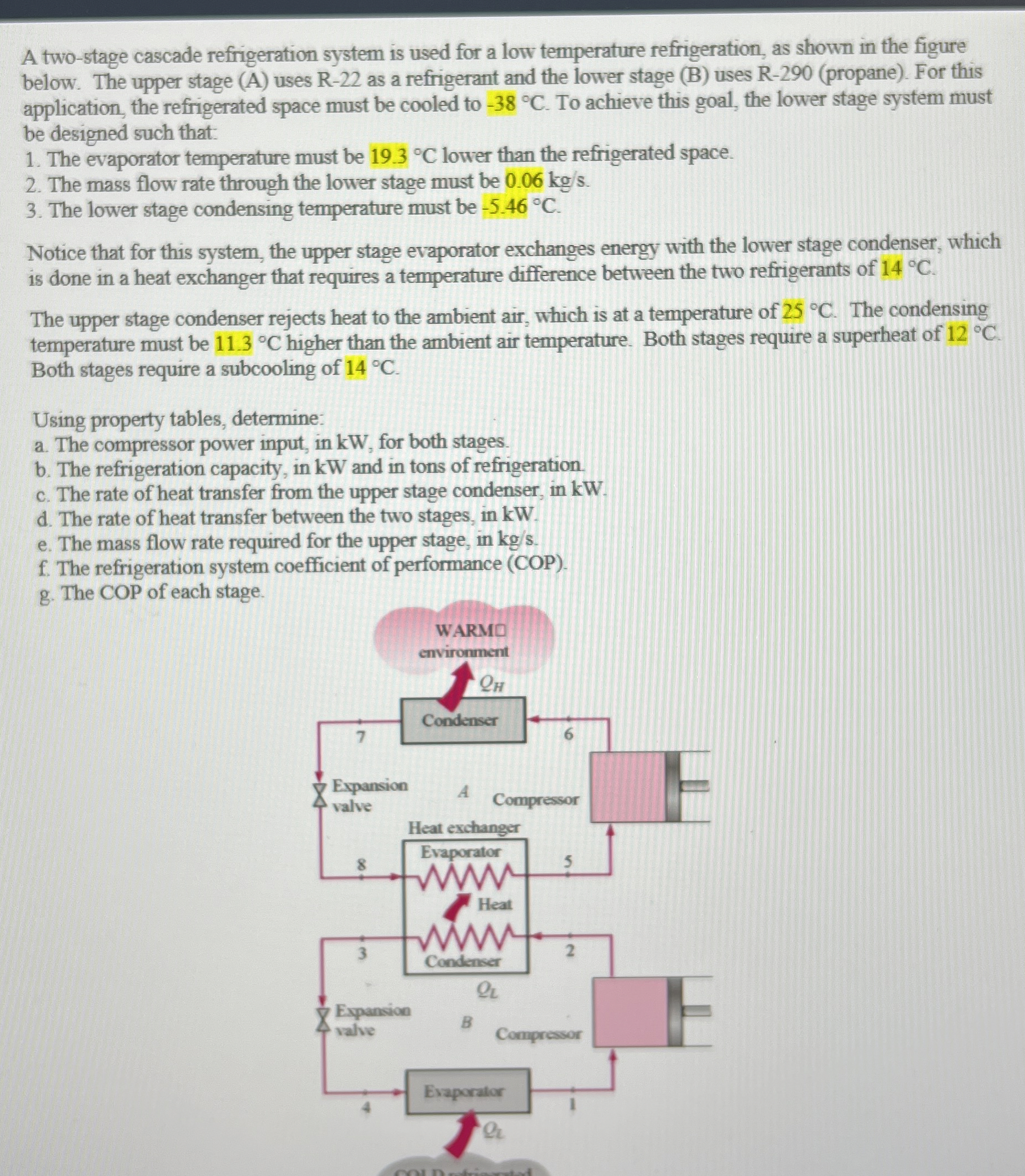
Question: A two - stage cascade refrigeration system is used for a low temperature refrigeration, as shown in the figure below. The upper stage ( A
A twostage cascade refrigeration system is used for a low temperature refrigeration, as shown in the figure below. The upper stage A uses as a refrigerant and the lower stage B uses propane For this application, the refrigerated space must be cooled to To achieve this goal, the lower stage system must be designed such that:
The evaporator temperature must be lower than the refrigerated space.
The mass flow rate through the lower stage must be
The lower stage condensing temperature must be
Notice that for this system, the upper stage evaporator exchanges energy with the lower stage condenser, which is done in a heat exchanger that requires a temperature difference between the two refrigerants of
The upper stage condenser rejects heat to the ambient air, which is at a temperature of The condensing temperature must be higher than the ambient air temperature. Both stages require a superheat of Both stages require a subcooling of
Using property tables, determine:
a The compressor power input, in kW for both stages.
b The refrigeration capacity, in kW and in tons of refrigeration.
c The rate of heat transfer from the upper stage condenser, in kW
d The rate of heat transfer between the two stages, in kW
e The mass flow rate required for the upper stage, in
f The refrigeration system coefficient of performance COP
g The COP of each stage.
Step by Step Solution
There are 3 Steps involved in it
1 Expert Approved Answer
Step: 1 Unlock

Question Has Been Solved by an Expert!
Get step-by-step solutions from verified subject matter experts
Step: 2 Unlock
Step: 3 Unlock
 Study Help