







Question: A two variables linear programming problem ( 100 points) A utility company supplies drinking water to a community, which demands at least 10,000m3 of water
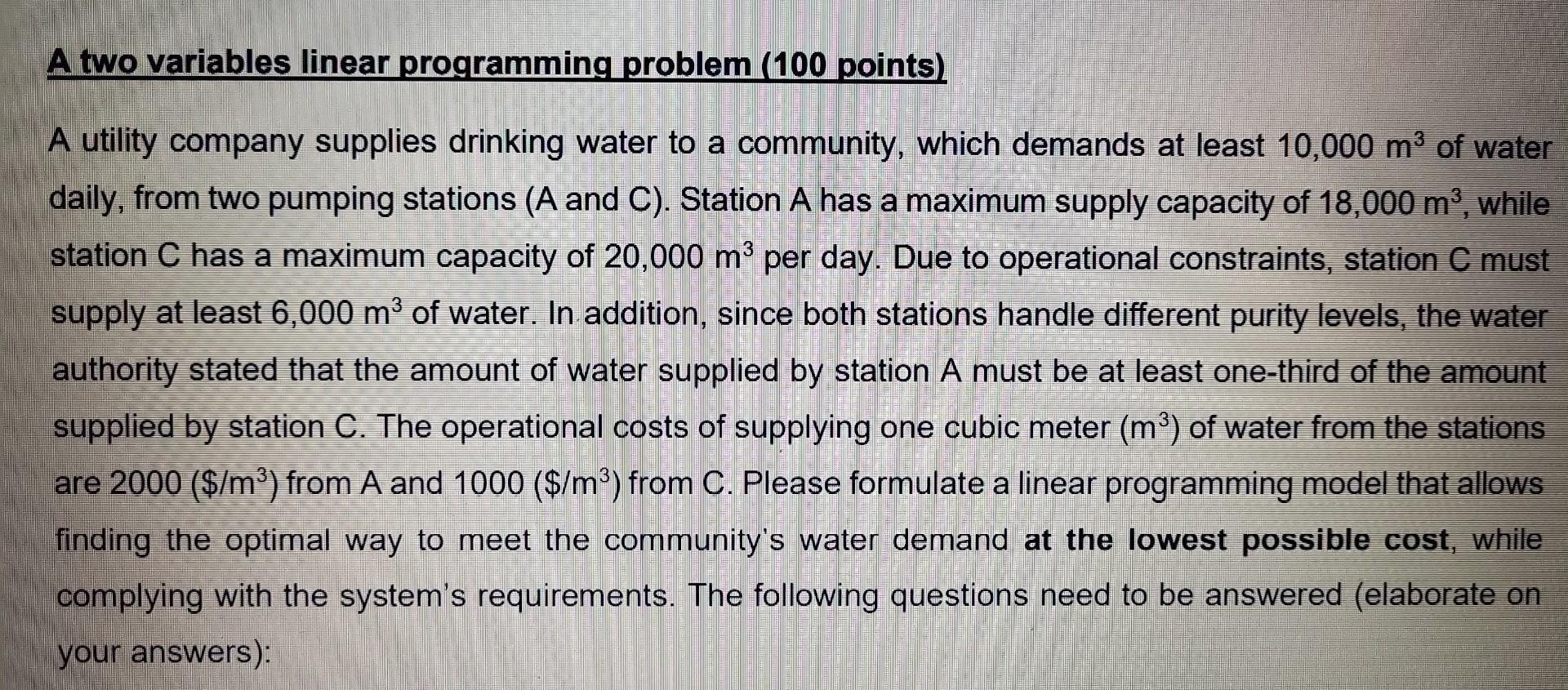
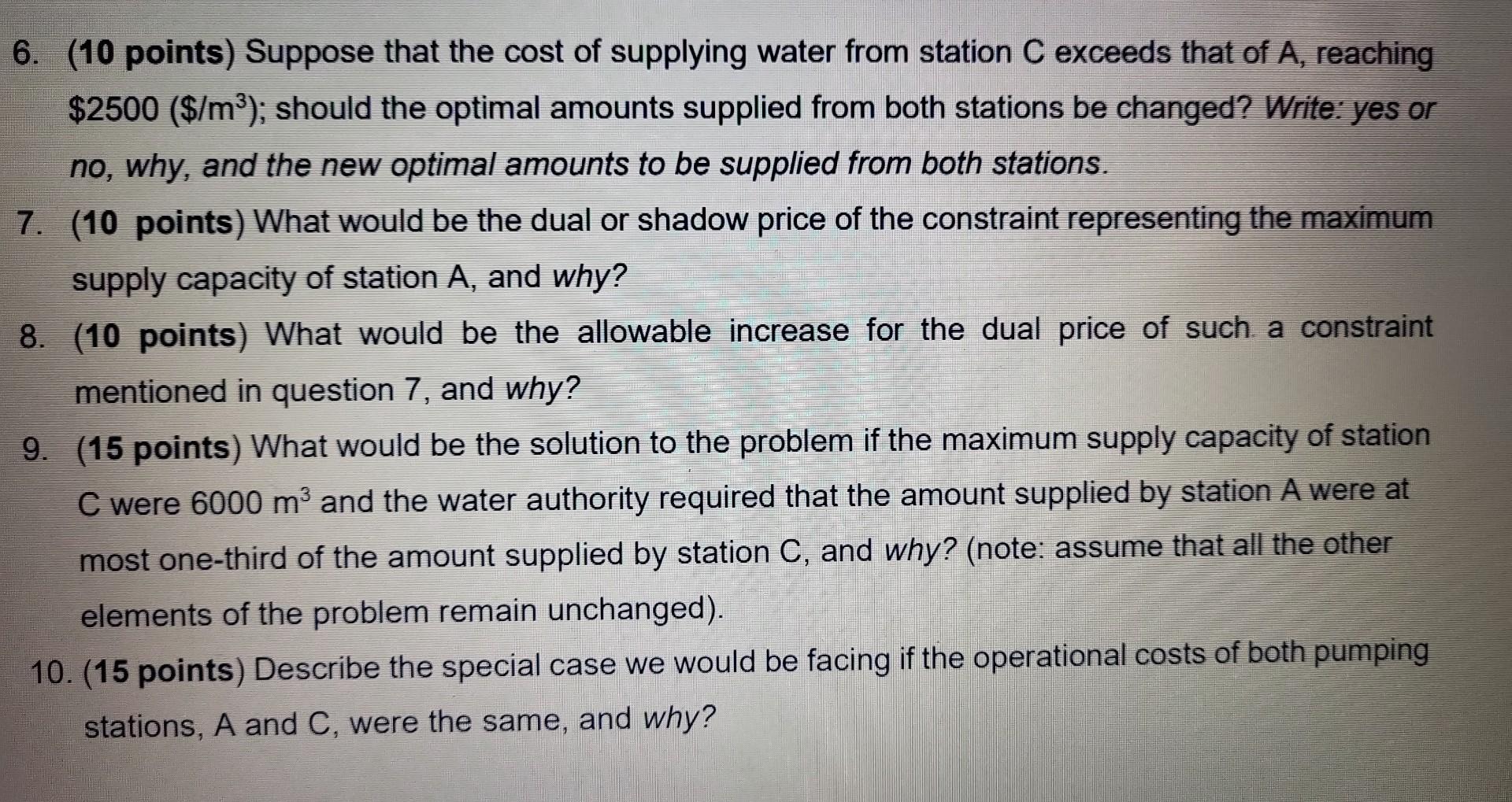
A two variables linear programming problem ( 100 points) A utility company supplies drinking water to a community, which demands at least 10,000m3 of water daily, from two pumping stations ( A and C). Station A has a maximum supply capacity of 18,000m3, while station C has a maximum capacity of 20,000m3 per day. Due to operational constraints, station C must supply at least 6,000m3 of water. In addition, since both stations handle different purity levels, the water authority stated that the amount of water supplied by station A must be at least one-third of the amount supplied by station C. The operational costs of supplying one cubic meter (m3) of water from the stations are 2000($/m3) from A and 1000($/m3) from C. Please formulate a linear programming model that allows finding the optimal way to meet the community's water demand at the lowest possible cost, while complying with the system's requirements. The following questions need to be answered (elaborate on your answers): 6. (10 points) Suppose that the cost of supplying water from station C exceeds that of A, reaching $2500($/m3); should the optimal amounts supplied from both stations be changed? Write: yes or no, why, and the new optimal amounts to be supplied from both stations. 7. (10 points) What would be the dual or shadow price of the constraint representing the maximum supply capacity of station A, and why? 8. (10 points) What would be the allowable increase for the dual price of such a constraint mentioned in question 7 , and why? 9. (15 points) What would be the solution to the problem if the maximum supply capacity of station C were 6000m3 and the water authority required that the amount supplied by station A were at most one-third of the amount supplied by station C, and why? (note: assume that all the other elements of the problem remain unchanged). 10. (15 points) Describe the special case we would be facing if the operational costs of both pumping stations, A and C, were the same, and why
Step by Step Solution
There are 3 Steps involved in it

Get step-by-step solutions from verified subject matter experts
 Study Help