







Question: a) Uning a 2 year moving average, the forecast for year 6 = mies (round your response to the neavest whole number). b) If a
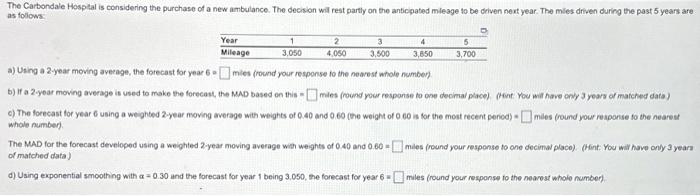
a) Uning a 2 year moving average, the forecast for year 6 = mies (round your response to the neavest whole number). b) If a 2 -year moving average is used to make the forecast, the MAD based on this = miles (round your response to ope decmal pace) (Pent: You mill have only 3 years of matched data) c) The forecast for year 6 using a weighted 2 year moving average with weights of 0.40 and 0.60 (the weight of 060 a sor the most recent period) * miles (round your respanse fo the nearest whole number): The MAD for the forecast deveioped using a weighted 2 year moving average with weights of 0.40 and 0.60= miles (round your response to one decimal place). (hint: You will have only 3 year of matched data) d) Using exponential smoothing with =0.30 and the forecast for year 1 being 3.050 , the forecast for year 6= miles (round your nesponse fo the neavest wholo number). a) Uning a 2 year moving average, the forecast for year 6 = mies (round your response to the neavest whole number). b) If a 2 -year moving average is used to make the forecast, the MAD based on this = miles (round your response to ope decmal pace) (Pent: You mill have only 3 years of matched data) c) The forecast for year 6 using a weighted 2 year moving average with weights of 0.40 and 0.60 (the weight of 060 a sor the most recent period) * miles (round your respanse fo the nearest whole number): The MAD for the forecast deveioped using a weighted 2 year moving average with weights of 0.40 and 0.60= miles (round your response to one decimal place). (hint: You will have only 3 year of matched data) d) Using exponential smoothing with =0.30 and the forecast for year 1 being 3.050 , the forecast for year 6= miles (round your nesponse fo the neavest wholo number)
Step by Step Solution
There are 3 Steps involved in it

Get step-by-step solutions from verified subject matter experts
 Study Help