



Question: a) Use the delta method to derive the asymptotic variance expression below Avar(bar()_MLE) = 1/nv_1 [ (_2 (V_2)^2)/ 4c^4 + (_3 V_2)/ c^2 + _4
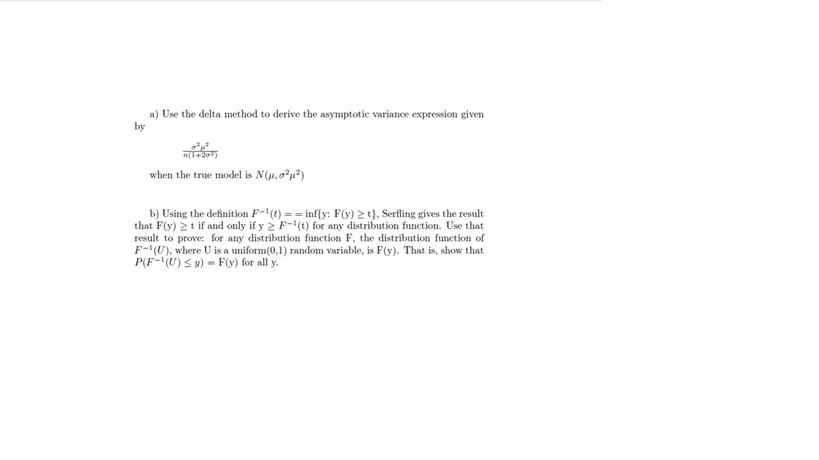
a) Use the delta method to derive the asymptotic variance expression below
Avar(bar(μ)_MLE) = 1/nv_1 [ (μ_2 (V_2)^2)/ 4c^4 + (μ_3 V_2)/ c^2 + μ_4 - (μ_2)^2 ]
b) Using the definition F^-(1) (t) = inf{ y: F(y) >= t} Serfling gives the result that F(y) >= t if and only if y >= F^-(1) (t) for any distribution function. Use that result to prove: for any distribution function F , the distribution function of F^-(1) (U), where U is a uniform(0,1) random variable, is F(y). That is, show that P(F^-(1) (U) =< y) for all y.
a) Use the delta method to derive the asymptotic variance expression given by when the true model is N(.0) b) Using the definition F-(t) == inf{y: F(y) 2 t), Serfling gives the result that F(y) 2 t if and only if y 2 F-1(t) for any distribution function. Use that result to prove: for any distribution function F, the distribution function of F-1(U), where U is a uniform(0,1) random variable, is F(y). That is, show that P(F-1(U) S9)F(y) for all y
Step by Step Solution
There are 3 Steps involved in it
that given The true model it NJ M2 Firek of all about want to Say Saying when you are Symp... View full answer

Get step-by-step solutions from verified subject matter experts