







Question: a. Using a vertical bar chart, plot the pressure drop (i.e. P3P2 ) for these eight nominal pipe sizes: 3/4, 1, 1. 1/4,11/2,2,21/2,3,4,6, and 8
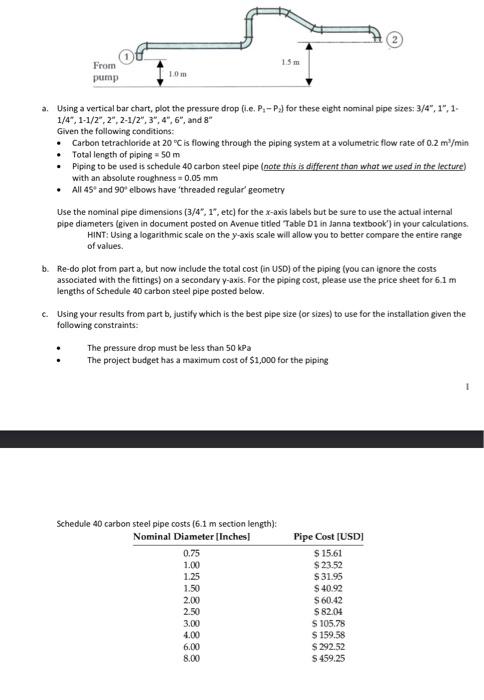
a. Using a vertical bar chart, plot the pressure drop (i.e. P3P2 ) for these eight nominal pipe sizes: 3/4", 1", 1. 1/4,11/2,2,21/2,3,4,6, and 8 Gien the following conditions: - Carbon tetrachloride at 20C is flowing through the piping system at a volumetric flow fate of 0.2m3/min - Total length of piping =50m - Piping to be used is schedule 40 carbon steel pipe (note this is different than what we used in the lecture) with an absolute roughness =0.05mm - All 45 and 90 elbows have 'threaded regular' geometry Use the nominal pipe dimensions [3/4,1, etc] for the x-axis labels but be sure to use the actual internal pipe diameters (given in document posted on Avenue titled 'Table D1 in Janna textbook') in your calculations. HINT: Using a logarithmic scale on the y-axis scale will allow you to better compare the entire range of values. b. Re-do plot from part a, but now include the total cost (in USD) of the piping (you can ignore the costs associated with the fittings) on a secondary y-axis. For the piping cost, please use the price sheet for 6.1m lengths of Schedule 40 carbon steel pipe posted below. c. Using your results from part b, justify which is the best pipe size (or sizes) to use for the installation given the following constraints: The pressure drop must be less than 50kPa The project budget has a maximum cost of $1,000 for the piping Schedule 40 carbe
Step by Step Solution
There are 3 Steps involved in it

Get step-by-step solutions from verified subject matter experts
 Study Help