Question: a) Using the EDD (liest due date decision for sequencing the jobs the order is (to resolve a tie, use the order in which the
a) Using the EDD (liest due date decision for
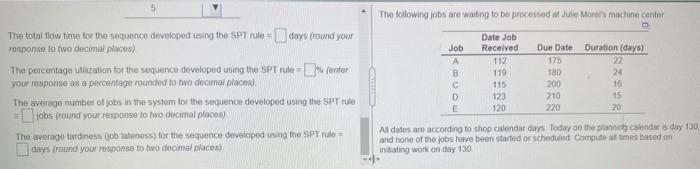
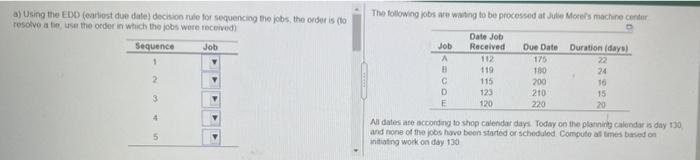
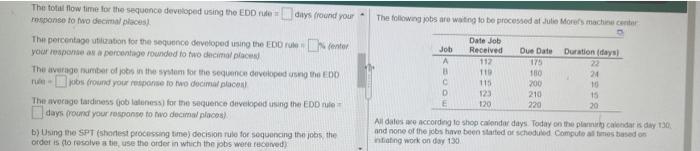
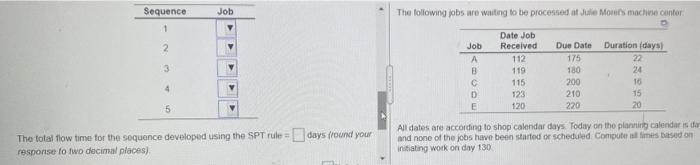
a) Using the EDD (liest due date decision for sequencing the jobs the order is (to resolve a tie, use the order in which the jobs were received Sequence Job 1 2 The following jobs are waiting to be processed at de Morels machine conter Date Job Job Received Due Date Duration days) A 112 175 22 B 119 180 24 C 115 200 10 D 210 15 E 120 220 20 All dates are according to shop calendar days Today on the planning Calendaris day 130 and one of the jobs have been started or scheduled Computo al mes based on initiating work on day 130 123 3 4 The following jobs are waiting to be processed at Julie More's machine conter The total tow time for the sequence developed using the EDD+ Guys round your sponse to two decimal places) The percentage utilization for the sequence developed using the EDO enter your responde as a percentage rounded to troncimal place The average number of jobs in the system for the sequence developed using the EDD -obs (round your response to two decimalucon The average fadiness job aleness for the sequence developed using the EDD days cround your response to no decimal places) b) Using the SPT (shortest processing time decision rule for sequencing the jobs the order is (to resolve a te use the order in which the jobs were record 200 Date Job Job Received Due Date Duration days) A 112 175 22 TO 180 24 115 10 D 123 210 15 E 120 20 All dates we according to shop calendar days. Today on the planning endaris day 130 and none of the jobs have been started or scheduled Computea mes based on nitiating work on day 130 220 Sequence Job The following jobs are waiting to be processed in Julie Morots machine contor 1 2 Job A B 3 Date Job Received 112 119 115 123 120 Due Date Duration days) 175 22 180 24 200 10 210 15 220 20 4 D E 5 The total flow time for the sequence developed using the SPT rule=days fround your response to two decimal places) All dates are according to shop calendar days. Today on the planning Calendaris de and none of the jobs have been started or scheduled Computer alimis sed on initiating work on day 130 The following jobs are waiting to be processed at Julie Morela machine conter The total flow time for the sequence developed using the SPT rule days from your response to two decimal places) The percentage unication for the sequence developed using the SPTrue } fontor your response as a percentage rounded to two decimal places) The average number of jobs in the system for the sequence developed using the SPT rule jobs (round your response to two decimal places) The average tardness (job lateness for the sequence developed using the SPT rule days (round your response to two decimal places) Job A B c D E Date Job Received 112 119 115 123 120 Due Date Duration days) 175 22 180 24 200 15 210 15 220 20 All dates are according to shop calendar days Today on the partidaris day 130 and none of the jobs have been starfod or scheduled Computeal times based on initiating work on day 130
Step by Step Solution

There are 3 Steps involved in it

1 Expert Approved Answer
Step: 1 Unlock blur-text-image

Question Has Been Solved by an Expert!

Get step-by-step solutions from verified subject matter experts

Step: 2 Unlock
Step: 3 Unlock

Students Have Also Explored These Related General Management Questions!