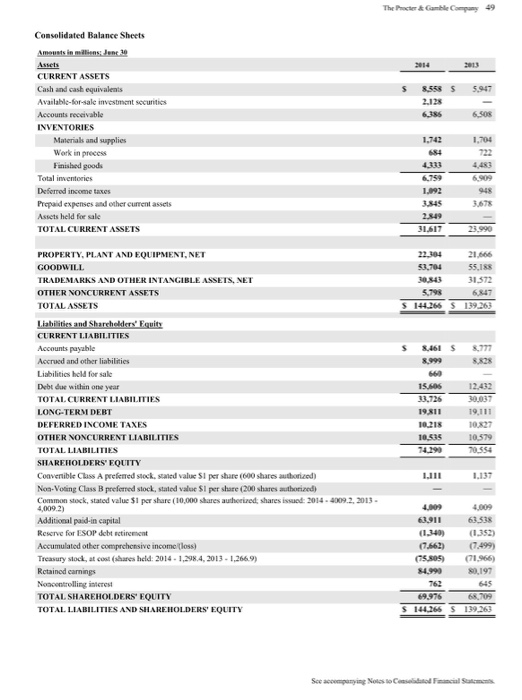
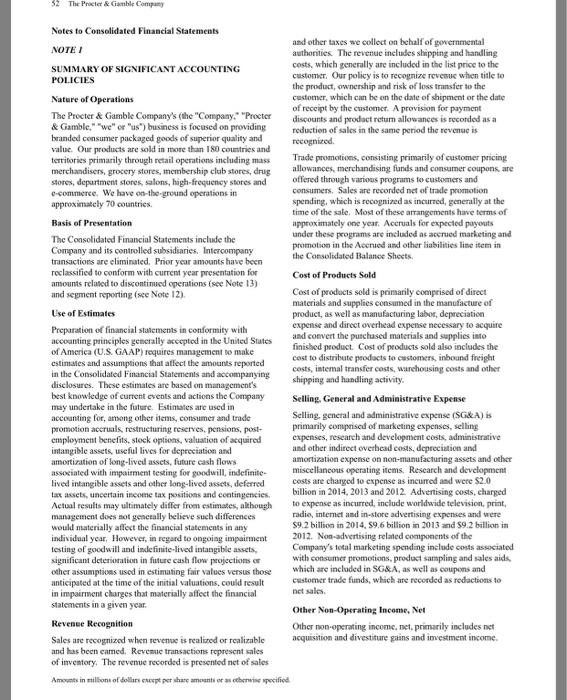
(a) What criteria does P&G use to classify "Cash and cash equivalents" as reported in its balance sheet?
(b) As of June 30, 2014, what balances did P&G have in cash and cash equivalents? What were the major uses of cash during the year?
(c) P&G reports no allowance for doubtful accounts, suggesting that bad debt expense is it reasonable that a company like P&G would not have material bad debt expense? Explain.
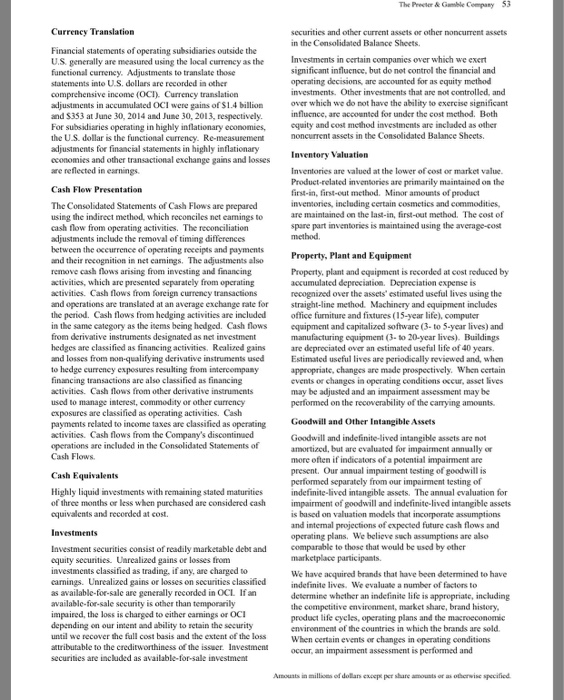
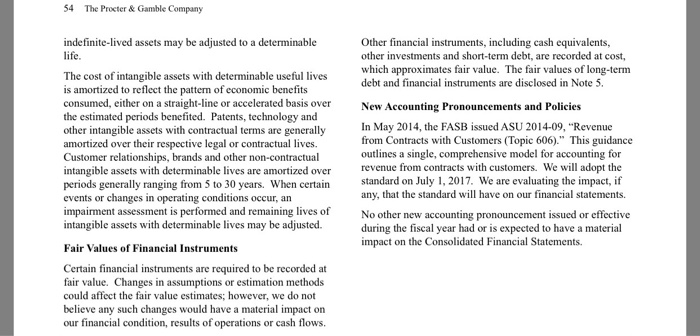
Attached is the balanced sheet and notes to the financial statement.
52
The Procter & Gamble Company
Amounts in millions of dollars except per share amounts or as otherwise specified.
Notes to Consolidated Financial Statements
NOTE 1
SUMMARYOFSIGNIFICANTACCOUNTING
POLICIES
Nature of Operations
The Procter & Gamble Company's (the "Company," "Procter
& Gamble," "we" or "us") business is focused on providing
branded consumer packaged goods of superior quality and
value. Our products are sold in more than 180 countries and
territories primarily through retail operations including mass
merchandisers, grocery stores, membership club stores, drug
stores, department stores, salons, high-frequency stores and
e-commerce. We have on-the-ground operations in
approximately 70 countries.
Basis of Presentation
The Consolidated Financial Statements include the
Company and its controlled subsidiaries. Intercompany
transactions are eliminated. Prior year amounts have been
reclassified to conform with current year presentation for
amounts related to discontinued operations (see Note 13)
and segment reporting (see Note 12).
Use of Estimates
Preparation of financial statements in conformity with
accounting principles generally accepted in the United States
ofAmerica (U.S. GAAP) requires management to make
estimates and assumptions that affect the amounts reported
in the Consolidated Financial Statements and accompanying
disclosures. These estimates are based on management's
best knowledge of current events and actions the Company
may undertake in the future. Estimates are used in
accounting for, among other items, consumer and trade
promotion accruals, restructuring reserves, pensions, post-
employment benefits, stock options, valuation of acquired
intangible assets, useful lives for depreciation and
amortization of long-lived assets, future cash flows
associated with impairment testing for goodwill, indefinite-
lived intangible assets and other long-lived assets, deferred
tax assets, uncertain income tax positions and contingencies.
Actual results may ultimately differ from estimates, although
management does not generally believe such differences
would materially affect the financial statements in any
individual year. However, in regard to ongoing impairment
testing of goodwill and indefinite-lived intangible assets,
significant deterioration in future cash flow projections or
other assumptions used in estimating fair values versus those
anticipated at the time of the initial valuations, could result
in impairment charges that materially affect the financial
statements in a given year.
Revenue Recognition
Sales are recognized when revenue is realized or realizable
and has been earned. Revenue transactions represent sales
of inventory. The revenue recorded is presented net of sales
and other taxes we collect on behalf of governmental
authorities. The revenue includes shipping and handling
costs, which generally are included in the list price to the
customer. Our policy is to recognize revenue when title to
the product, ownership and risk of loss transfer to the
customer, which can be on the date of shipment or the date
of receipt by the customer. Aprovision for payment
discounts and product return allowances is recorded as a
reduction of sales in the same period the revenue is
recognized.
Trade promotions, consisting primarily of customer pricing
allowances, merchandising funds and consumer coupons, are
offered through various programs to customers and
consumers. Sales are recorded net of trade promotion
spending, which is recognized as incurred, generally at the
time of the sale.
Most of these arrangements have terms of
approximately one year. Accruals for expected payouts
under these programs are included as accrued marketing and
promotion in theAccrued and other liabilities line item in
the Consolidated Balance Sheets.
Cost of Products Sold
Cost of products sold is primarily comprised of direct
materials and supplies consumed in the manufacture of
product, as well as manufacturing labor, depreciation
expense and direct overhead expense necessary to acquire
and convert the purchased materials and supplies into
finished product. Cost of products sold also includes the
cost to distribute products to customers, inbound freight
costs, internal transfer costs, warehousing costs and other
shipping and handling activity.
Selling, General andAdministrative Expense
Selling, general and administrative expense (SG&A) is
primarily comprised of marketing expenses, selling
expenses, research and development costs, administrative
and other indirect overhead costs, depreciation and
amortization expense on non-manufacturing assets and other
miscellaneous operating items. Research and development
costs are charged to expense as incurred and were $2.0
billion in 2014, 2013 and 2012. Advertising costs, charged
to expense as incurred, include worldwide television, print,
radio, internet and in-store advertising expenses and were
$9.2 billion in 2014, $9.6 billion in 2013 and $9.2 billion in
2012. Non-advertising related components of the
Company's total marketing spending include costs associated
with consumer promotions, product sampling and sales aids,
which are included in SG&A, as well as coupons and
customer trade funds, which are recorded as reductions to
net sales.
Other Non-Operating Income, Net
Other non-operating income, net, primarily includes net
acquisition and divestiture gains and investment income.
The Procter & Gamble Company
53
Amounts in millions of dollars except per share amounts or as otherwise specified.
Currency Translation
Financial statements of operating subsidiaries outside the
U.S. generally are measured using the local currency as the
functional currency. Adjustments to translate those
statements into U.S. dollars are recorded in other
comprehensive income (OCI). Currency translation
adjustments in accumulated OCI were gains of $1.4 billion
and $353 at June 30, 2014 and June 30, 2013, respectively.
For subsidiaries operating in highly inflationary economies,
the U.S. dollar is the functional currency. Re-measurement
adjustments for financial statements in highly inflationary
economies and other transactional exchange gains and losses
are reflected in earnings.
Cash Flow Presentation
The Consolidated Statements of Cash Flows are prepared
using the indirect method, which reconciles net earnings to
cash flow from operating activities. The reconciliation
adjustments include the removal of timing differences
between the occurrence of operating receipts and payments
and their recognition in net earnings. The adjustments also
remove cash flows arising from investing and financing
activities, which are presented separately from operating
activities. Cash flows from foreign currency transactions
and operations are translated at an average exchange rate for
the period. Cash flows from hedging activities are included
in the same category as the items being hedged. Cash flows
from derivative instruments designated as net investment
hedges are classified as financing activities. Realized gains
and losses from non-qualifying derivative instruments used
to hedge currency exposures resulting from intercompany
financing transactions are also classified as financing
activities. Cash flows from other derivative instruments
used to manage interest, commodity or other currency
exposures are classified as operating activities. Cash
payments related to income taxes are classified as operating
activities. Cash flows from the Company's discontinued
operations are included in the Consolidated Statements of
Cash Flows.
Cash Equivalents
Highly liquid investments with remaining stated maturities
of three months or less when purchased are considered cash
equivalents and recorded at cost.
Investments
Investment securities consist of readily marketable debt and
equity securities. Unrealized gains or losses from
investments classified as trading, if any, are charged to
earnings. Unrealized gains or losses on securities classified
as available-for-sale are generally recorded in OCI. If an
available-for-sale security is other than temporarily
impaired, the loss is charged to either earnings or OCI
depending on our intent and ability to retain the security
until we recover the full cost basis and the extent of the loss
attributable to the creditworthiness of the issuer. Investment
securities are included as available-for-sale investment
securities and other current assets or other noncurrent assets
in the Consolidated Balance Sheets.
Investments in certain companies over which we exert
significant influence, but do not control the financial and
operating decisions, are accounted for as equity method
investments. Other investments that are not controlled, and
over which we do not have the ability to exercise significant
influence, are accounted for under the cost method. Both
equity and cost method investments are included as other
noncurrent assets in the Consolidated Balance Sheets.
Inventory Valuation
Inventories are valued at the lower of cost or market value.
Product-related inventories are primarily maintained on the
first-in, first-out method. Minor amounts of product
inventories, includi
ng certain cosmetics and commodities,
are maintained on the last-in, first-out method. The cost of
spare part inventories is maintained using the average-cost
method.
Property, Plant and Equipment
Property, plant and equipment is recorded at cost reduced by
accumulated depreciation. Depreciation expense is
recognized over the assets' estimated useful lives using the
straight-line method. Machinery and equipment includes
office furniture and fixtures (15-year life), computer
equipment and capitalized software (3- to 5-year lives) and
manufacturing equipment (3- to 20-year lives). Buildings
are depreciated over an estimated useful life of 40 years.
Estimated useful lives are periodically reviewed and, when
appropriate, changes are made prospectively. When certain
events or changes in operating conditions occur, asset lives
may be adjusted and an impairment assessment may be
performed on the recoverability of the carrying amounts.
Goodwill and Other IntangibleAssets
Goodwill and indefinite-lived intangible assets are not
amortized, but are evaluated for impairment annually or
more often if indicators of a potential impairment are
present. Our annual impairment testing of goodwill is
performed separately from our impairment testing of
indefinite-lived intangible assets. The annual evaluation for
impairment of goodwill and indefinite-lived intangible assets
is based on valuation models that incorporate assumptions
and internal projections of expected future cash flows and
operating plans. We believe such assumptions are also
comparable to those that would be used by other
marketplace participants.
We have acquired brands that have been determined to have
indefinite lives. We evaluate a number of factors to
determine whether an indefinite life is appropriate, including
the competitive environment, market share, brand history,
product life cycles, operating plans and the macroeconomic
environment of the countries in which the brands are sold.
When certain events or changes in operating conditions
occur, an impairment assessment is performed and
54
The Procter & Gamble Company
Amounts in millions of dollars except per share amounts or as otherwise specified.
indefinite-lived assets may be adjusted to a determinable
life.
The cost of intangible assets with determinable useful lives
is amortized to reflect the pattern of economic benefits
consumed, either on a straight-line or accelerated basis over
the estimated periods benefited. Patents, technology and
other intangible assets with contractual terms are generally
amortized over their respective legal or contractual lives.
Customer relationships, brands and other non-contractual
intangible assets with determinable lives are amortized over
periods generally ranging from 5 to 30 years. When certain
events or changes in operating conditions occur, an
impairment assessment is performed and remaining lives of
intangible assets with determinable lives may be adjusted.
FairV alues of Financial Instruments
Certain financial instruments are required to be recorded at
fair value. Changes in assumptions or estimation methods
could affect the fair value estimates; however, we do not
believe any such changes would have a material impact on
our financial condition, results of operations or cash flows.
Other financial instruments, including cash equivalents,
other investments and short-term debt, are recorded at cost,
which approximates fair value. The fair values of long-term
debt and financial instruments are disclosed in Note 5.
NewAccounting Pronouncements and Policies
In May 2014, the FASB issuedASU 2014-09, Revenue
from Contracts with Customers (Topic 606). This guidance
outlines a single, comprehensive model for accounting for
revenue from contracts with customers. We will adopt the
standard on July 1, 2017. We are evaluating the impact, if
any, that the standard will have on our financial statements.
No other new accounting pronouncement issued or effective
during the fiscal year had or is expected to have a material
impact on the Consolidated Financial Statements.