







Question: a. What is the arithmetic average return over the 10 -year period? b. What is the geometric average return over the 10 -year period? c.
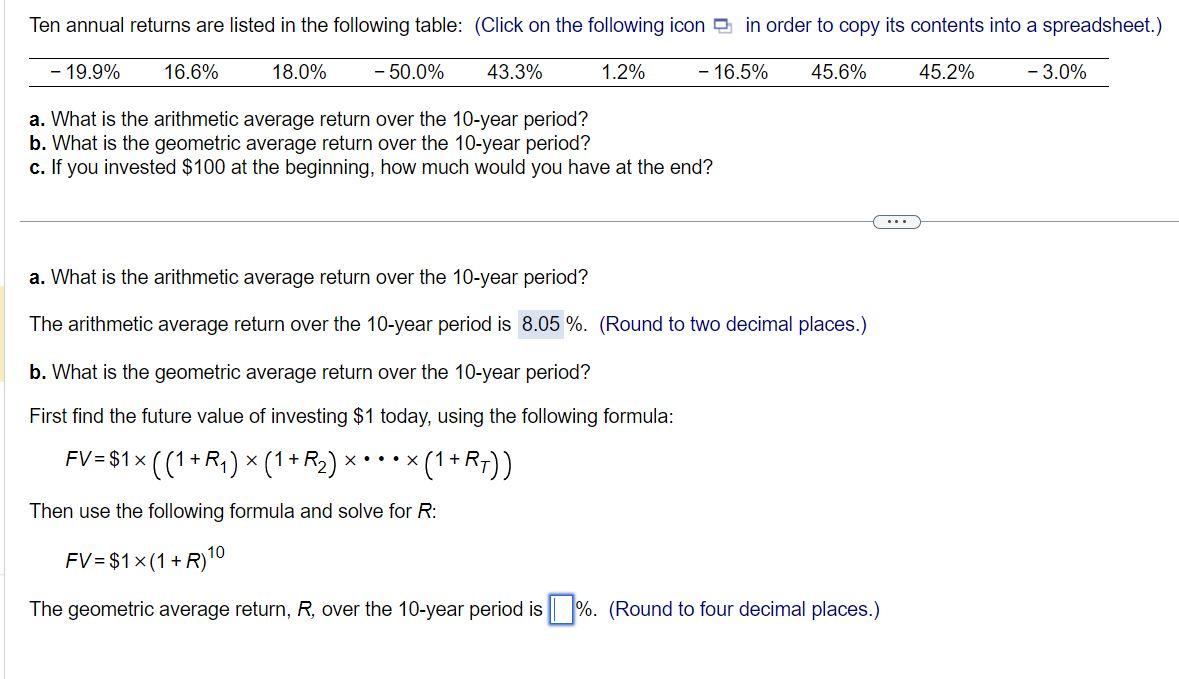
a. What is the arithmetic average return over the 10 -year period? b. What is the geometric average return over the 10 -year period? c. If you invested $100 at the beginning, how much would you have at the end? a. What is the arithmetic average return over the 10 -year period? The arithmetic average return over the 10 -year period is \%. (Round to two decimal places.) b. What is the geometric average return over the 10 -year period? First find the future value of investing $1 today, using the following formula: FV=$1((1+R1)(1+R2)(1+RT)) Then use the following formula and solve for R : FV=$1(1+R)10 The geometric average return, R, over the 10 -year period is %. (Round to four decimal places.)
Step by Step Solution
There are 3 Steps involved in it

Get step-by-step solutions from verified subject matter experts
 Study Help