







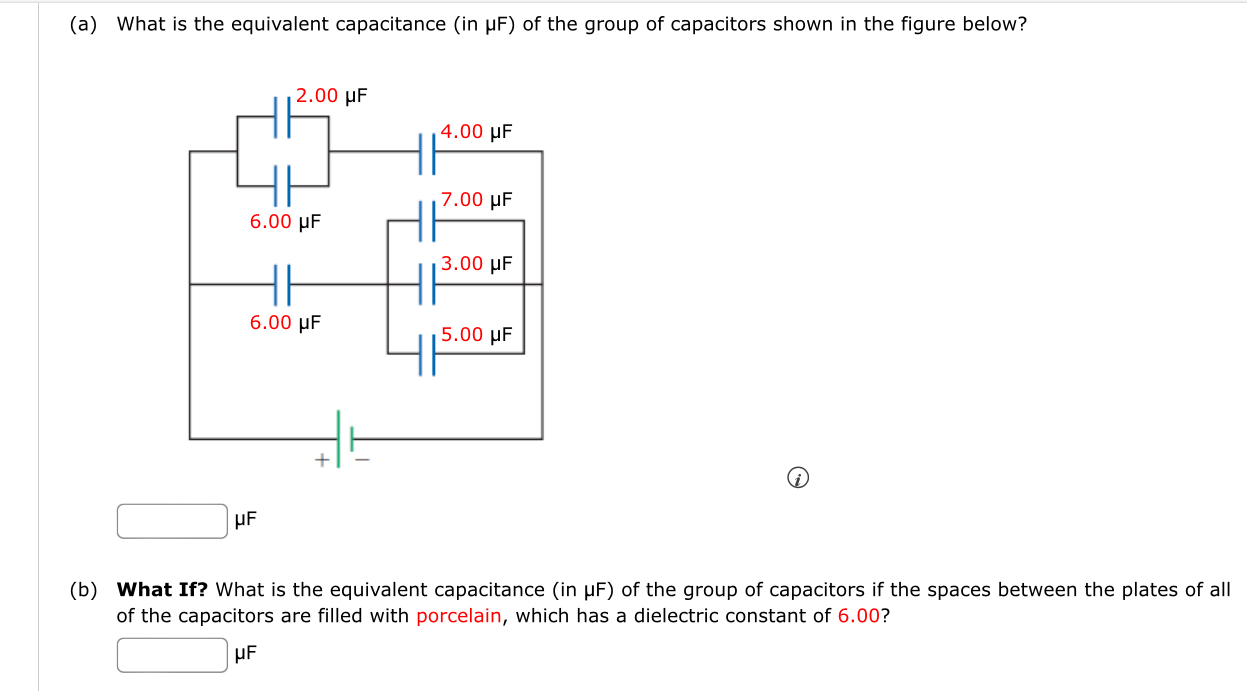
Question: ( a ) What is the equivalent capacitance ( in F ) of the group of capacitors shown in the figure below? 2 . 0
a
What is the equivalent capacitance in F of the group of capacitors shown in the figure below?
F
F
F
F
F
F
F
A circuit consists of a battery and seven capacitors. The battery is at the bottom of the circuit, and a wire extends to the left from the positive terminal of the battery, turns upward, and then splits into two wires, one horizontal to the right, and one vertical. The horizontal wire extends to the right through a F capacitor, then splits into three parallel wires: the top wire of this split runs through a F capacitor, the middle wire extends through a Fcapacitor and the bottom wire extends through a F capacitor. These three wires then recombine and the wire splits in two: one wire turns up to connect to a set of circuit elements to be described below, and the other wire turns down and to the left to connect to the negative terminal of the battery. The vertical wire resulting from the very first split of the wire mentioned above continues up and turns to the right, and then splits into two parallel wires: the top wire of this split runs through a F capacitor, and the bottom wire extends through a F capacitor. These two wires recombine, and the wire extends to the right through a Fcapacitor before turning down and connecting to the abovementioned wire that was recombined from the split into three horizontal wires.
F
b
What If What is the equivalent capacitance in F of the group of capacitors if the spaces between the plates of all of the capacitors are filled with porcelain, which has a dielectric constant of a What is the equivalent capacitance in mu mathrmF of the group of capacitors shown in the figure below?
mu mathrmF
b What If What is the equivalent capacitance in mu mathrmF of the group of capacitors if the spaces between the plates of all of the capacitors are filled with porcelain, which has a dielectric constant of
mu mathrmF
Step by Step Solution
There are 3 Steps involved in it
1 Expert Approved Answer
Step: 1 Unlock

Question Has Been Solved by an Expert!
Get step-by-step solutions from verified subject matter experts
Step: 2 Unlock
Step: 3 Unlock
 Study Help