







Question: a) what population parameter is being tested? b) how many populations are being tested? c) calculate the sample variance of paleo dieters net weight change.
a) what population parameter is being tested? b) how many populations are being tested? c) calculate the sample variance of paleo dieters net weight change. d) what is the claim? e. The claim is the ___ hypothesis? (null or alternative) f) what is alternative hypothesis? g) what is the test statistic? h) The critical region is best described as? (right, two, or left tailed.) i. What is the P value? j. What is the significance level (expressed as a decimal) k. What is the statistical conclusion? (fail to reject H0, or reject H0) l. What is the wordy conclusion? a) there is sufficient evidence to warrant rejection of the claim that the weight of paleo dieters varies more than the weight of juice fast dieters after three months. b) there is not sufficient evidence to warrant rejection of the claim that the weight of Paleo dieters varies more than the weight of juice fast dieters after three months. c) There is sufficient evidence to support the claim that the weight of Paleo dieters varies more than the weight of juice fast dieters after three months d) There is not sufficient evidence to support the claim that the weight of paleo dieters varies more than the weight of juice fast dieters after three months.
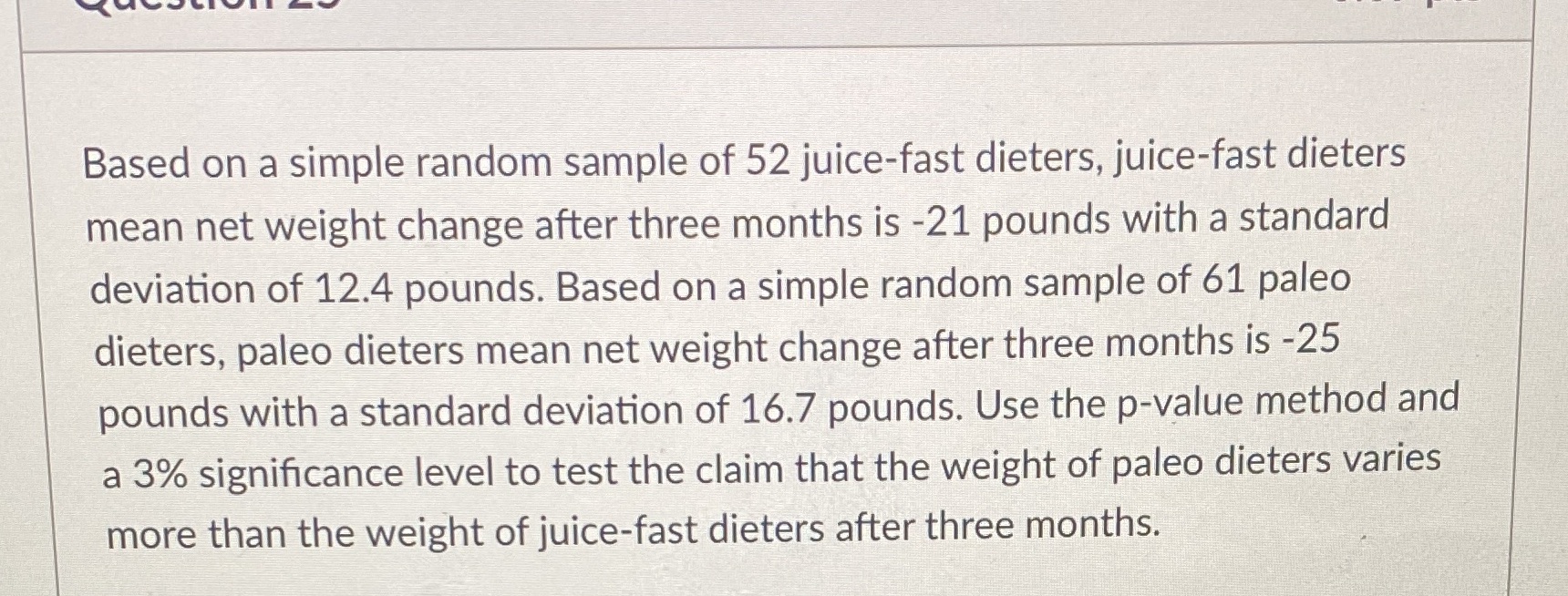
Based on a simple random sample of 52 juice-fast dieters, juice-fast dieters mean net weight change after three months is -21 pounds with a standard deviation of 12.4 pounds. Based on a simple random sample of 61 paleo dieters, paleo dieters mean net weight change after three months is -25 pounds with a standard deviation of 16.7 pounds. Use the p-value method and a 3% significance level to test the claim that the weight of paleo dieters varies more than the weight of juice-fast dieters after three months
Step by Step Solution
There are 3 Steps involved in it

Get step-by-step solutions from verified subject matter experts
 Study Help