







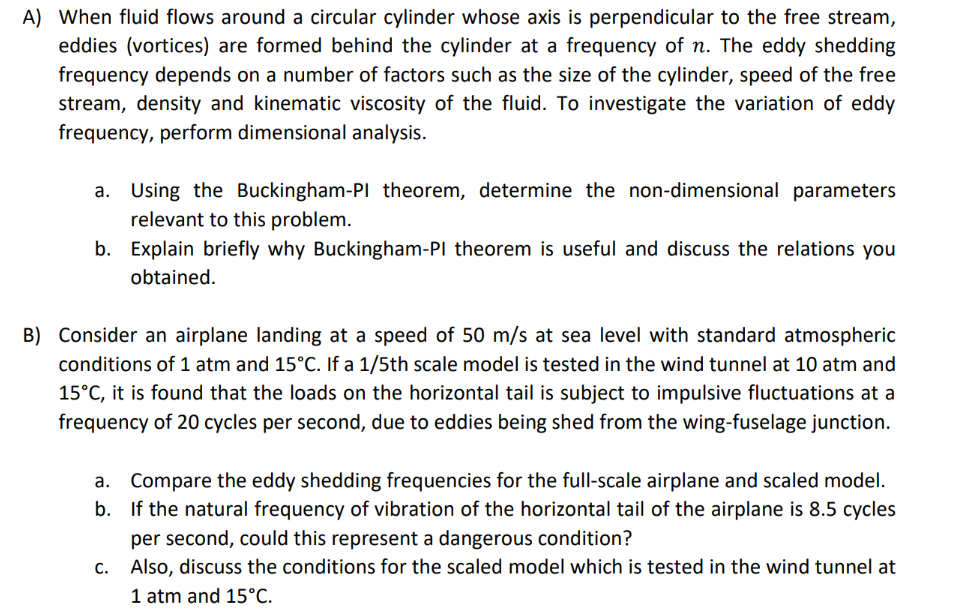
Question: A ) When fluid flows around a circular cylinder whose axis is perpendicular to the free stream, eddies ( vortices ) are formed behind the
A When fluid flows around a circular cylinder whose axis is perpendicular to the free stream, eddies vortices are formed behind the cylinder at a frequency of n The eddy shedding frequency depends on a number of factors such as the size of the cylinder, speed of the free stream, density and kinematic viscosity of the fluid. To investigate the variation of eddy frequency, perform dimensional analysis.
a Using the BuckinghamPI theorem, determine the nondimensional parameters relevant to this problem.
b Explain briefly why BuckinghamPI theorem is useful and discuss the relations you obtained.
B Consider an airplane landing at a speed of mathrm~mmathrms at sea level with standard atmospheric conditions of atm and circmathrmC If a th scale model is tested in the wind tunnel at atm and circmathrmC it is found that the loads on the horizontal tail is subject to impulsive fluctuations at a frequency of cycles per second, due to eddies being shed from the wingfuselage junction.
a Compare the eddy shedding frequencies for the fullscale airplane and scaled model.
b If the natural frequency of vibration of the horizontal tail of the airplane is cycles per second, could this represent a dangerous condition?
c Also, discuss the conditions for the scaled model which is tested in the wind tunnel at atm and circmathrmC
Step by Step Solution
There are 3 Steps involved in it
1 Expert Approved Answer
Step: 1 Unlock

Question Has Been Solved by an Expert!
Get step-by-step solutions from verified subject matter experts
Step: 2 Unlock
Step: 3 Unlock
 Study Help