







Question: (a) When manufacturing a component, the chosen processing route will depend on the type of material it is made of. For each of the following
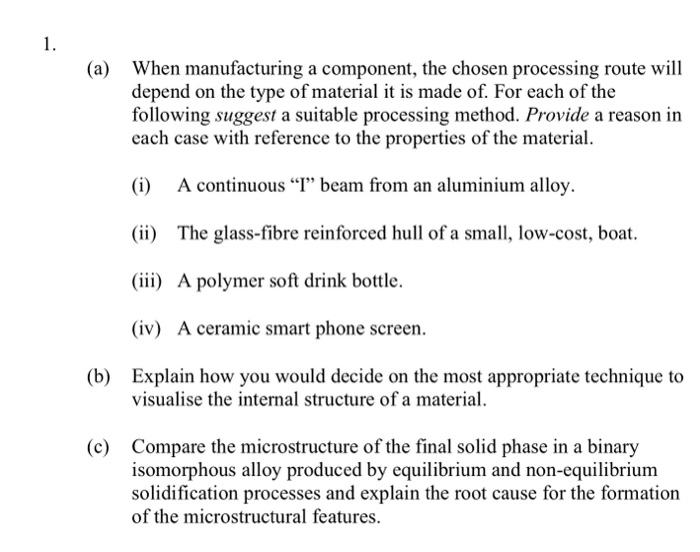
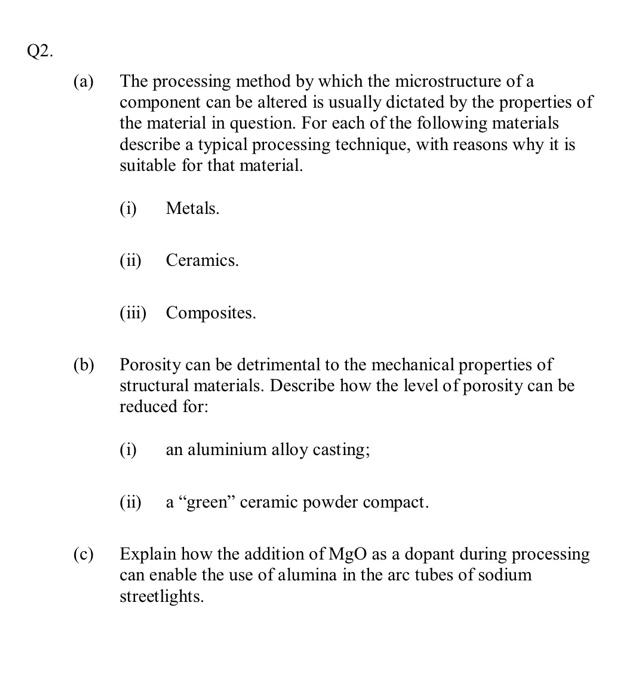
(a) When manufacturing a component, the chosen processing route will depend on the type of material it is made of. For each of the following suggest a suitable processing method. Provide a reason in each case with reference to the properties of the material. (i) A continuous "I" beam from an aluminium alloy. (ii) The glass-fibre reinforced hull of a small, low-cost, boat. (iii) A polymer soft drink bottle. (iv) A ceramic smart phone screen. (b) Explain how you would decide on the most appropriate technique to visualise the internal structure of a material. (c) Compare the microstructure of the final solid phase in a binary isomorphous alloy produced by equilibrium and non-equilibrium solidification processes and explain the root cause for the formation of the microstructural features. (a) The processing method by which the microstructure of a component can be altered is usually dictated by the properties of the material in question. For each of the following materials describe a typical processing technique, with reasons why it is suitable for that material. (i) Metals. (ii) Ceramics. (iii) Composites. (b) Porosity can be detrimental to the mechanical properties of structural materials. Describe how the level of porosity can be reduced for: (i) an aluminium alloy casting; (ii) a "green" ceramic powder compact. (c) Explain how the addition of MgO as a dopant during processing can enable the use of alumina in the arc tubes of sodium streetlights
Step by Step Solution
There are 3 Steps involved in it

Get step-by-step solutions from verified subject matter experts
 Study Help