





Question: A widget maker is selling widget in two cities: City A and City B. The unit production cost is $5.00. Let P1 be the price
A widget maker is selling widget in two cities:

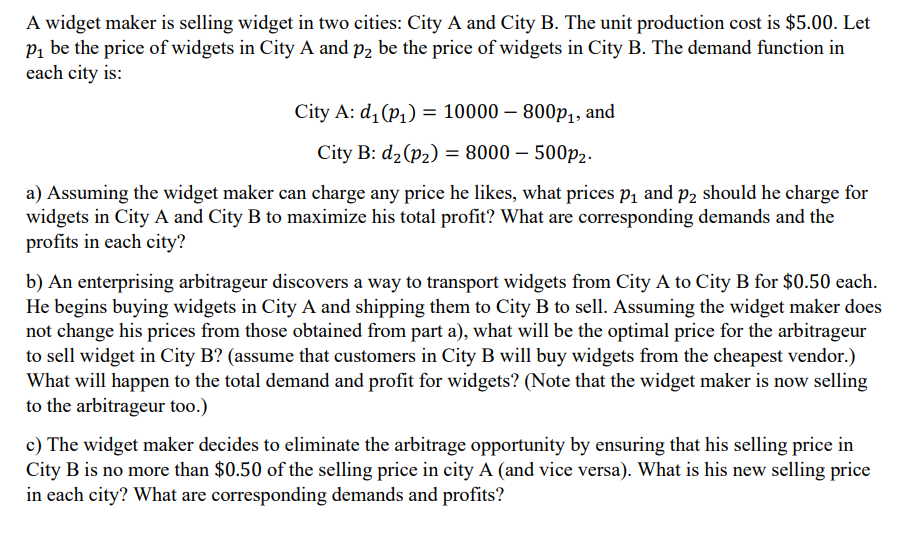
A widget maker is selling widget in two cities: City A and City B. The unit production cost is $5.00. Let P1 be the price of widgets in City A and P2 be the price of widgets in City B. The demand function in each city is: City A: d (P1) = 10000 800p7, and City B: d2(p2) = 8000 500p2. a) Assuming the widget maker can charge any price he likes, what prices p1 and p2 should he charge for widgets in City A and City B to maximize his total profit? What are corresponding demands and the profits in each city? b) An enterprising arbitrageur discovers a way to transport widgets from City A to City B for $0.50 each. He begins buying widgets in City A and shipping them to City B to sell. Assuming the widget maker does not change his prices from those obtained from part a), what will be the optimal price for the arbitrageur to sell widget in City B? (assume that customers in City B will buy widgets from the cheapest vendor.) What will happen to the total demand and profit for widgets? (Note that the widget maker is now selling to the arbitrageur too.) c) The widget maker decides to eliminate the arbitrage opportunity by ensuring that his selling price in City B is no more than $0.50 of the selling price in city A (and vice versa). What is his new selling price in each city? What are corresponding demands and profits

Step by Step Solution

There are 3 Steps involved in it

1 Expert Approved Answer
Step: 1 Unlock blur-text-image

Question Has Been Solved by an Expert!

Get step-by-step solutions from verified subject matter experts

Step: 2 Unlock
Step: 3 Unlock

Students Have Also Explored These Related General Management Questions!