







Question: a) Write a Matlab program to generate a signal g(t) = 10 exp(-2.4 t ) [u(t)-u(t-7)] by sampling at frequency equal to 2 times its
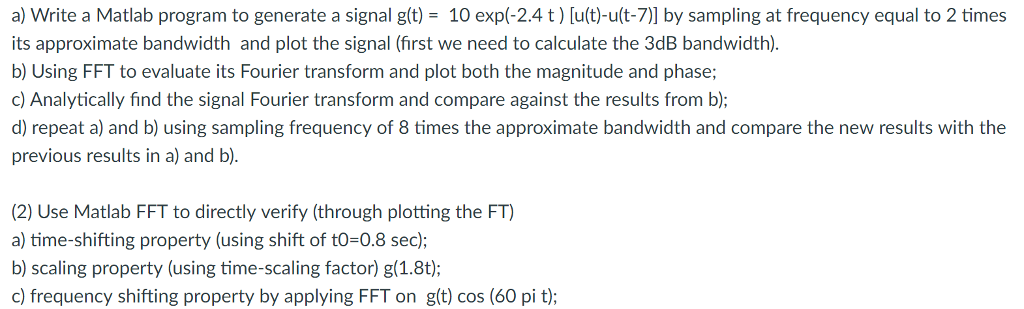
a) Write a Matlab program to generate a signal g(t) = 10 exp(-2.4 t ) [u(t)-u(t-7)] by sampling at frequency equal to 2 times its approximate bandwidth and plot the signal (first we need to calculate the 3dB bandwidth). b) Using FFT to evaluate its Fourier transform and plot both the magnitude and phase; c) Analytically find the signal Fourier transform and compare against the results from b); d) repeat a) and b) using sampling frequency of 8 times the approximate bandwidth and compare the new results with the previous results in a) and b). (2) Use Matlab FFT to directly verify (through plotting the FT) a) time-shifting property (using shift of to-0.8 sec); b) scaling property (using time-scaling factor) g(1.8t); c) frequency shifting property by applying FFT on g(t) cos (60 pi t); a) Write a Matlab program to generate a signal g(t) = 10 exp(-2.4 t ) [u(t)-u(t-7)] by sampling at frequency equal to 2 times its approximate bandwidth and plot the signal (first we need to calculate the 3dB bandwidth). b) Using FFT to evaluate its Fourier transform and plot both the magnitude and phase; c) Analytically find the signal Fourier transform and compare against the results from b); d) repeat a) and b) using sampling frequency of 8 times the approximate bandwidth and compare the new results with the previous results in a) and b). (2) Use Matlab FFT to directly verify (through plotting the FT) a) time-shifting property (using shift of to-0.8 sec); b) scaling property (using time-scaling factor) g(1.8t); c) frequency shifting property by applying FFT on g(t) cos (60 pi t)
Step by Step Solution
There are 3 Steps involved in it

Get step-by-step solutions from verified subject matter experts
 Study Help