







Question: a) Write a subroutine using the ARM assembly programming language to construct tables of 20 (n = 0, 1, 2, ..., 19) 32-bit data.
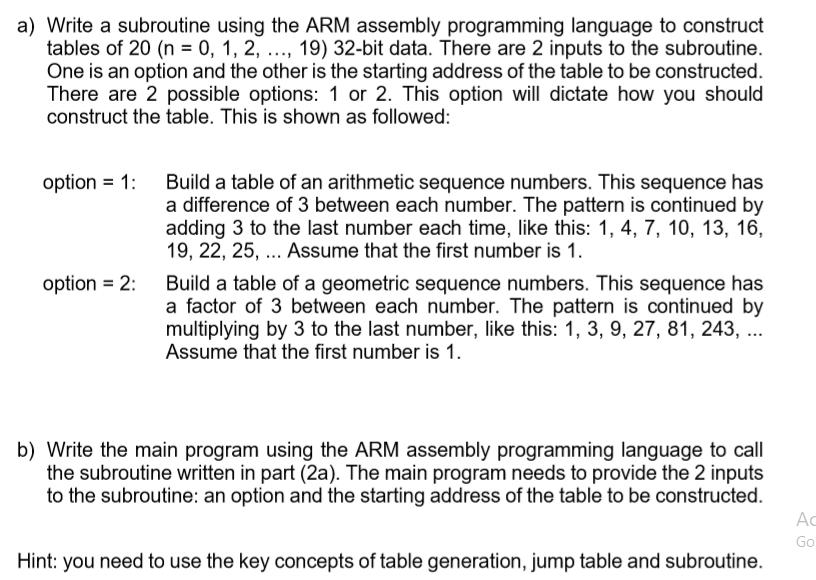
a) Write a subroutine using the ARM assembly programming language to construct tables of 20 (n = 0, 1, 2, ..., 19) 32-bit data. There are 2 inputs to the subroutine. One is an option and the other is the starting address of the table to be constructed. There are 2 possible options: 1 or 2. This option will dictate how you should construct the table. This is shown as followed: = option 1: Build a table of an arithmetic sequence numbers. This sequence has a difference of 3 between each number. The pattern is continued by adding 3 to the last number each time, like this: 1, 4, 7, 10, 13, 16, 19, 22, 25, ... Assume that the first number is 1. option = 2: Build a table of a geometric sequence numbers. This sequence has a factor of 3 between each number. The pattern is continued by multiplying by 3 to the last number, like this: 1, 3, 9, 27, 81, 243, ... Assume that the first number is 1. b) Write the main program using the ARM assembly programming language to call the subroutine written in part (2a). The main program needs to provide the 2 inputs to the subroutine: an option and the starting address of the table to be constructed. Hint: you need to use the key concepts of table generation, jump table and subroutine. Ac Go
Step by Step Solution
There are 3 Steps involved in it

Get step-by-step solutions from verified subject matter experts
 Study Help