







Question: (a) Write the following sums in summation notation: i. 25+35+45 +55 +65 +75 ii. sin()+sin(/2) + + sin(/n) + sin(/(n+1)) One way that a

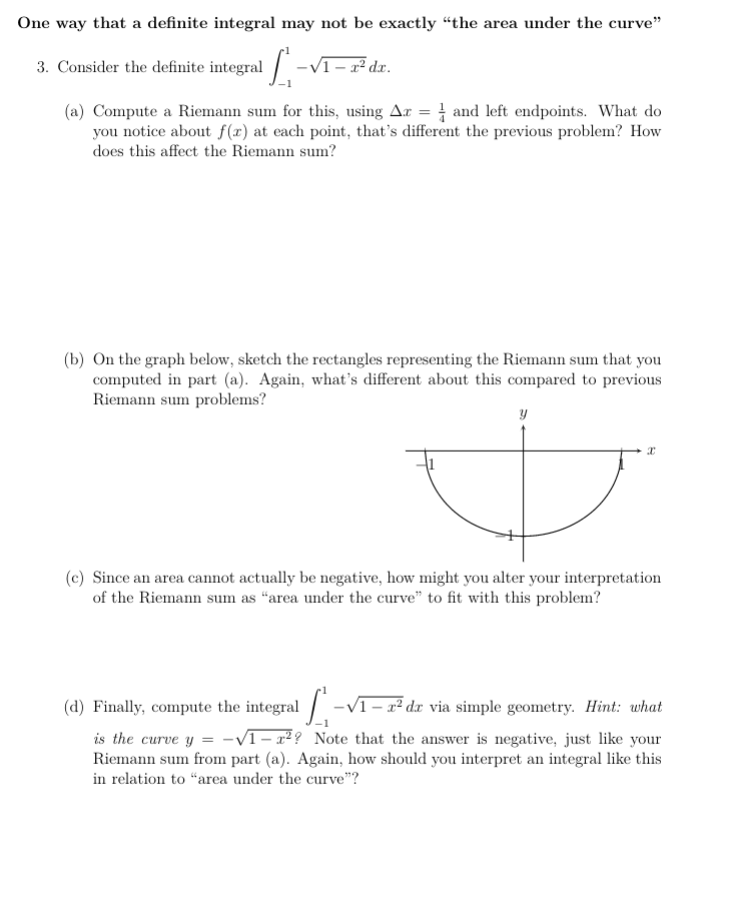
(a) Write the following sums in summation notation: i. 25+35+45 +55 +65 +75 ii. sin()+sin(/2) + + sin(/n) + sin(/(n+1)) One way that a definite integral may not be exactly "the area under the curve" 3. Consider the definite integral- -1-x dx. (a) Compute a Riemann sum for this, using Ar = and left endpoints. What do you notice about f(x) at each point, that's different the previous problem? How does this affect the Riemann sum? (b) On the graph below, sketch the rectangles representing the Riemann sum that you computed in part (a). Again, what's different about this compared to previous Riemann sum problems? y (c) Since an area cannot actually be negative, how might you alter your interpretation of the Riemann sum as "area under the curve" to fit with this problem? (d) Finally, compute the integral- -1-2 dr via simple geometry. Hint: what is the curve y = 1-x? Note that the answer is negative, just like your Riemann sum from part (a). Again, how should you interpret an integral like this in relation to "area under the curve"?
Step by Step Solution
There are 3 Steps involved in it

Get step-by-step solutions from verified subject matter experts
 Study Help