







Question: a. Your uncle asks you to evaluate a project that has the following properties: (1) The project has conventional cash flows and (2) The project
a. Your uncle asks you to evaluate a project that has the following properties: (1) The project has conventional cash flows and (2) The project has a discounted payback period that is less than the projects life. What can you conclude about its NPV? Briefly explain your conclusion.
b. In a world with risk-free borrowing and lending, efficient portfolios have NO unsystematic risk. Is this statement true or false? Briefly explain your answer.
d. discuss the disadvantages of payback period and internal rate of return (IRR).
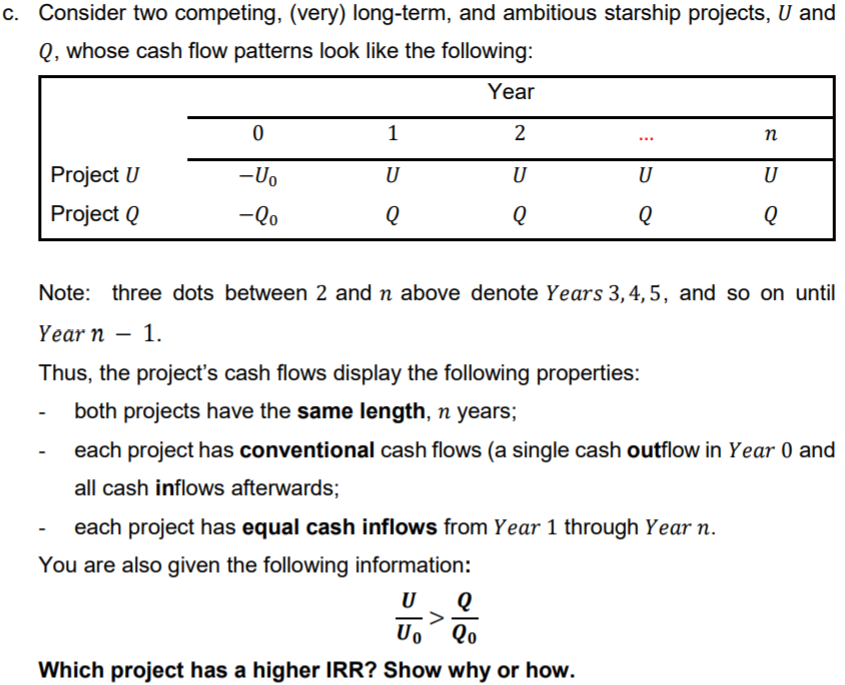
C. Consider two competing, (very) long-term, and ambitious starship projects, U and Q, whose cash flow patterns look like the following: Year 0 1 2 n -U. U U U U Project U Project Q -Qo Q Q Q Q Note: three dots between 2 and n above denote Years 3,4,5, and so on until Year n - 1. Thus, the project's cash flows display the following properties: both projects have the same length, n years; each project has conventional cash flows (a single cash outflow in Year 0 and all cash inflows afterwards; each project has equal cash inflows from Year 1 through Year n. You are also given the following information: U Q > U lo Which project has a higher IRR? Show why or how. C. Consider two competing, (very) long-term, and ambitious starship projects, U and Q, whose cash flow patterns look like the following: Year 0 1 2 n -U. U U U U Project U Project Q -Qo Q Q Q Q Note: three dots between 2 and n above denote Years 3,4,5, and so on until Year n - 1. Thus, the project's cash flows display the following properties: both projects have the same length, n years; each project has conventional cash flows (a single cash outflow in Year 0 and all cash inflows afterwards; each project has equal cash inflows from Year 1 through Year n. You are also given the following information: U Q > U lo Which project has a higher IRR? Show why or how
Step by Step Solution
There are 3 Steps involved in it

Get step-by-step solutions from verified subject matter experts
 Study Help