







Question: A-14.4 scheduling problem, but we will not do that. Instead, you only define a weighted directed graph such that solving a shortest path problem on
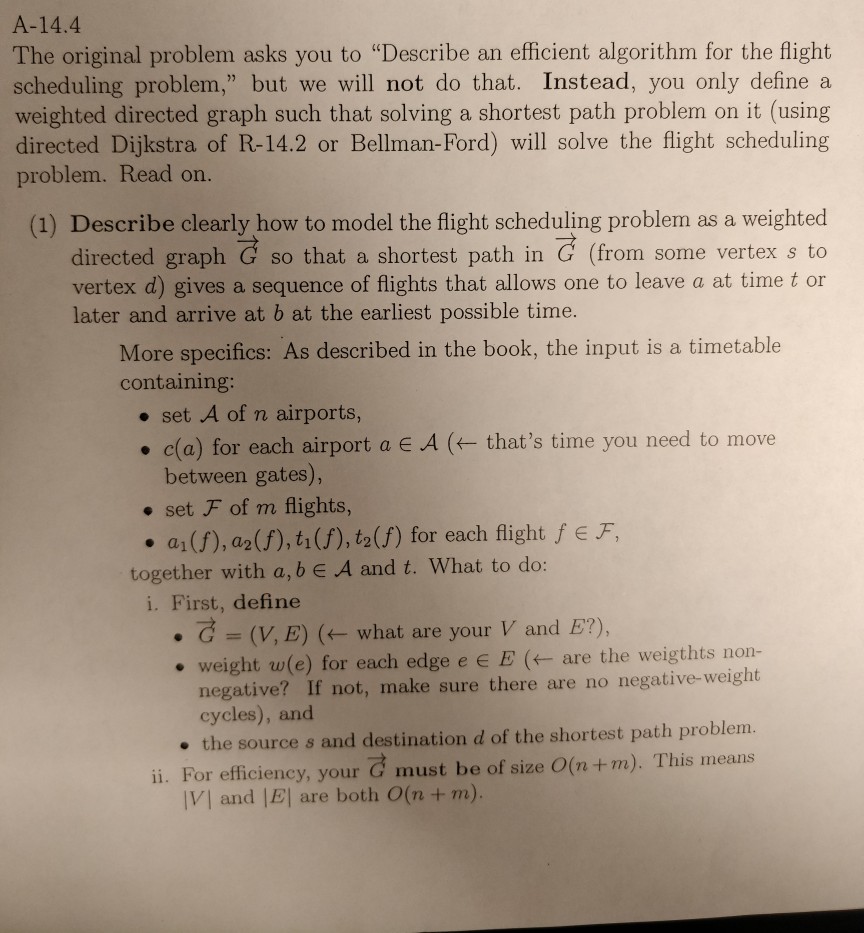
A-14.4 scheduling problem," but we will not do that. Instead, you only define a weighted directed graph such that solving a shortest path problem on it (using directed Dijkstra of R-14.2 or Bellman-Ford) will solve the flight scheduling problem. Read on. (1) Describe clearly how to model the flight scheduling problem as a weighted directed graph G so that a shortest path in G (from some vertex s to vertex d) gives a sequence of flights that allows one to leave a at time t or later and arrive at b at the earliest possible time. More specifics: As desaribed in the book,the input is a timetable containing: set A of n airports, . c(a) for each airport aE A that's time you need to move between gates), . set F of m flights, a(f), az(f),ti(f), t2(f) for each flight f EF together with a, bE A and t. What to do: i. First, define G-(V, E) (? what are your V and E?), . weight w(e) for each edge e E E (? are the weigthts non- negative? If not, make sure there are no negative-weight cycles), and the source s and destination d of the shortest path problem. IVI and |EI are both O(n+m). ii. For efficiency, your d must be of size O(n +m). This means
Step by Step Solution
There are 3 Steps involved in it

Get step-by-step solutions from verified subject matter experts
 Study Help