







Question: A17. Let X be a non-negative discrete random variable with possible values 0,1,2, (a) Show that E(X)=n=0P(X>n)=r=1P(Xr) (b) Find the E(X) if P(X>n)=21(31)n 418. A
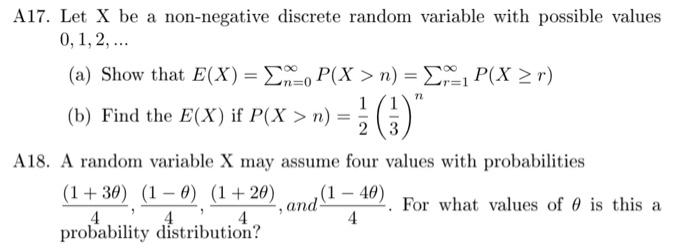
A17. Let X be a non-negative discrete random variable with possible values 0,1,2, (a) Show that E(X)=n=0P(X>n)=r=1P(Xr) (b) Find the E(X) if P(X>n)=21(31)n 418. A random variable X may assume four values with probabilities 4(1+3),4(1),4(1+2), and 4(14). For what values of is this a A17. Let X be a non-negative discrete random variable with possible values 0,1,2, (a) Show that E(X)=n=0P(X>n)=r=1P(Xr) (b) Find the E(X) if P(X>n)=21(31)n 418. A random variable X may assume four values with probabilities 4(1+3),4(1),4(1+2), and 4(14). For what values of is this a
Step by Step Solution
There are 3 Steps involved in it
1 Expert Approved Answer
Step: 1 Unlock

Question Has Been Solved by an Expert!
Get step-by-step solutions from verified subject matter experts
Step: 2 Unlock
Step: 3 Unlock
 Study Help