







Question: A2. (15 marks) a. The ozone hole forms every year in spring when the sunlight returns to the Antarctic because of introduced chlorine to the
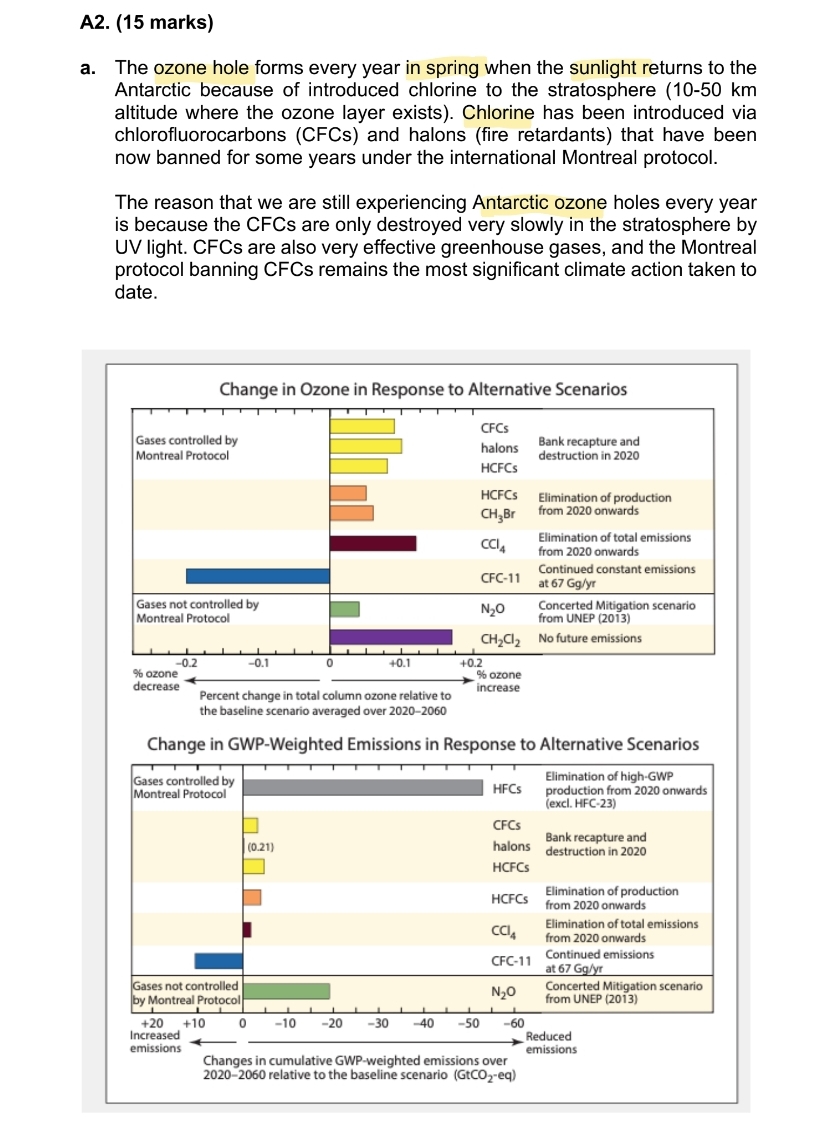
A2. (15 marks) a. The ozone hole forms every year in spring when the sunlight returns to the Antarctic because of introduced chlorine to the stratosphere (10-50 km altitude where the ozone layer exists). Chlorine has been introduced via chlorofluorocarbons (CFCs) and halons (fire retardants) that have been now banned for some years under the international Montreal protocol. The reason that we are still experiencing Antarctic ozone holes every year is because the CFCs are only destroyed very slowly in the stratosphere by UV light. CFCs are also very effective greenhouse gases, and the Montreal protocol banning CFCs remains the most significant climate action taken to date. Change in Ozone in Response to Alternative Scenarios CFCs Gases controlled by Bank recapture and Montreal Protocol halons destruction in 2020 HCFCs HCFCS Elimination of production CH, Br from 2020 onward CCIA Elimination of total emissions from 2020 onwards CFC-11 Continued constant emissions at 67 Gg/yr Gases not controlled by NO Concerted Mitigation scenario Montreal Protocol from UNEP (2013) CH2Cl, No future emissions -0.2 -0.1 40.1 +0.2 % ozone 9% ozone decrease Percent change in total column ozone relative to increase the baseline scenario averaged over 2020-2060 Change in GWP-Weighted Emissions in Response to Alternative Scenarios Gases controlled by Elimination of high-GWP Montreal Protocol HFCS production from 2020 onwards (excl. HFC-23) CFCs Bank recapture and (0.21) halons destruction in 2020 HCFCS HCFCs Elimination of production from 2020 onwards CCI Elimination of total emissions from 2020 onwards CFC-11 Continued emissions at 67 Gg/yr Gases not controlled NO Concerted Mitigation scenario by Montreal Protocol from UNEP (2013) +20 +10 -10 -20 -30 -40 -50 -60 Increased Reduced emissions emissions Changes in cumulative GWP-weighted emissions over 2020-2060 relative to the baseline scenario (GtCO2-eq)CFCs were replaced by HFCs, which were recently also banned due to them having very high global warming potentials. HCFCs (another replacement gas was proposed to be banned from 2020). As policy makers are concerned with both ozone depletion and global warming draw a conceptual model that captures the complexityr of system from emissions to impacts. Make sure it clearly captures how replacement gases need to consider all possible impacts so that solving one issue doesn't result in another, {15 marks)
Step by Step Solution
There are 3 Steps involved in it

Get step-by-step solutions from verified subject matter experts
 Study Help