







Question: *** A4.cxx *************** #include #include #include #include #include #include card.hxx using namespace std; using cards = std::deque ; ostream& operator it(ostream, ); copy(c.begin(), c.end(),
*** A4.cxx ***************
#include
#include "card.hxx"
using namespace std; using cards = std::deque
ostream& operator it(ostream, " "); copy(c.begin(), c.end(), it); return os;
}
cards gen_deck_of_cards() { cards retval; for (card_faces f(card_faces_begin), fEnd; f != fEnd; ++f) for (card_suits s(card_suits_begin), sEnd; s != sEnd; ++s) retval.push_back(card{ *f,*s }); return retval; }
void shuffle_cards(cards& cs) { random_device rd; mt19937 gen(rd()); shuffle(cs.begin(), cs.end(), gen); }
cards draw(size_t num, cards& desk) { auto pos = desk.begin(); if (num
cards cd(desk.begin(), pos);
desk.erase(desk.begin(), pos);
return cd; }
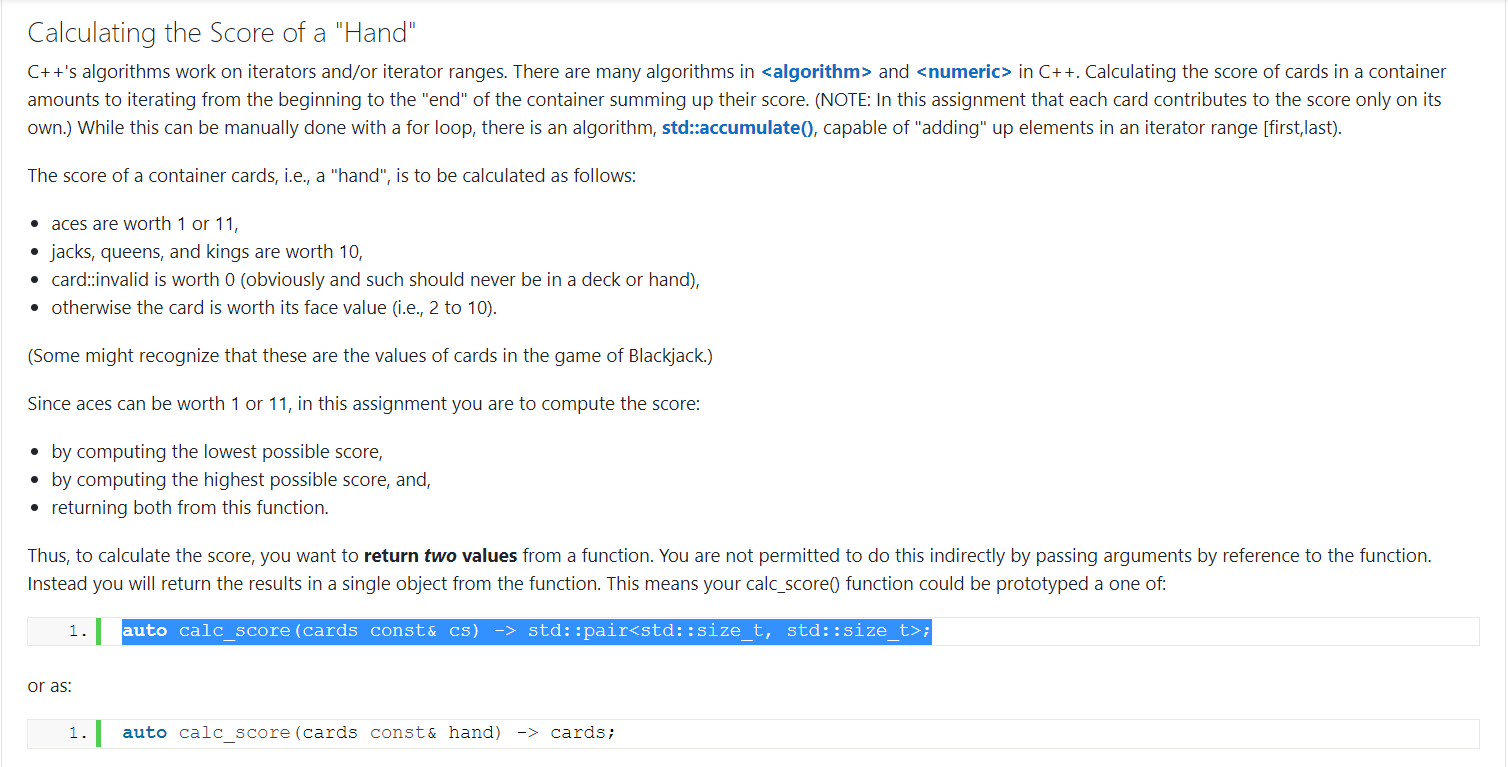
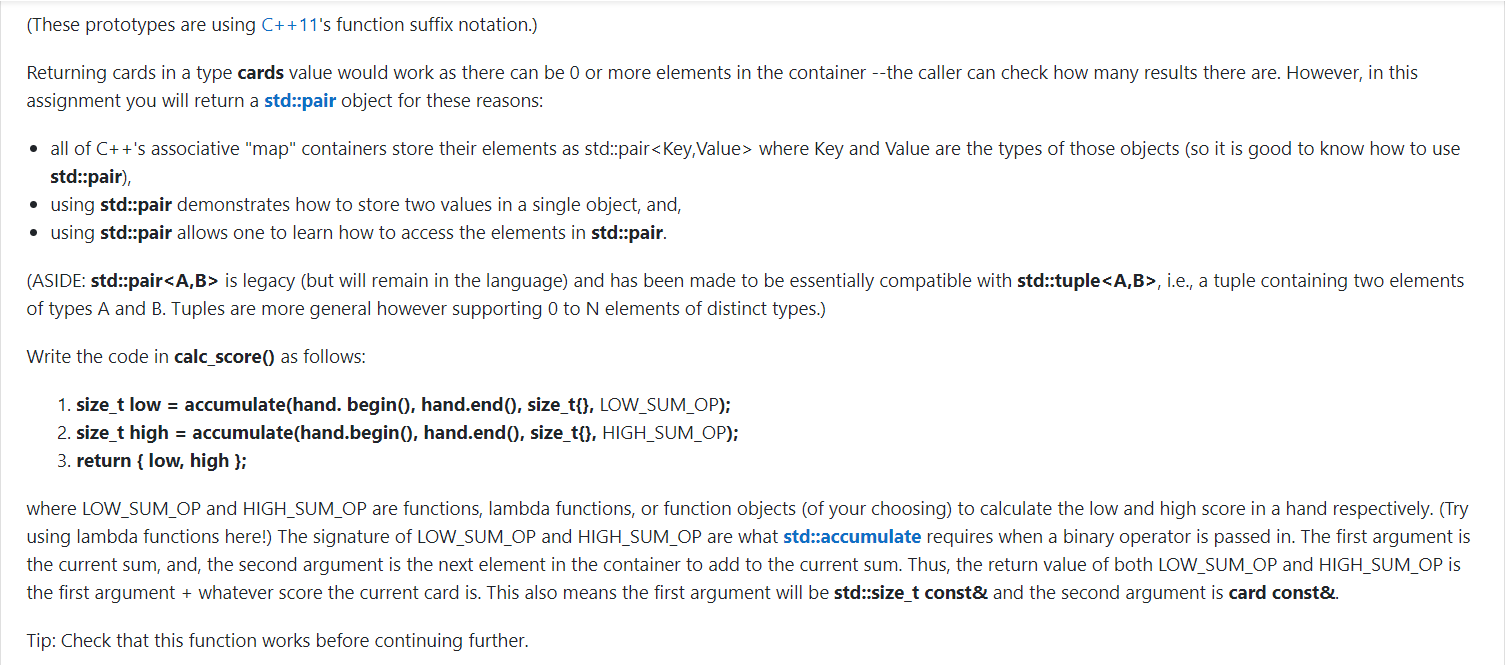
auto calc_score(cards const& hand)->std::pair<:size_t std::size_t> { size_t low = accumulate(hand.begin(), hand.end(), size_t{}, LOW_SUM_OP); // Add Lambda function here size_t high = accumulate(hand.begin(), hand.end(), size_t{}, HIGH_SUM_OP); return{ low, high }; }
int main() { cards deck = gen_deck_of_cards(); shuffle_cards(deck); cout
auto result = calc_score(hand);
if (get(result) == get(result) ) { cout (result) (result) (result)
*************************************************************************************************************************************************************************************
*************** card.hxx ****************************
#ifndef card_hxx_ #define card_hxx_
//===========================================================================
#include
class card { public: using face_type = char; enum { invalid=0, ace=1, jack=11, queen=12, king=13 };
enum suit_type : char { club, spade, diamond, heart };
private: face_type face_; suit_type suit_;
public: // default construct invalid card value when face_ == 0... constexpr card() : face_{} { };
constexpr card(card const&) = default; constexpr card(card&&) = default; constexpr card& operator =(card const&) = default; constexpr card& operator =(card&&) = default;
constexpr card(face_type const& f, suit_type const& s) : face_{f}, suit_{s} { if (!valid()) throw std::domain_error("Invalid card."); }
constexpr auto operator (card const&) const noexcept = default;
constexpr operator bool() const noexcept { return valid(); }
constexpr bool valid() const noexcept { return face_
constexpr face_type face() const noexcept { return face_; } constexpr suit_type suit() const noexcept { return suit_; }
constexpr void invalidate() noexcept { face_ = invalid; }
constexpr void set(face_type const& f, suit_type const& s) { card tmp(f,s); swap(tmp); }
constexpr void swap(card& b) noexcept { using std::swap; swap(face_, b.face_); swap(suit_, b.suit_); }
friend std::istream& operator >>(std::istream&, card&); friend std::ostream& operator
inline constexpr auto operator ( card::suit_type const& a, card::suit_type const& b ) noexcept { return static_cast<:underlying_type_t>>(a) static_cast<:underlying_type_t>>(b) ; }
inline constexpr void swap(card& a, card& b) noexcept { a.swap(b); }
//===========================================================================
struct card_faces_begin_t final { }; constexpr card_faces_begin_t card_faces_begin{};
class card_faces { private: card::face_type face_;
public: constexpr card_faces(card_faces_begin_t const&) noexcept : face_{card::ace} { }
constexpr card_faces(card::face_type const& f = card::king+1) : face_{f} { }
constexpr card_faces(card_faces const&) noexcept = default; constexpr card_faces& operator =( card_faces const&) noexcept = default;
constexpr bool operator ==(card_faces const& b) const noexcept = default;
constexpr card::face_type const& operator *() const noexcept { return face_; }
// prefix ++ constexpr card_faces& operator ++() noexcept { ++face_; return *this; }
// postfix ++ constexpr card_faces operator ++(int) noexcept { card_faces retval(*this); this->operator ++(); return retval; } };
//===========================================================================
struct card_suits_begin_t final { }; constexpr card_suits_begin_t card_suits_begin{};
class card_suits { private: std::optional<:suit_type> suit_;
public: // default constructor constructs invalid suit... constexpr card_suits() noexcept : suit_{} { }
constexpr card_suits(card_suits_begin_t const&) noexcept : suit_{card::club} { }
constexpr card_suits(card::suit_type const& s) : suit_{s} { }
constexpr card_suits(card_suits const&) noexcept = default; constexpr card_suits& operator =(card_suits const&) noexcept = default;
constexpr bool operator ==(card_suits const& b) const noexcept = default;
constexpr card::suit_type const& operator *() const noexcept { return *suit_; }
// prefix ++ constexpr card_suits& operator ++() noexcept { if (suit_) { switch (*suit_) { case card::club: suit_ = card::spade; break; case card::spade: suit_ = card::diamond; break; case card::diamond: suit_ = card::heart; break; default: case card::heart: suit_.reset(); break; } } return *this; }
// postfix ++ constexpr card_suits operator ++(int) noexcept { card_suits retval(*this); this->operator ++(); return retval; } };
//===========================================================================
// // For I/O purposes: // * a "0" face is an invalid card. // * a "1" face is a 10. // * a "A", "J", "Q", or "K" face is the same. // * otherwise the face is a number between 2 and 9. // * the suit is one of "H", "D", "C", or "S" representing // hearts, diamonds, clubs, and spades respectively // * when read in, the suit or face can be in lower case // * when written out, the suit or face will always be upper case // inline std::istream& operator >>(std::istream& is, card& c) { std::istream::sentry s(is); if (s) { // read in card "number"... char ch; if (is >> ch) // this can skip whitespace { switch (ch) { case '0': c.face_ = card::invalid; break; case 'a': case 'A': c.face_ = card::ace; break; case '2': c.face_ = 2; break; case '3': c.face_ = 3; break; case '4': c.face_ = 4; break; case '5': c.face_ = 5; break; case '6': c.face_ = 6; break; case '7': c.face_ = 7; break; case '8': c.face_ = 8; break; case '9': c.face_ = 9; break; case '1': c.face_ = 10; break; case 'j': case 'J': c.face_ = card::jack; break; case 'q': case 'Q': c.face_ = card::queen; break; case 'k': case 'K': c.face_ = card::king; break;
default: is.setstate(std::ios::failbit); is.unget(); return is; } }
// read in card suit... auto ch2 = is.get(); // i.e., unformatted call to get char so no whitespace is skipped if (ch2 == std::istream::traits_type::eof()) { // NOTE: unformatted calls return traits_type::eof() to indicate // an error. This is like checking for a EOF or -1 error when // doing file I/O in C. is.setstate(std::ios::badbit); return is; }
switch (static_cast
default: is.setstate(std::ios::badbit); // invalid suit break; } } return is; }
inline std::ostream& operator (c.face_); break; }
// output suit... switch (c.suit_) { case card::club: os
//===========================================================================
#endif // #ifndef card_hxx_
*************************************************************************************************************************************************************************************
Calculating the Score of a "Hand" C++'s algorithms work on iterators and/or iterator ranges. There are many algorithms in
Step by Step Solution
There are 3 Steps involved in it

Get step-by-step solutions from verified subject matter experts
 Study Help