



Question: Above two questions are the problems I wanted to be solved and the a,b,c,d,e are below which are all the DFAs and NFAs in this
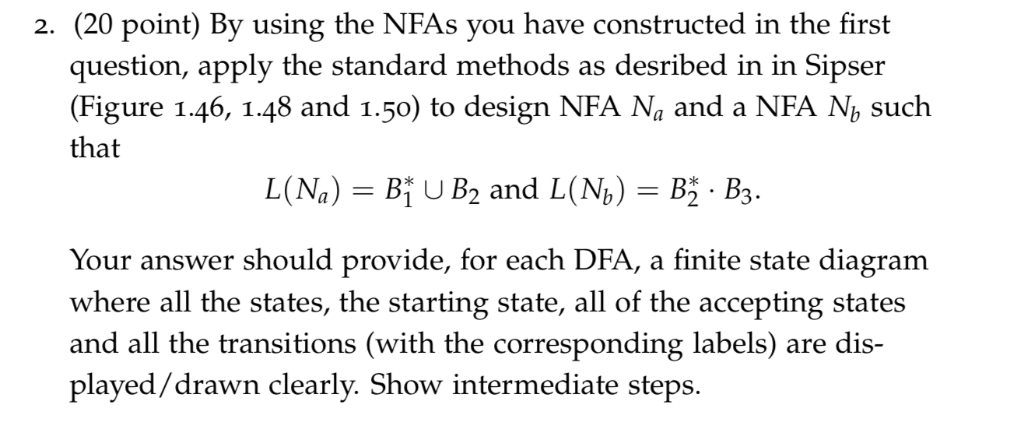
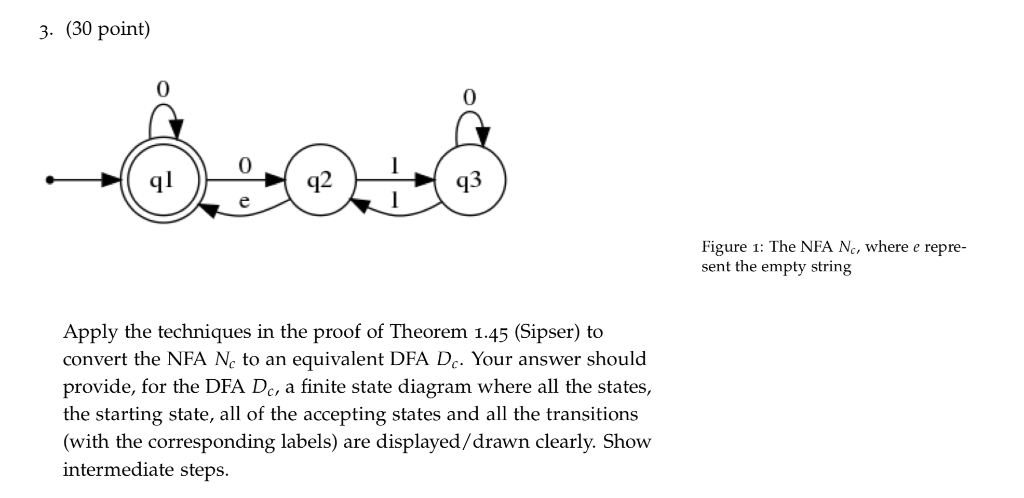
Above two questions are the problems I wanted to be solved and the a,b,c,d,e are below
which are
all the DFAs and NFAs in this homework use = {0, 1} as the alphabet.
(50 point) For i=1,2 and 3, design NFAs Ni, such that L(Ni) = B5, where:
(a) B1 = {w | w has an even number of 0 s, or, contains exactly two 1 s}.
(b) B2 = {w | every odd position of w is 1}. (c) B3 = {w | all strings except the empty string and the string 11}. (d) B4 = {0} with two states.
(e) B5 = 011+ with three states.
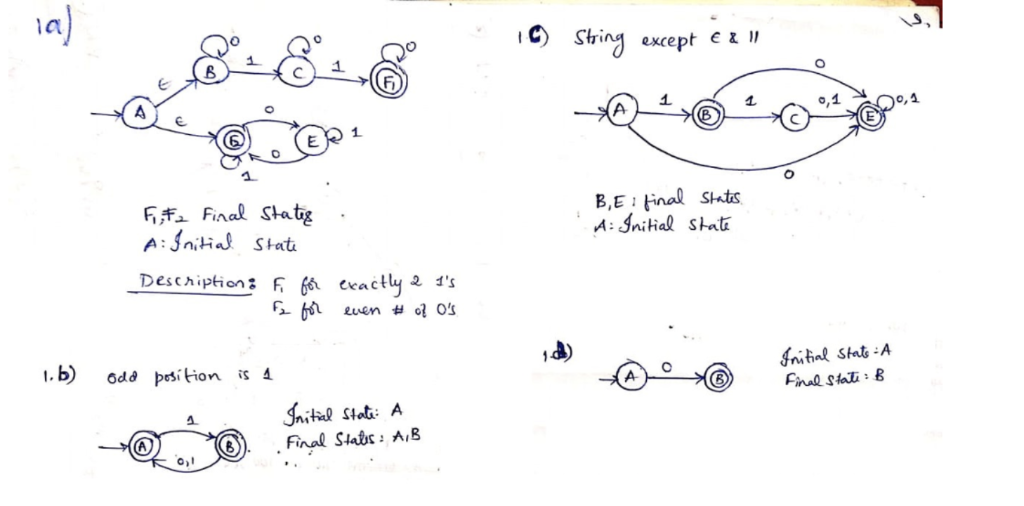
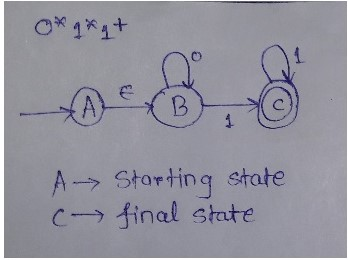
2. (20 point) By using the NFAs you have constructed in the first question, apply the standard methods as desribed in in Sipser (Figure 1.46, 1.48 and 1.50) to design NFA Na and a NFA N, such that Your answer should provide, for each DFA, a finite state diagram where all the states, the starting state, all of the accepting states and all the transitions (with the corresponding labels) are dis played/drawn clearly. Show intermediate steps. 3. (30 point) 0 0 0 q2 q3 Figure 1: The NFA Nc, where e repre- sent the empty string Apply the techniques in the proof of Theorem 1.45 (Sipser) to convert the NFA Nc to an equivalent DFA Dc. Your answer should provide, for the DFA D, a finite state diagram where all the states, the starting state, all of the accepting states and all the transitions (with the corresponding labels) are displayed/drawn clearly. Show intermediate steps a Shring except eZ Final statig ly 1's b) dd position is 4 :@y TO). 'Final Stats :A8 oyl co et A Starting state c final state
Step by Step Solution
There are 3 Steps involved in it

Get step-by-step solutions from verified subject matter experts