







Question: Abraham has preferences represented by the utility function u(w) = ln(w) while Sarah has preferences represented by the utility function v(w)=a(u(w))+b. Sarah and Abraham are
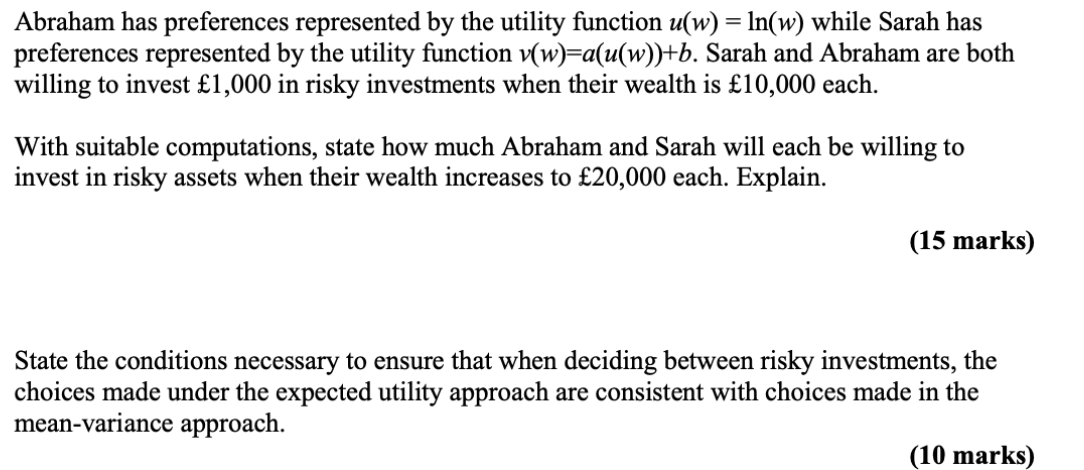
Abraham has preferences represented by the utility function u(w) = ln(w) while Sarah has preferences represented by the utility function v(w)=a(u(w))+b. Sarah and Abraham are both willing to invest 1,000 in risky investments when their wealth is 10,000 each. With suitable computations, state how much Abraham and Sarah will each be willing to invest in risky assets when their wealth increases to 20,000 each. Explain. (15 marks) State the conditions necessary to ensure that when deciding between risky investments, the choices made under the expected utility approach are consistent with choices made in the mean-variance approach. (10 marks) Abraham has preferences represented by the utility function u(w) = ln(w) while Sarah has preferences represented by the utility function v(w)=a(u(w))+b. Sarah and Abraham are both willing to invest 1,000 in risky investments when their wealth is 10,000 each. With suitable computations, state how much Abraham and Sarah will each be willing to invest in risky assets when their wealth increases to 20,000 each. Explain. (15 marks) State the conditions necessary to ensure that when deciding between risky investments, the choices made under the expected utility approach are consistent with choices made in the mean-variance approach. (10 marks)
Step by Step Solution
There are 3 Steps involved in it

Get step-by-step solutions from verified subject matter experts
 Study Help