







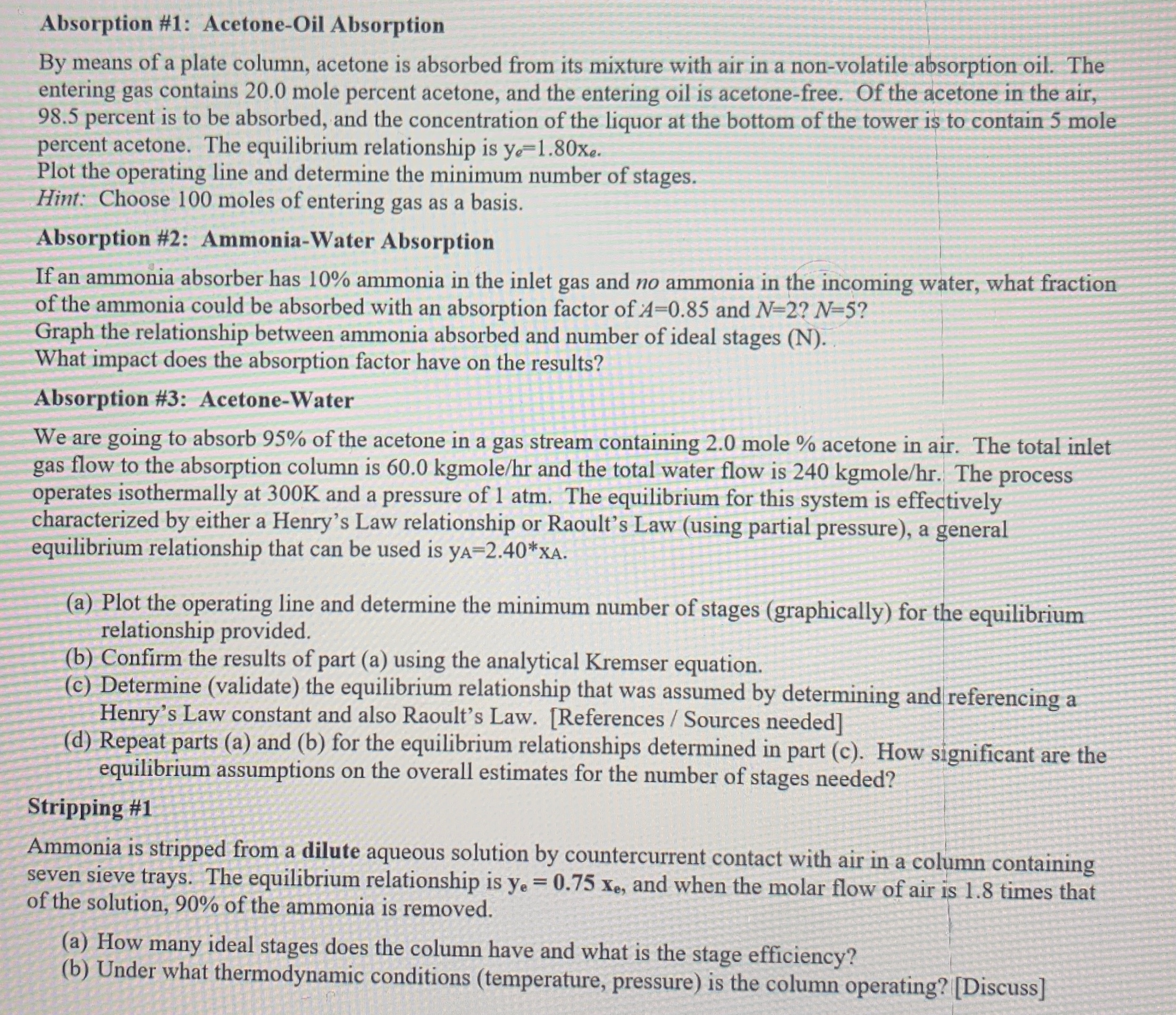
Question: Absorption # 1 : Acetone - Oil Absorption By means of a plate column, acetone is absorbed from its mixture with air in a non
Absorption #: AcetoneOil Absorption
By means of a plate column, acetone is absorbed from its mixture with air in a nonvolatile absorption oil. The entering gas contains mole percent acetone, and the entering oil is acetonefree. Of the acetone in the air, percent is to be absorbed and the concentration of the liquor at the bottom of the tower is to contain mole percent acetone. The equilibrium relationship is
Plot the operating line and determine the minimum number of stages.
Hint: Choose moles of entering gas as a basis.
Absorption #: AmmoniaWater Absorption
If an ammonia absorber has ammonia in the inlet gas and no ammonia in the incoming water, what fraction of the ammonia could be absorbed with an absorption factor of and
Graph the relationship between ammonia absorbed and number of ideal stages What impact does the absorption factor have on the results?
Absorption #: AcetoneWater
We are going to absorb of the acetone in a gas stream containing mole acetone in air. The total inlet gas flow to the absorption column is kgmol and the total water flow is kgmol The process operates isothermally at and a pressure of atm. The equilibrium for this system is effectively characterized by either a Henry's Law relationship or Raoult's Law using partial pressure a general equilibrium relationship that can be used is
a Plot the operating line and determine the minimum number of stages graphically for the equilibrium relationship provided.
b Confirm the results of part a using the analytical Kremser equation.
c Determine validate the equilibrium relationship that was assumed by determining and referencing a Henry's Law constant and also Raoult's Law. References Sources needed
d Repeat parts a and b for the equilibrium relationships determined in part c How significant are the equilibrium assumptions on the overall estimates for the number of stages needed?
Stripping #
Ammonia is stripped from a dilute aqueous solution by countercurrent contact with air in a column containing seven sieve trays. The equilibrium relationship is and when the molar flow of air is times that of the solution, of the ammonia is removed.
a How many ideal stages does the column have and what is the stage efficiency?
b Under what thermodynamic conditions temperature pressure is the column operating? Discuss
Step by Step Solution
There are 3 Steps involved in it
1 Expert Approved Answer
Step: 1 Unlock

Question Has Been Solved by an Expert!
Get step-by-step solutions from verified subject matter experts
Step: 2 Unlock
Step: 3 Unlock
 Study Help