







Question: Abstract Data Types and Algorithms Question 1 (1 point) Select all the options below that are true about RootishArrayStacks. a) RootishArrayStacks have O( (n) (i.e.
Abstract Data Types and Algorithms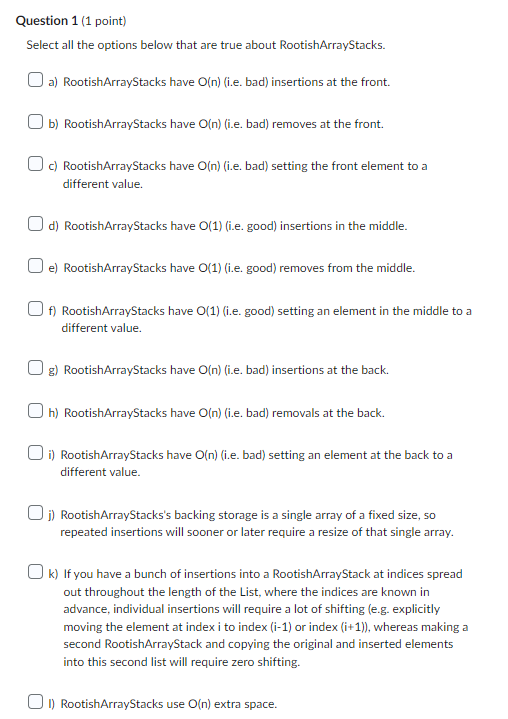
Question 1 (1 point) Select all the options below that are true about RootishArrayStacks. a) RootishArrayStacks have O( (n) (i.e. bad) insertions at the front. b) RootishArrayStacks have O(n) (i.e. bad) removes at the front. c) RootishArrayStacks have O( n) (i.e. bad) setting the front element to a different value. d) RootishArrayStacks have O(1) (i.e. good) insertions in the middle. e) RootishArrayStacks have O(1) (i.e. good) removes from the middle. f) RootishArrayStacks have O(1) (i.e. good) setting an element in the middle to a different value. g) RootishArrayStacks have O(n) (i.e. bad) insertions at the back. h) RootishArrayStacks have O(n) (i.e. bad) removals at the back. i) RootishArrayStacks have O( (n) (i.e. bad) setting an element at the back to a different value. j) RootishArrayStacks's backing storage is a single array of a fixed size, so repeated insertions will sooner or later require a resize of that single array. k) If you have a bunch of insertions into a RootishArrayStack at indices spread out throughout the length of the List, where the indices are known in advance, individual insertions will require a lot of shifting (e.g. explicitly moving the element at index i to index (i1) or index ( i+1)), whereas making a second RootishArrayStack and copying the original and inserted elements into this second list will require zero shifting. I) RootishArrayStacks use O(n) extra space
Step by Step Solution
There are 3 Steps involved in it

Get step-by-step solutions from verified subject matter experts
 Study Help