







Question: Academic Response require a thesis/claim, evidence from the article in the form of quotes and paraphrases, and analysis of this evidence. Part 2: Transfer Response.
Academic Response
require a thesis/claim, evidence from the article in the form of quotes and paraphrases, and analysis of this evidence.
Part 2: Transfer Response.
BRIEFLY summarize the reading. What are you being asked to do (inform, persuade, etc.)? Who is the audience? What genre are you being asked to write in?
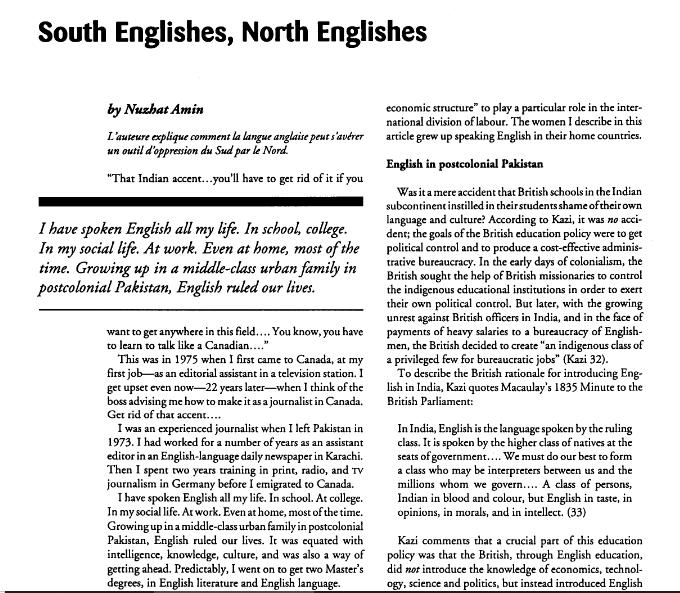
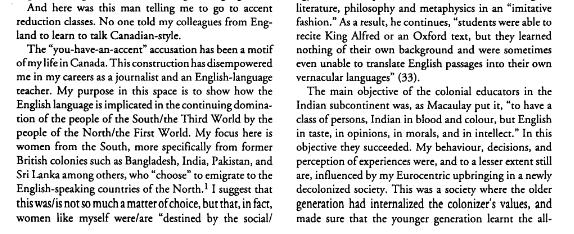
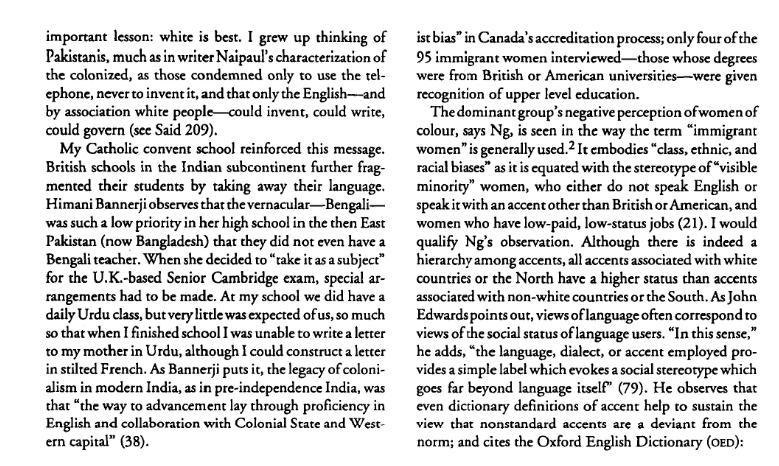
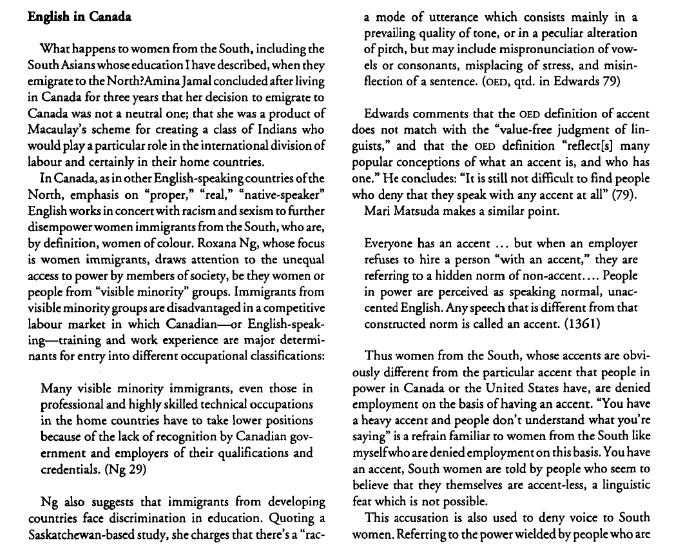
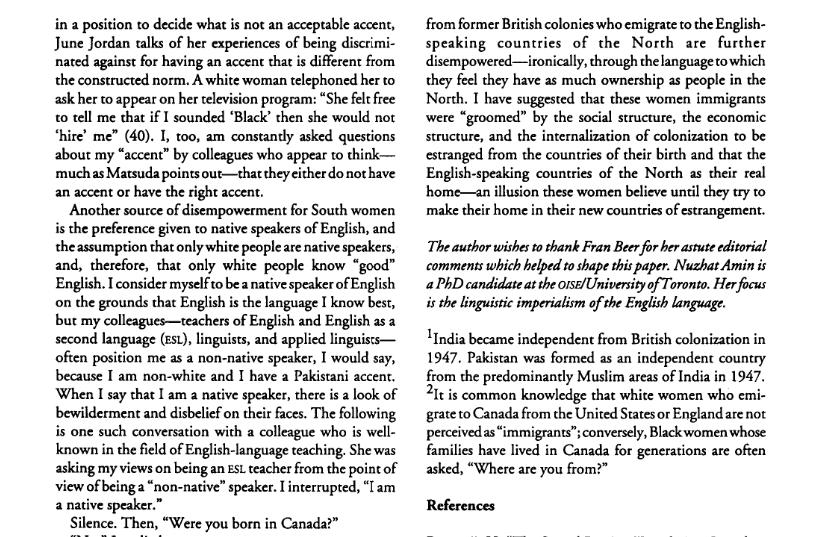
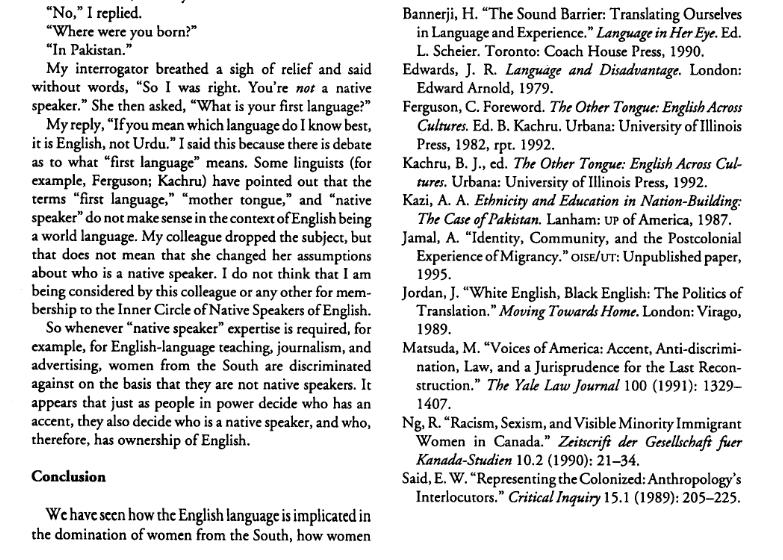
South Englishes, North Englishes by Nuzhat Amin L'auteure explique comment la langue anglaise peut s'avrer un outil d'oppression du Sud par le Nord. "That Indian accent...you'll have to get rid of it if you I have spoken English all my life. In school, college. In my social life. At work. Even at home, most of the time. Growing up in a middle-class urban family in postcolonial Pakistan, English ruled our lives. want to get anywhere in this field.... You know, you have to learn to talk like a Canadian...." This was in 1975 when I first came to Canada, at my first job as an editorial assistant in a television station. I get upset even now-22 years later-when I think of the boss advising me how to make it as a journalist in Canada. Get rid of that accent.... I was an experienced journalist when I left Pakistan in 1973. I had worked for a number of years as an assistant editor in an English-language daily newspaper in Karachi. Then I spent two years training in print, radio, and TV journalism in Germany before I emigrated to Canada. I have spoken English all my life. In school. At college. In my social life. At work. Even at home, most of the time. Growing up in a middle-class urban family in postcolonial Pakistan, English ruled our lives. It was equated with intelligence, knowledge, culture, and was also a way of getting ahead. Predictably, I went on to get two Master's degrees, in English literature and English language. economic structure" to play a particular role in the inter- national division of labour. The women I describe in this article grew up speaking English in their home countries. English in postcolonial Pakistan Was it a mere accident that British schools in the Indian subcontinent instilled in their students shame of their own language and culture? According to Kazi, it was no acci- dent; the goals of the British education policy were to get political control and to produce a cost-effective adminis- trative bureaucracy. In the early days of colonialism, the British sought the help of British missionaries to control the indigenous educational institutions in order to exert their own political control. But later, with the growing unrest against British officers in India, and in the face of payments of heavy salaries to a bureaucracy of English- men, the British decided to create "an indigenous class of a privileged few for bureaucratic jobs" (Kazi 32). To describe the British rationale for introducing Eng- lish in India, Kazi quotes Macaulay's 1835 Minute to the British Parliament: In India, English is the language spoken by the ruling class. It is spoken by the higher class of natives at the seats of government.... We must do our best to form a class who may be interpreters between us and the millions whom we govern.... A class of persons, Indian in blood and colour, but English in taste, in opinions, in morals, and in intellect. (33) Kazi comments that a crucial part of this education policy was that the British, through English education, did not introduce the knowledge of economics, technol- ogy, science and politics, but instead introduced English
Step by Step Solution
There are 3 Steps involved in it
Thesis In her article South Englishes North Englishes Nuzhat Amin explores the concept of language v... View full answer

Get step-by-step solutions from verified subject matter experts
 Study Help