



Question: ACC 213: Chapter Ten Handouts Multiple Choice 1. The production department should generally be responsible for materials price variances that resulted from A) purchases made
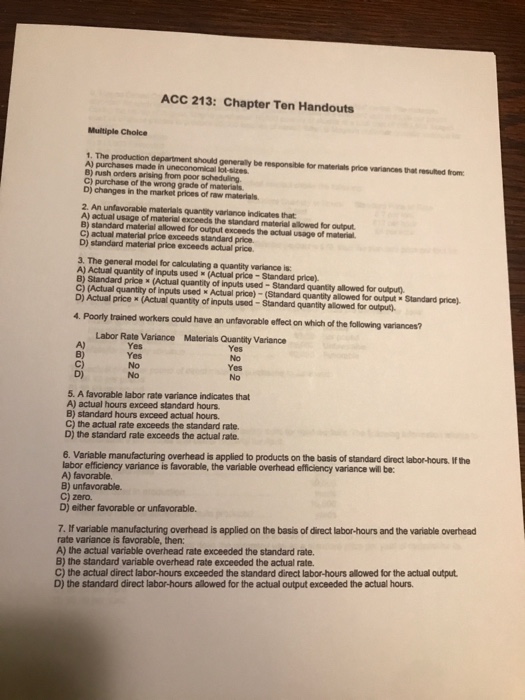
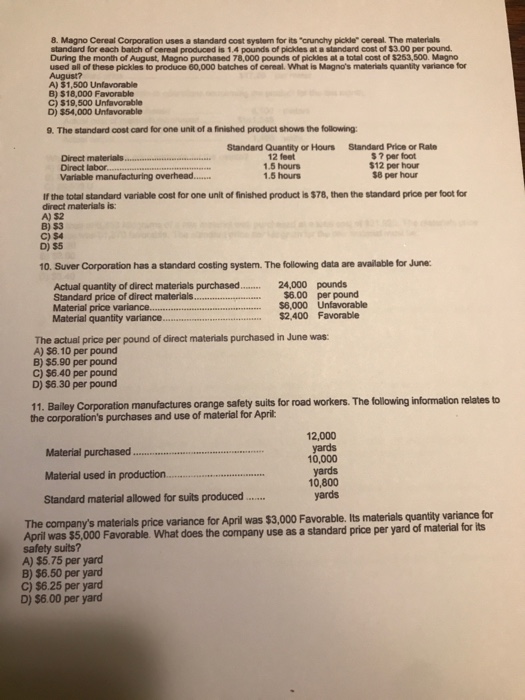
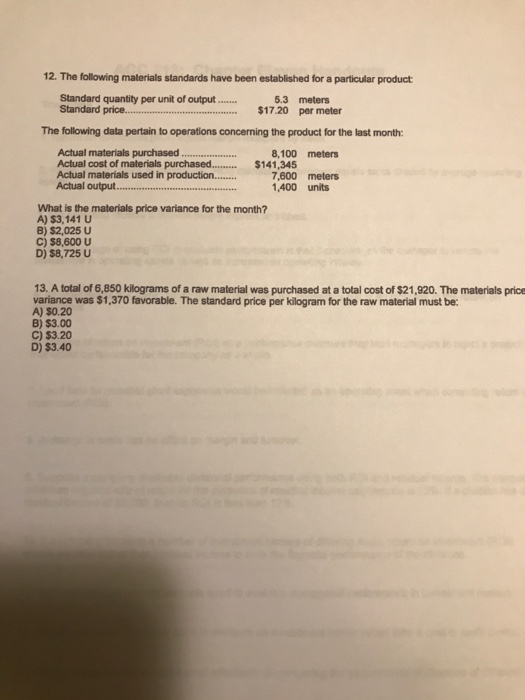
ACC 213: Chapter Ten Handouts Multiple Choice 1. The production department should generally be responsible for materials price variances that resulted from A) purchases made in uneconomical lol-sizes B) rush orders arising from poor scheduling C) purchase of the wrong grade of materials D) changes in the market prices of raw materials 2. An unfavorable materials quantity variance indicates that A) actual usage of material exceeds the standard material allowed for output B) standard material allowed for output exceeds the actual usage of material C) actual material price exceeds standard price. D) standard material price exceeds actual price 3. The general model for calculating a quantity variance is: Actual quantity of inputs used (Actual price-Standard price). B) Standard pricex(Actual quantity of inputs used-Standard quantity allowed for output) C) (Actual quantity of inputs used x Actual price)-(Standard quantity allowed for output Standard price) D) Actual price x(Actual quantity of inputs used- Standard quantity alowed for output) 4. Poorly trained workers could have an unfavorable effect on which of the following variances? Labor Rate Variance Yes Yes No No Materials Quantity Variance Yes No A) B) C) D) No 5. A favorable labor rate variance indicates that A) actual hours exceed standard hours B) standard hours exceed actual hours C) the actual rate exceeds the standard rate. D) the standard rate exceeds the actual rate. 6. Variable manufacturing overhead is applied to products on the basis of standard direct labor-hours. If the labor efficiency variance is favorable, the variable overhead efficlency variance will ber A) favorable B) unfavorable. C) zero. D) either favorable or unfavorable. 7. If variable manufacturing overhead is applied on the basis of direct labor-hours and the variable overhead rate variance is favorable, then: A) the actual variable overhead rate exceeded the standard rate. B) the standard variable overhead rate exceeded the actual rate. C) the actual direct labor-hours exceeded the standard direct labor-hours allowed for the actual output D) the standard direct labor-hours allowed for the actual output exceeded the actual hours
Step by Step Solution
There are 3 Steps involved in it

Get step-by-step solutions from verified subject matter experts