Question: ACC 640 9-1 Scenario The auditing team of your CPA firm has performed an audit engagement for Keystone, which consists of testing financial statements, internal
ACC 640 9-1 Scenario
The auditing team of your CPA firm has performed an audit engagement for Keystone, which consists of testing financial statements, internal controls, and other factors that could have an impact on the company's position. At the end of the audit, the engagement partner has asked you to submit to all the firm's partners the final executive summary audit report. This will include an overall executive summary of the firm's internal control effectiveness in providing reasonable assurance on the company's financial statements and an explanation of the choice of an unqualified opinion versus a different opinion type.
Directions
After reviewing the Scenario and Supporting Materials sections of this document, you will analysis of the audit engagement program using the Summary of Audit Findings document and then summary audit report.
Specifically, you must address the following rubric criteria:
Evaluate assertions regarding the financial statement. Consider the following:
Accuracy and valuation, existence, completeness, rights and obligations, and presentation and disclosure
Describe the control gaps and anomalies present in the summary of audit findings.
Present how the findings are in accordance with generally accepted auditing standards (GAAS).
Formulate an opinion of the audit results. Include the following:
The validity of the results
The impact of the external audit on the client
The rationale for an unqualified opinion versus the other three opinion types
Identify the required elements to be communicated in the audit report.
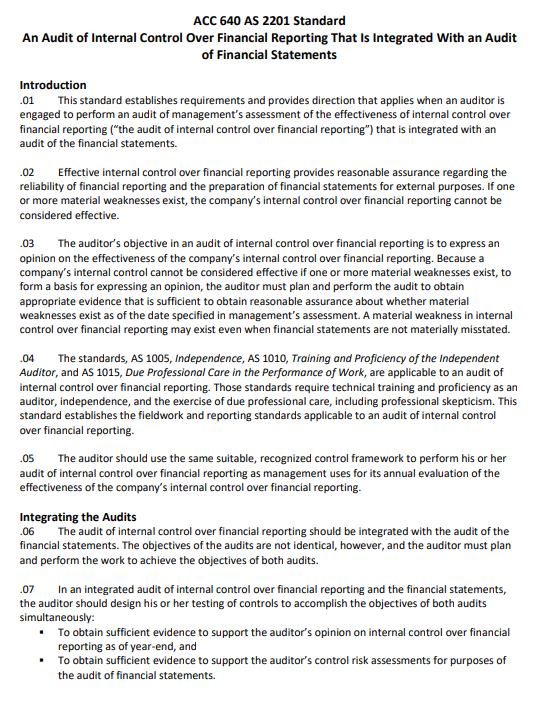
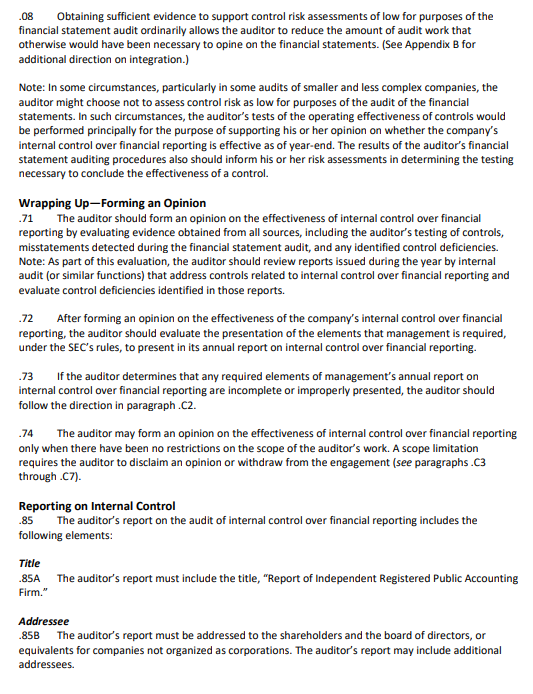
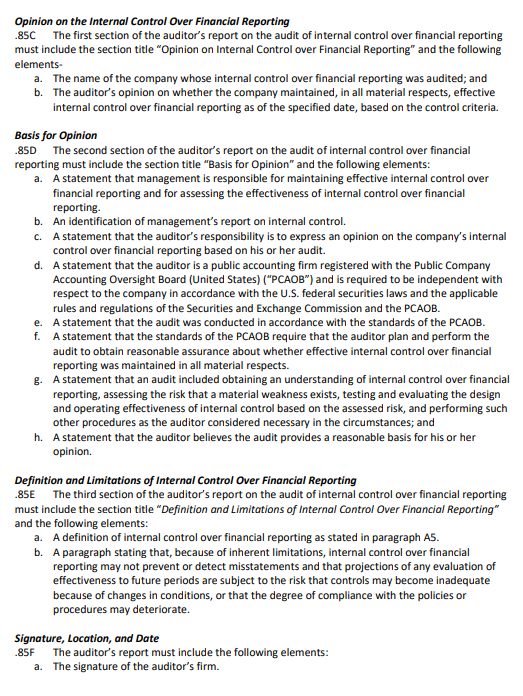
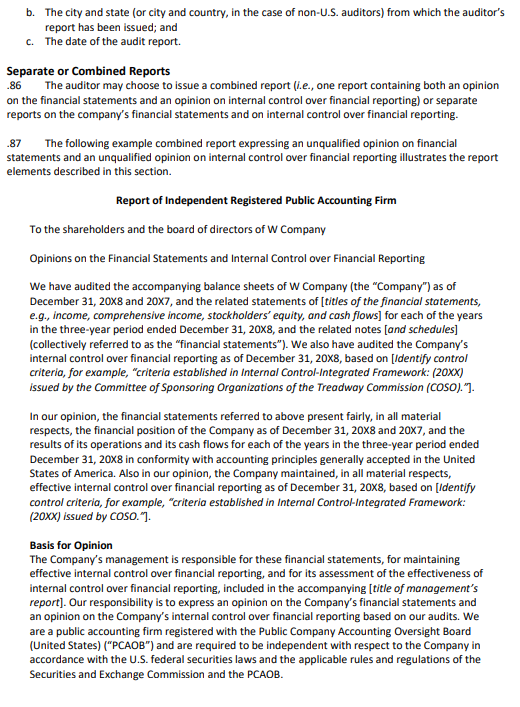
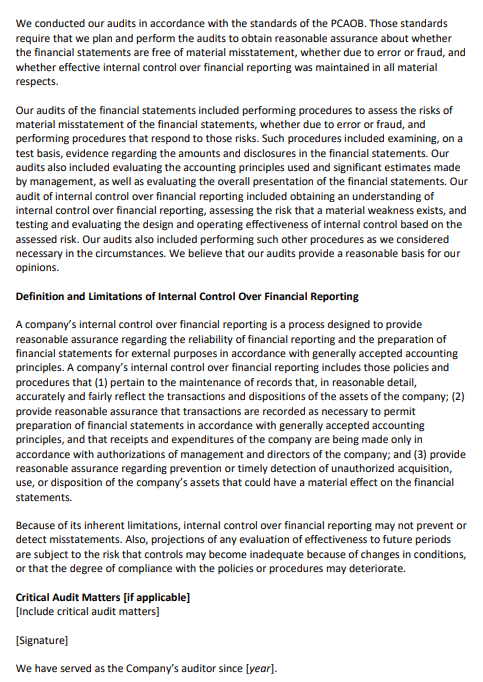
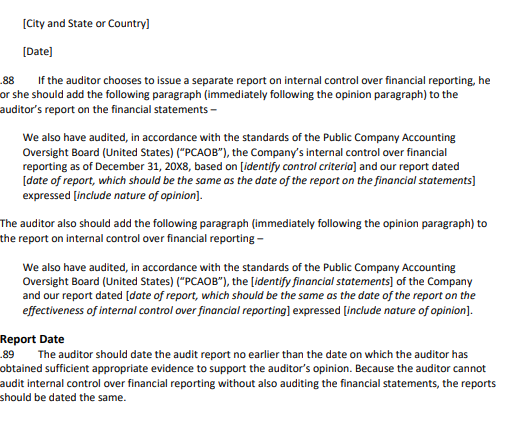
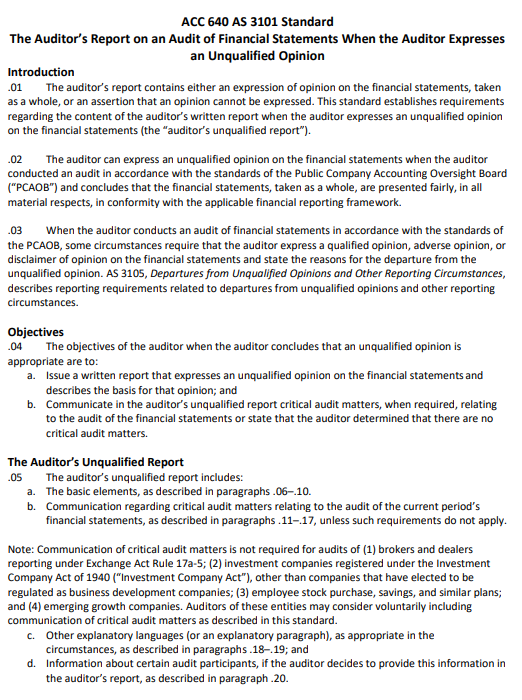
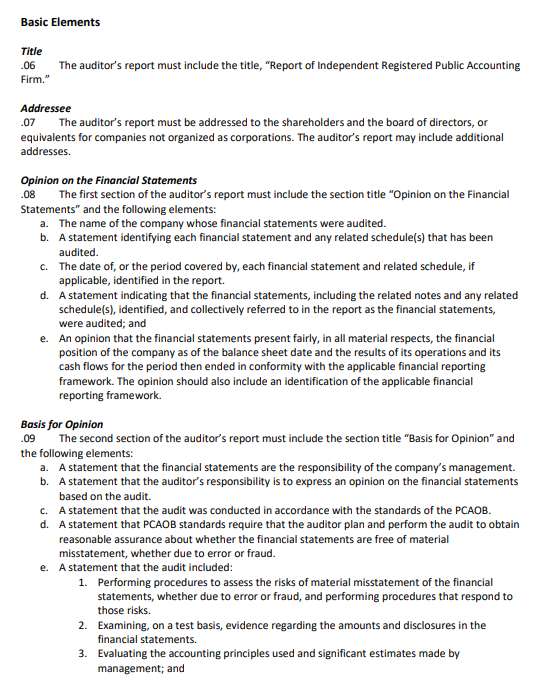
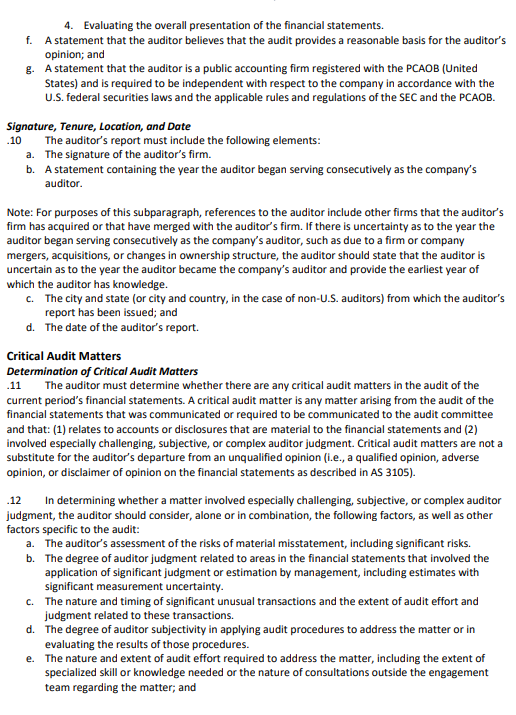
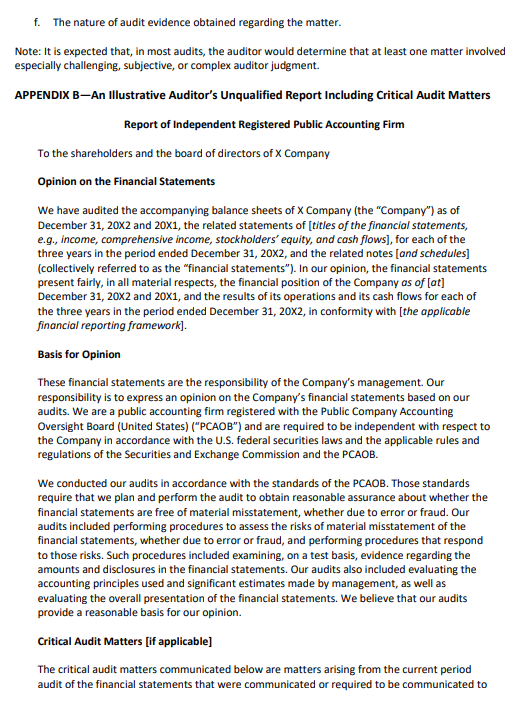
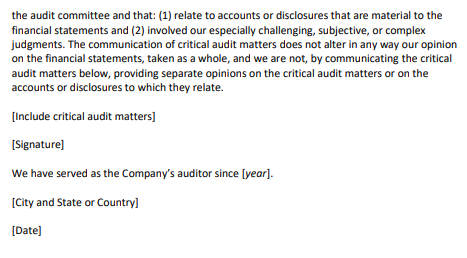
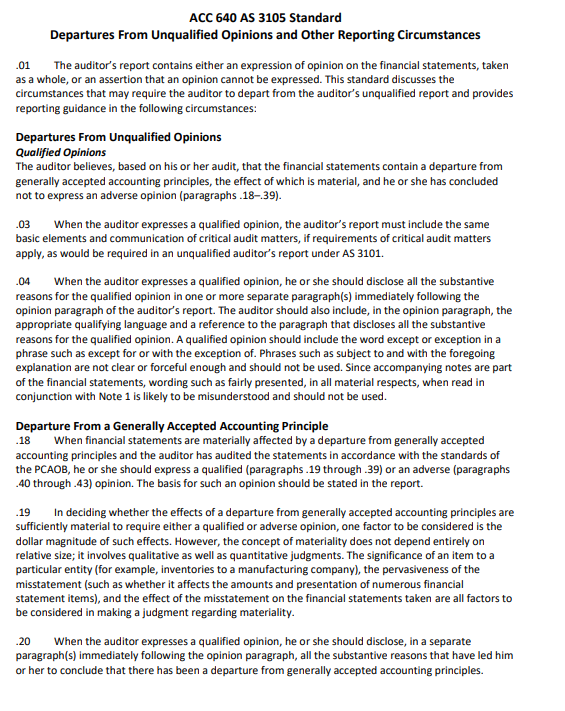
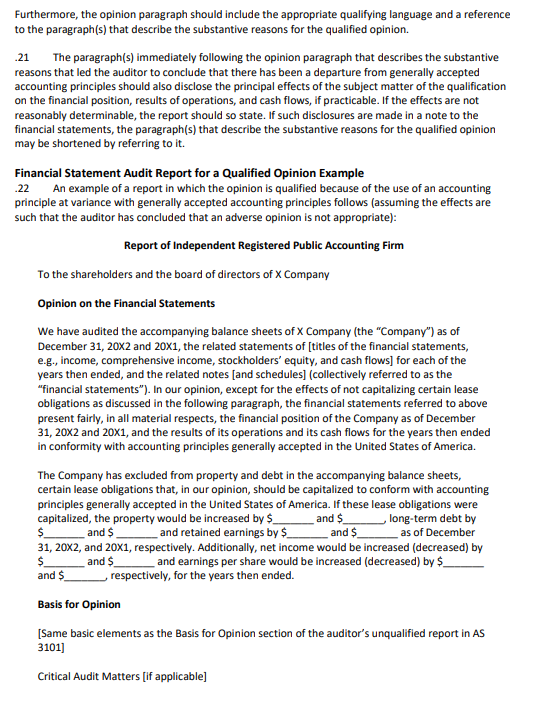
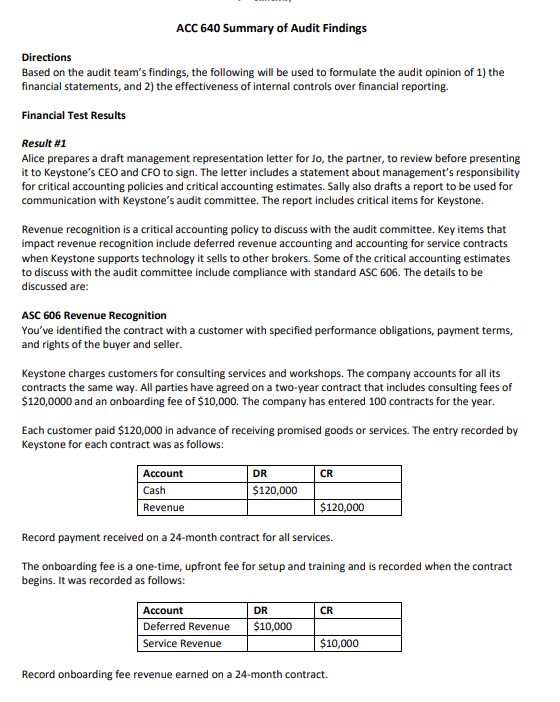
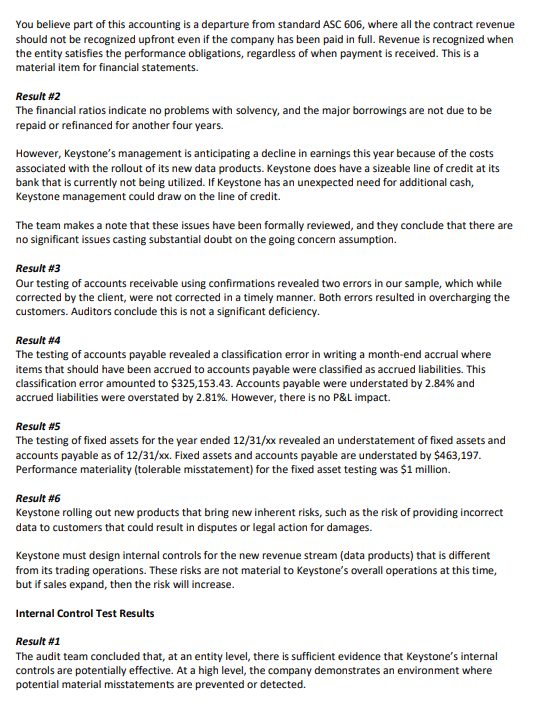
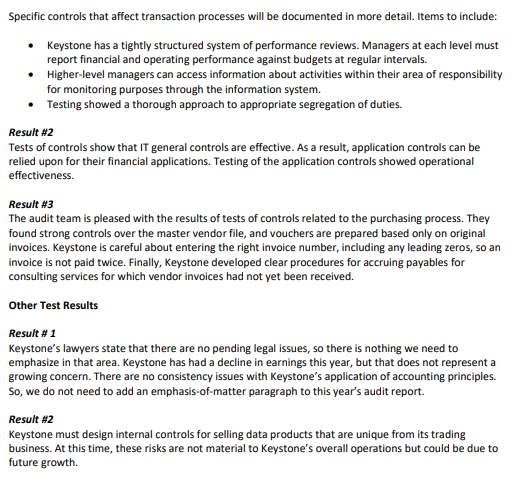
ACC 640 AS 2201 Standard An Audit of Internal Control Over Financial Reporting That Is Integrated With an Audit of Financial Statements Introduction .01 This standard establishes reguirements and provides direction that applies when an auditor is engaged to perform an audit of management's assessment of the effectiveness of internal control over financial reporting (\"the audit of internal control over financial reporting) that is integrated with an audit of the financial statements. .02 Effective internal control over financial reporting provides reasonable assurance regarding the reliability of financial reporting and the preparation of financial statements for external purposes. If one or more material weaknesses exist, the company''s internal control over financial reporting cannot be considered effective. .03 The auditor's objective in an audit of internal control over financial reporting is to express an opinion on the effectiveness of the company's internal control over financial reporting. Because a company's internal control cannot be considered effective if one or more material weaknesses exist, to form a basis for expressing an opinion, the auditor must plan and perform the audit to obtain appropriate evidence that is sufficient to obtain reasonable assurance about whether material weaknesses exist as of the date specified in management's assessment. A material weakness in internal control over financial reporting may exist even when financial statements are not materially misstated. .04 The standards, AS 1005, independence, A5 1010, Training and Praficiency of the independent Auditor, and AS 1015, Due Professional Care in the Performance of Work, are applicable to an audit of internal contral over financial reporting. Those standards reguire technical training and proficiency as an auditor, independence, and the exercise of due professional care, including professional skepticism. This standard establishes the fieldwork and reporting standards applicable to an audit of internal control over financial reporting. 05 The auditor should use the same suitable, recognized control framework to perform his or her audit of internal control over financial reporting as management uses for its annual evaluation of the effectiveness of the company's internal control over financial reporting. Integrating the Audits 06 The audit of internal control over financial reparting should be integrated with the audit of the financial statements. The objectives of the audits are not identical, however, and the auditor must plan and perform the work to achieve the objectives of both audits. 07 In an integrated audit of internal control over financial reporting and the financial statements, the auditor should design his or her testing of controls to accomplish the objectives of both audits simultaneaushy: * To obtain sufficient evidence to support the auditor's opinion oninternal contral over financial reporting as of year-end, and = To abtain sufficient evidence to support the auditor's control risk assessments for purposes of the audit of financial statements. 08 Obtaining sufficient evidence to support control risk assessments of low for purposes of the financial statement audit ordinarily allows the auditor to reduce the amount of audit work that otherwise would have been necessary to opine on the financial statements. (See Appendix B for additional direction on integration.) Mote: In some circumstances, particularly in some audits of smaller and less complex companies, the auditor might choose not to assess control risk as low for purposes of the audit of the financial statements. In such circumstances, the auditor's tests of the operating effectiveness of controls would be performed principally for the purpose of supporting his or her opinion on whether the company's internal control over financial reporting is effective as of year-end. The results of the auditor's financial statement auditing procedures also should inform his or her risk assessments in determining the testing necessary to conclude the effectiveness of a control. Wrapping UpForming an Opinion g1 The auditor should form an opinion on the effectiveness of internal control over financial reporting by evaluating evidence obtained from all sources, including the auditor's testing of controls, misstatements detected during the financial statement audit, and any identified control deficiencies. Mote: As part of this evaluation, the auditor should review reports issued during the year by internal audit [or similar functions) that address controls related to internal control over financial reporting and evaluate control deficiencies identified in those reports. a2 After forming an opinion on the effectiveness of the company's internal control over financial reporting, the auditor should evaluate the presentation of the elements that management is required, under the SEC's rules, to present in its annual report on internal control over financial reporting. .73 If the auditor determines that any reqguired elements of management's annual report on internal control over financial reporting are incomplete or improperly presented, the auditor should follow the direction in paragraph .C2. 14 The auditor may form an opinion on the effectiveness of internal control over financial reporting anly when there have been no restrictions on the scope of the auditor's work. A scope limitation requires the auditor to disclaim an opinion or withdraw from the engagement [see paragraphs .C3 thraugh .C7). Reporting on Internal Control B5 The auditor's report on the audit of internal control over financial reporting includes the following elements: Title B548 The auditor's report must include the title, "Report of Independent Registered Public Accounting Firm.\" Addressee B5B The auditor's report must be addressed to the shareholders and the board of directors, or equivalents for companies not organized as corporations. The auditor's report may include additional addressees. Opinion on the Internal Control Over Financial Reparting B5C The first section of the auditor's report on the audit of internal control over financial reporting must include the section title "Opinion on Internal Control over Financial Reporting and the following elements- a. The name of the company whose internal control over financial reporting was audited; and b. The auditor's opinion on whether the company maintained, in all material respects, effective internal control over financial reporting as of the specified date, based on the control criteria. Basis for Opinion B5D The second section of the auditor's report on the audit of internal control over financial reporting must include the section title \"Basis for Opinion and the following elements: a. Astatement that management is responsible for maintaining effective internal control over financial reporting and for assessing the effectiveness of internal control over financial reporting. An identification of management's report on internal control. A statement that the auditor's responsibility is to express an opinion on the company's internal control over financial reporting based on his or her audit. d. Astatement that the auditor is a public accounting firm registered with the Public Company Accounting Oversight Board [United States) ("PCADB) and is required to be independent with respect to the company in accordance with the U5, federal securities laws and the applicable rules and regulations of the Securities and Exchange Commission and the PCADB. e. Astatement that the audit was conducted in accordance with the standards of the PCADS. f. Astatement that the standards of the PCADE require that the auditor plan and perform the audit to obtain reasonable assurance about whether effective internal control over financial reporting was maintained in all material respects. g. Astatement that an audit included obtaining an understanding of internal control over financial reporting, assessing the risk that a material weakness exists, testing and evaluating the design and operating effectiveness of internal control based on the assessed risk, and performing such other procedures as the auditor considered necessary in the circumstances; and h. A statement that the auditor believes the audit provides a reasonable basis for his or her opinion. Definition and Limitations of Internal Control Over Financial Reporting B5E The third section of the auditor's report on the audit of internal control over financial reporting must include the section title "Definition and Limitations of internal Control Over Financlal Reporting and the following elements: a. A definition of internal contral over financial reporting as stated in paragraph A5. b. A paragraph stating that, because of inherent limitations, internal control over financial reporting may not prevent or detect misstatements and that projections of any evaluation of effectiveness to future periods are subject to the risk that controls may become inadequate because of changes in conditions, or that the degree of compliance with the policies or procedures may deteriorate. Signature, Location, and Date B5F The auditor's report must include the following elements: a. The signature of the auditor's firm. b. The city and state [or city and country, in the case of non-U.5. auditors) from which the auditor's report has been issued; and . The date of the audit report. Separate or Combined Reports BB The auditor may choose to issue a combined report [Le., one report containing both an opinion on the financial statements and an opinion on internal control over financial reporting) or separate reports on the company's financial statements and on internal control over financial reporting. B7 The following example combined report expressing an ungualified opinion on financial statements and an unqualified opinion on internal control over financial reporting illustrates the report elements described in this section. Report of Independent Registered Public Accounting Firm To the shareholders and the board of directors of W Company Opinions on the Financial Statements and Internal Control over Financial Reporting We have audited the accompanying balance sheets of W Company [the "Company\") as of December 31, 20X8 and 20X7, and the related statements of [titles of the financlal statements, .0., income, comprehensive income, stockholders\" equity, and cash fTows] for each of the years in the three-year period ended December 31, 20X8, and the related notes [ond schedules] [collectively referred to as the \"financial statements\"). We also have audited the Company's internal control over financial reporting as of December 31, 20X8, based on [Identify control criteria, for example, \"criteria established In internal Control-Integroted Fromework: [20XX]) issued by the Committee of Sponsoring Organizations of the Treadway Commission [CO50).7]. In our opinion, the financial statements referred to above present fairly, in all material respects, the financial position of the Company as of December 31, 20XE and 20X7, and the results of its operations and its cash flows for each of the years in the three-year period ended December 31, 20%8 in conformity with accounting principles generally accepted in the United States of America. Also in our opinion, the Company maintained, in all material respects, effective internal control over financial reporting as of December 31, 20X8, based on [Identify contral criteria, for exampile, \"criterio established in Internal Control-integroted Fromework: (20%X) issied by COS0.7). Basis for Opinion The Company's management is responsible for these financial statements, for maintaining effective internal control over financial reporting, and for its assessment of the effectiveness of internal control over financial reporting, included in the accompanying [title of monogement's report]. Our responsibility is to express an opinion on the Company's financial statements and an opinion an the Company's internal control over financial reparting based on our audits. We are a public accounting firm registered with the Public Company Accounting Owversight Board (United States) ("PCADB") and are required to be independent with respect to the Company in accordance with the U.S. federal securities laws and the applicable rules and regulations of the Securities and Exchange Commission and the PCAOB. We conducted our audits in accordance with the standards of the PCADB. Those standards require that we plan and perform the audits to obtain reasonable assurance about whether the financial statements are free of material misstatement, whether due to errar or fraud, and whether effective internal control over financial reporting was maintained in all material respects. Our audits of the financial statements included performing procedures to assess the risks of material misstatement of the financial statements, whether due to error or fraud, and performing procedures that respond to those risks. Such procedures included examining, on a test basis, evidence regarding the amounts and disclosures in the financial statements. Our audits also included evaluating the accounting principles used and significant estimates made by management, as well as evaluating the overall presentation of the financial statements. Our audit of internal control over financial reporting included obtaining an understanding of internal control over financial reporting, assessing the risk that a material weakness exists, and testing and evaluating the design and operating effectiveness of internal control based on the assessed risk. Our audits also included performing such other procedures as we considered necessary in the circumstances. We believe that our audits provide a reasonable basis for our apinions. Definition and Limitations of Internal Control Over Financial Reporting & company's internal control over financial reporting is a process designed to provide reasonable assurance regarding the reliability of financial reporting and the preparation of financial statements for external purposes in accordance with generally accepted accounting principles. A company's internal control over financial reporting includes those policies and procedures that (1) pertain to the maintenance of records that, in reasonable detail, accurately and fairly reflect the transactions and dispositions of the assets of the company; [2) provide reasonable assurance that transactions are recorded as necessary to permit preparation of financial statements in accordance with generally accepted accounting principles, and that receipts and expenditures of the company are being made only in accordance with authorizations of management and directors of the company; and (3) provide reasonable assurance regarding prevention or timely detection of unauthorized acquisition, use, or disposition of the company's assets that could have a material effect on the financial staterments. Because of its inherent limitations, internal control over financial reporting may not prevent or detect misstatements. Also, projections of any evaluation of effectiveness to future periods are subject to the risk that controls may become inadequate because of changes in conditions, or that the degree of compliance with the policies or procedures may deteriorate. Critical Audit Matters [if applicable] [Include critical audit matters) [Signature] We have served as the Company's auditor since [year]. [City and State or Country] [Date] B8 If the auditor chooses to issue a separate report on internal control over financial reporting, he or she should add the following paragraph [immediately following the opinion paragraph) to the auditor''s repart on the financial statements We also have audited, in accordance with the standards of the Public Company Accounting Oversight Board (United States) ("PCADB"), the Company's internal control over financial reporting as of December 31, 20XE, based on [identify control criteria] and our report dated [date af report, which should be the some as the dote of the report on the finonciol statements] expressed [include nature of opinion]. The auditor also should add the following paragraph (immediately following the opinion paragraph) to the report on internal control over financial reporting = We also have audited, in accordance with the standards of the Public Company Accounting Owversight Board (United States) ("PCADB"), the [identify finonclal statements] of the Company and our report dated [date of report, which should be the same as the date of the report on the effectiveness of internal control over financial reporting] expressed [include nature of opinion]. Report Date B9 The auditor should date the audit report no earlier than the date on which the auditor has obtained sufficient appropriate evidence to support the auditor's opinion. Because the auditor cannot audit internal control over financial reporting without also auditing the financial statements, the reports should be dated the same. ACC 640 AS 3101 Standard The Auditor's Report on an Audit of Financial Statements When the Auditor Expresses an Unqualified Opinion Introduction 01 The auditor's report contains either an expression of opinion on the financial statements, taken as a whole, or an assertion that an opinion cannot be expressed. This standard establishes requirements regarding the content of the auditor's written report when the auditor expresses an unqualified opinion on the financial statements (the "auditor's unqualified report"). 02 The auditor can express an unqualified opinion on the financial statements when the auditor conducted an audit in accordance with the standards of the Public Company Accounting Oversight Board ["PCAOB") and concludes that the financial statements, taken as a whole, are presented fairly, in all material respects, in conformity with the applicable financial reporting framework. 03 When the auditor conducts an audit of financial statements in accordance with the standards of the PCAOB, some circumstances require that the auditor express a qualified opinion, adverse opinion, or disclaimer of opinion on the financial statements and state the reasons for the departure from the unqualified opinion. AS 3105, Departures from Unqualified Opinions and Other Reporting Circumstances, describes reporting requirements related to departures from unqualified opinions and other reporting circumstances. Objectives .04 The objectives of the auditor when the auditor concludes that an unqualified opinion is appropriate are to: a. Issue a written report that expresses an unqualified opinion on the financial statements and describes the basis for that opinion; and b. Communicate in the auditor's unqualified report critical audit matters, when required, relating to the audit of the financial statements or state that the auditor determined that there are no critical audit matters. The Auditor's Unqualified Report 05 The auditor's unqualified report includes: a. The basic elements, as described in paragraphs .06-.10. b. Communication regarding critical audit matters relating to the audit of the current period's financial statements, as described in paragraphs .11-.17, unless such requirements do not apply. Note: Communication of critical audit matters is not required for audits of (1) brokers and dealers reporting under Exchange Act Rule 17a-5; (2) investment companies registered under the Investment Company Act of 1940 ("Investment Company Act"), other than companies that have elected to be regulated as business development companies; (3) employee stock purchase, savings, and similar plans; and (4) emerging growth companies. Auditors of these entities may consider voluntarily including communication of critical audit matters as described in this standard. c. Other explanatory languages (or an explanatory paragraph), as appropriate in the circumstances, as described in paragraphs .18-.19; and d. Information about certain audit participants, if the auditor decides to provide this information in the auditor's report, as described in paragraph .20.Basic Elements Title 06 The auditor's report must include the title, "Report of Independent Registered Public Accounting Firm." Addressee 07 The auditor's report must be addressed to the shareholders and the board of directors, or equivalents for companies not organized as corporations. The auditor's report may include additional addresses. Opinion on the Financial Statements .08 The first section of the auditor's report must include the section title "Opinion on the Financial Statements" and the following elements: a. The name of the company whose financial statements were audited. b. A statement identifying each financial statement and any related schedule(s) that has been audited. C. The date of, or the period covered by, each financial statement and related schedule, if applicable, identified in the report. d. A statement indicating that the financial statements, including the related notes and any related schedule(s), identified, and collectively referred to in the report as the financial statements, were audited; and e. An opinion that the financial statements present fairly, in all material respects, the financial position of the company as of the balance sheet date and the results of its operations and its cash flows for the period then ended in conformity with the applicable financial reporting framework. The opinion should also include an identification of the applicable financial reporting framework. Basis for Opinion 09 The second section of the auditor's report must include the section title "Basis for Opinion" and the following elements: a. A statement that the financial statements are the responsibility of the company's management. b. A statement that the auditor's responsibility is to express an opinion on the financial statements based on the audit. C. A statement that the audit was conducted in accordance with the standards of the PCAOB. d. A statement that PCAOB standards require that the auditor plan and perform the audit to obtain reasonable assurance about whether the financial statements are free of material misstatement, whether due to error or fraud. e. A statement that the audit included: 1. Performing procedures to assess the risks of material misstatement of the financial statements, whether due to error or fraud, and performing procedures that respond to those risks. 2. Examining, on a test basis, evidence regarding the amounts and disclosures in the financial statements. Evaluating the accounting principles used and significant estimates made by management; and4. Evaluating the overall presentation of the financial statements. f. Astatement that the auditor believes that the audit provides a reasonable basis for the auditor's opinkon; and g. Astatement that the auditor is a public accounting firm registered with the PCAOEB (United States) and is required to be independent with respect to the company in accordance with the 1.5, federal securities laws and the applicable rules and regulations of the SEC and the PCADB. Signature, Tenure, Location, and Date .10 The auditor's report must include the following elements: a. The signature of the auditor's firm. b. A statement containing the year the auditor began serving consecutively as the company''s auditor. MNote: For purposes of this subparagraph, references to the auditor include other firms that the auditor's firm has acquired or that have merged with the auditor's firm. If there is uncertainty as to the year the auditor began serving consecutively as the company's auditor, such as due to a firm or company mergers, acguisitions, or changes in ownership structure, the auditor should state that the auditor is uncertain as to the year the auditor became the company's auditor and provide the earliest year of which the auditor has knowledge. . The city and state [or city and country, in the case of non-U.5. auditors) from which the auditor's report has been issued; and d. The date of the auditor's repaort. Critical Audit Matters Determination of Critical Audit Matters A1 The auditor must determine whether there are any critical audit matters in the audit of the current period's financial statements. A critical audit matter is any matter arising from the audit of the financial statements that was communicated or reguired to be communicated to the audit commitiee and that: (1) relates to accounts or disclosures that are material to the financial statements and (2) invalved especially challenging, subjective, or complex auditor judgment. Critical audit matters are not a substitute for the auditor's departure from an ungualified opinion {i.e., a qualified opinion, adverse opinion, or disclaimer of opinion on the financial statements as described in AS 3105). A2 In determining whether a matter involved especially challenging, subjective, or complex auditor judgment, the auditor should consider, alone or in combination, the following factors, as well as other factors specific to the audit: a. The auditor's assessment of the risks of material misstatement, including significant risks. b. The degree of auditor judgment related to areas in the financial statements that involved the application of significant judgment or estimation by management, including estimates with significant measurement uncertainky. . The nature and timing of significant unusual transactions and the extent of audit effort and judgment related to these transactions. d. The degree of auditor subjectivity in applying audit procedures to address the matter or in evaluating the results of those procedures. e. The nature and extent of audit effort required to address the matter, including the extent of specialized skill or knowledge needed or the nature of consultations outside the engagement team regarding the matter; and f. The nature of audit evidence obtained regarding the matter. Mote: It is expected that, in most audits, the auditor would determine that at least one matter involved especially challenging, subjective, or complex auditor judgment. APPENDIX BAn lllustrative Auditor's Ungualified Report Including Critical Audit Matters Report of independent Registered Public Accounting Firm To the shareholders and the board of directors of X Company Opinion on the Financial Statements 'We have audited the accompanying balance shieets of X Company (the "Company) as of December 31, 2082 and 20X1, the related statements of [titles of the fimancial stotements, .4q., income, comprehensive income, stockholders\" equity, and cash flows], for each of the three years in the period ended December 31, 20X2, and the related notes [ond schedules] (collectively referred to as the \"financial statements\"). In our opinion, the financial statements present fairly, in all material respects, the financial position of the Company as of [at] December 31, 2062 and 2001, and the results of its operations and its cash flows for each of the three years in the period ended December 31, 2062, in conformity with [the applicable financial reporting framework]. Basis for Opinion These financial statements are the responsibility of the Company's management. Our responsibility is to express an opinion on the Company's financial statements based on our audits. We are a public accounting firm registered with the Public Company Accounting Oversight Board (United States) ("PCADB") and are required to be independent with respect to the Company in accordance with the U.5. federal securities laws and the applicable rules and regulations of the Securities and Exchange Commission and the PCAQB. We conducted our audits in accordance with the standards of the PCAOB. Those standards require that we plan and perform the audit to obtain reasonable assurance about whether the financial statements are free of material misstatement, whether due to error or fraud. Our audits included performing procedures to assess the risks of material misstatement of the financial statements, whether due to error or fraud, and performing procedures that respond to those risks. Such procedures included examining, on a test basis, evidence regarding the amounts and disclosures in the financial statements. Our audits also included evaluating the accounting principles used and significant estimates made by management, as well as evaluating the overall presentation of the financial statements. We believe that our audits provide a reasonable basis for our opinion. Critical Audit Matters [if applicable] The critical audit matters communicated below are matters arising from the current period audit of the financial statements that were communicated or required to be communicated to the audit committee and that: (1) relate to accounts or disclosures that are material to the financial statements and (2) involved our especially challenging, subjective, or complex judgments. The communication of critical audit matters does not alter in any way our opinion on the financial statements, taken as a whole, and we are not, by communicating the critical audit matters below, providing separate opinions on the critical audit matters or on the accounts or disclosures to which they relate. [Include critical audit matters] [Signature] We have served as the Company's auditor since [year]. [City and State or Country] [Date] ACC 640 AS 3105 Standard Departures From Unqualified Opinions and Other Reporting Circumstances 01 The auditor's report contains either an expression of opinion on the financial statements, taken as a whole, or an assertion that an opinion cannot be expressed. This standard discusses the circumstances that may reqguire the auditor to depart from the auditor's ungualified report and provides reporting guidance in the following circumstances: Departures From Unqualified Opinions Qualified Opinions The auditor belleves, based on his or her audit, that the financial statements contain a departure from generally accepted accounting principles, the effect of which is material, and he or she has concluded not to express an adverse opinion (paragraphs (. 18-.39). 03 When the auditor expresses a qualified opinion, the auditor's report must include the same basic elements and communication of critical audit matters, if reguirements of critical audit matters apply, as would be required in an ungualified auditor's report under AS 3101. .04 When the auditor expresses a qualified opinion, he or she should disclose all the substantive reasons for the gualified opinion in one or more separate paragraphis) immediately following the opinion paragraph of the auditar's report. The auditor should also include, in the opinion paragraph, the appropriate qualifying language and a reference to the paragraph that discloses all the substantive reasans for the gualified opinion. & qualified opinion should include the word except or exception in a phrase such as except for or with the exception of. Phrases such as subject to and with the foregoing explanation are not clear or forceful encugh and should not be used. Since accompanying notes are part of the financial statements, wording such as fairly presented, in all material respects, when read in conjunction with Note 1 s likely to be misunderstood and should not be used. Departure From a Generally Accepted Accounting Principle 8 When financial statements are materially affected by a departure from generally accepted accounting principles and the auditor has audited the statements in accordance with the standards of the PCADB, he or she should express a qualified {paragraphs .19 through .39) or an adverse (paragraphs A0 through .43) opinion. The basis for such an opinion should be stated in the report. .19 In deciding whether the effects of a departure from generally accepted accounting principles are sufficiently material to require either a qualified or adverse opinion, one factor to be considered is the dollar magnitude of such effects. However, the concept of materiality does not depend entirely on relative size; it involves gqualitative as well as quantitative judgments. The significance of an ltem to a particular entity (for example, inventories to a manufacturing company), the pervasiveness of the misstatement (such as whether it affects the amounts and presentation of numerous financial statement items), and the effect of the misstaterment on the financial statements taken are all factors to be considered in making a judgment regarding materiality. .20 When the auditor expresses a qualified opinion, he or she should disclose, in a separate paragraph(s) immediately following the opinion paragraph, all the substantive reasons that have led him or her to conclude that there has been a departure from generally accepted accounting principles. Furthermore, the apinion paragraph should include the appropriate qualifying language and a reference to the paragraph(s) that describe the substantive reasons for the qualified opinion. 21 The paragraphis) immediately following the opinion paragraph that describes the substantive reasons that led the auditor to conclude that there has been a departure from generally accepted accounting principles should also disclose the principal effects of the subject matter of the qualification on the financial position, results of operations, and cash flows, if practicable. If the effects are not reasonably determinable, the report should so state. If such disclosures are made in a note to the financial statements, the paragraph(s) that describe the substantive reasons for the gualified opinion may be shortened by referring to it. Financial Statement Audit Report for a Qualified Opinion Example 22 An example of a report in which the opinion is gualified because of the use of an accounting principle at variance with generally accepted accounting principles follows (assuming the effects are such that the auditor has concluded that an adverse opinion is not appropriate): Report of Independent Registered Public Accounting Firm To the shareholders and the board of directors of X Company Opinion on the Financial 5tatements We have audited the accompanying balance sheets of X Company [the "Company}) as of December 31, 2062 and 20X1, the related statements of [titles of the financial statements, e.g., income, comprehensive income, stockholders' equity, and cash flows] for each of the yvears then ended, and the related notes [and schedules] [collectively referred to as the \"financial statements\"). In our opinion, except for the effects of not capitalizing certain lease obligations as discussed in the following paragraph, the financial statements referred to above present fairly, in all material respects, the financial position of the Company as of December 31, 20x2 and 20X1, and the results of its operations and its cash flows for the years then ended in conformity with accounting principles generally accepted in the United States of America. The Company has excluded from property and debt in the accompanying balance sheets, certain lease obligations that, in our opinion, should be capitalized to conform with accounting principles generally accepted in the United States of America. If these lease obligations were capitalized, the property would be increased by 5 and 5 , long-term debt by 5 and % and retained earnings by & and 5 as of December 31, 20%2, and 20X1, respectively. Additionally, net income would be increased (decreased) by 5 and 5 and earnings per share would be increased (decreased) by 5 and 5 respectively, for the years then ended. Basis for Opinion [Same basic elements as the Basis for Opinion section of the auditor's unqualified report in AS 3101] Critical Audit Matters [if applicable] ACC 640 Summary of Audit Findings Directions Based on the audit team's findings, the following will be used to formulate the audit opinion of 1) the financial statements, and 2) the effectiveness of internal controls over financial reporting. Financial Test Results Result 81 Alice prepares a draft management representation letter for Jo, the partner, to review before presenting it to Keystone's CEQ and CFO to sign. The letter includes a statement about management's responsibility for critical accounting policies and critical accounting estimates. Sally also drafts a report to be used for communication with Keystone's audit committee. The report includes critical items for Keystone. Revenue recognition is a critical accounting policy to discuss with the audit committee. Key items that impact revenue recognition include deferred revenue accounting and accounting for service contracts when Keystone supports technology it sells to other brokers. Some of the critical accounting estimates to discuss with the audit committee include compliance with standard ASC 606. The details to be discussed are: ASC 606 Revenue Recognition You've identified the contract with a customer with specified performance obligations, payment terms, and rights of the buyer and seller. Keystone charges customers for consulting services and waorkshops. The company accounts for all its cantracts the same way. All parties have agreed on a two-year contract that includes consulting fees of 5120,0000 and an onboarding fee of 510,000, The company has entered 100 contracts for the year. Each customer paid 5120,000 in advance of receiving promised goods or services. The entry recorded by Keystone for each contract was as follows: Account Revenue Record payment received on a 24-month contract for all services. The onboarding fee is a one-time, upfront fee for setup and training and is recorded when the contract begins. It was recorded as follows: Record onboarding fee revenue earmed on a 24-month contract. You believe part of this accounting is a departure from standard ASC 606, where all the contract revenue should not be recognized upfront even if the company has been paid in full. Revenue is recognized when the entity satisfies the performance obligations, regardless of when payment is received. This is a material itemn for financial statements. Result #2 The financial ratios indicate no problems with solvency, and the major borrowings are not due to be repaid or refinanced for another four years. However, Keystone's management is anticipating a decline in earnings this year because of the costs associated with the rollout of its new data products. Keystone does have a sizeable line of credit at its bank that is currently not being utilized. If Keystone has an unexpected need for additional cash, Keystone management could draw on the line of credit. The team makes a note that these issues have been formally reviewed, and they conclude that there are no significant issues casting substantial doubt on the going concern assumption. Result #3 Our testing of accounts receivable using confirmations revealed two errors in our sample, which while carrected by the client, were not corrected in a timely manner. Both ermors resulted in overcharging the customers. Auditors conclude this is not a significant deficiency. Result #4 The testing of accounts payable revealed a classification error in writing a month-end accrual where items that should have been accrued to accounts payable were classified as accrued liabilities. This classification error amounted to 5325,153.43. Accounts payable were understated by 2.84% and accrued liabilities were overstated by 2.81%. However, there is no PEL impact. Result 5 The testing of fixed assets for the year ended 12/31/x revealed an understatement of fixed assets and accounts payable as of 12/31/0c. Fixed assets and accounts payable are understated by 5463,197. Performance materiality (tolerable misstatement) for the fixed asset testing was 51 million. Result #6 Keystone rolling out new products that bring new inherent risks, such as the risk of providing incorrect data to customers that could result in disputes or legal action for damages. Keystone must design internal controls for the new revenue stream (data products) that is different from its trading operations. These risks are not material to Keystone's overall operations at this time, but if sales expand, then the risk will increase. Internal Control Test Results Result #1 The audit team concluded that, at an entity level, there is sufficient evidence that Keystone's internal cantrols are potentially effective. At a high level, the company demaonstrates an environment where potential material misstatements are prevented or detected. Specific controls that affect transaction processes will be documented in more detail. items ta include: Keystone has a tightly structured system of performance reviews. Managers at each level must report financial and operating performance against budgets at regular intervals. # Higher-level managers can access information about activities within their area of responsibility for monitoring purposes through the information system. # Testing showed a thorough approach to appropriate segregation of duties. Result #2 Tests of controls show that IT general controls are effective. As a result, application controls can be relied upon for their financial applications. Testing of the application contrals showed operational effectiveness. Result #3 The audit team is pleased with the results of tests of controls related to the purchasing process. They found strong controls over the master vendor file, and vouchers are prepared based only on original invaices. Keystone is careful about entering the right invoice number, including any leading zeros, so an imvaice is not paid twice. Finally, Keystone developed clear procedures for accruing payables for cansulting services for which wendor invoices had not yet been received. Other Test Results Result # 1 Keystone's lawyers state that there are no pending legal issues, so there is nothing we need to emphasize in that area. Keystone has had a decline in earnings this year, but that does not represent a growing concern. There are no consistency issues with Keystone's application of accounting principles. %0, we do not need to add an emphasis-of-rmatter paragraph to this year's audit report. Result 2 Keystone must design internal controls for selling data products that are unique from its trading business. At this time, these risks are not material to Keystone's overall operations but could be due to future growth
Step by Step Solution
There are 3 Steps involved in it
1 Expert Approved Answer
Step: 1 Unlock
Question Has Been Solved by an Expert!
Get step-by-step solutions from verified subject matter experts
Step: 2 Unlock
Step: 3 Unlock
Students Have Also Explored These Related Accounting Questions!









 Study Help