


Question: ACC309 Tutor-Marked Assignment Question 1 (a) In ACC213 - Introduction to Income Tax, you have been taught that there is a fine line between the
ACC309 Tutor-Marked Assignment Question 1 (a) In
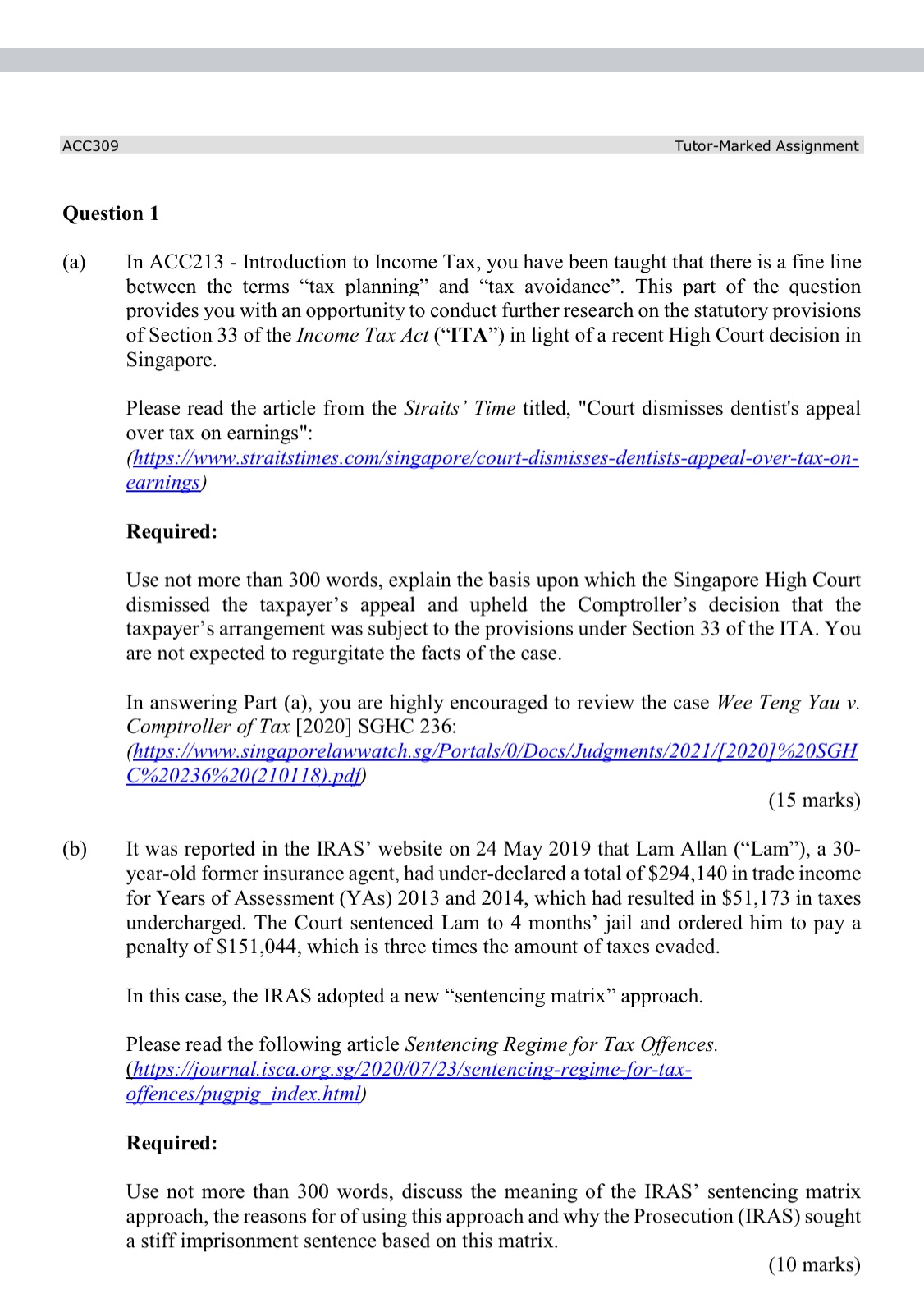
ACC309 Tutor-Marked Assignment Question 1 (a) In ACC213 - Introduction to Income Tax, you have been taught that there is a fine line between the terms "tax planning" and "tax avoidance". This part of the question provides you with an opportunity to conduct further research on the statutory provisions of Section 33 of the Income Tax Act ("ITA") in light of a recent High Court decision in Singapore. Please read the article from the Straits' Time titled, "Court dismisses dentist's appeal over tax on earnings": (https://www.straitstimes.com/singapore/court-dismisses-dentists-appeal-over-tax-on- earnings Required: Use not more than 300 words, explain the basis upon which the Singapore High Court dismissed the taxpayer's appeal and upheld the Comptroller's decision that the taxpayer's arrangement was subject to the provisions under Section 33 of the ITA. You are not expected to regurgitate the facts of the case. In answering Part (a), you are highly encouraged to review the case Wee Teng Yau v. Comptroller of Tax [2020] SGHC 236: https://www.singaporelawwatch.sg/Portals/0/Docs/Judgments/2021/[20201%20SGH C%20236%20(210118).pdf) (15 marks) (b) It was reported in the IRAS' website on 24 May 2019 that Lam Allan ("Lam"), a 30- year-old former insurance agent, had under-declared a total of $294, 140 in trade income for Years of Assessment (YAs) 2013 and 2014, which had resulted in $51, 173 in taxes undercharged. The Court sentenced Lam to 4 months' jail and ordered him to pay a penalty of $151,044, which is three times the amount of taxes evaded. In this case, the IRAS adopted a new "sentencing matrix" approach. Please read the following article Sentencing Regime for Tax Offences. (https://journal.isca.org.sg/2020/07/23/sentencing-regime-for-tax- offences/pugpig_index.html) Required: Use not more than 300 words, discuss the meaning of the IRAS' sentencing matrix approach, the reasons for of using this approach and why the Prosecution (IRAS) sought a stiff imprisonment sentence based on this matrix. (10 marks)

Step by Step Solution

There are 3 Steps involved in it

1 Expert Approved Answer
Step: 1 Unlock blur-text-image

Question Has Been Solved by an Expert!

Get step-by-step solutions from verified subject matter experts

Step: 2 Unlock
Step: 3 Unlock

Students Have Also Explored These Related Accounting Questions!