







Question: According to example 6.4 in the paper solve for the mass of the jumper that would give a velocity of 36 m/s after 4 seconds
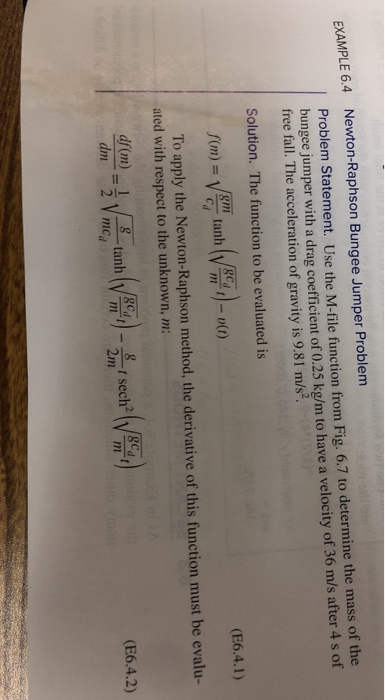
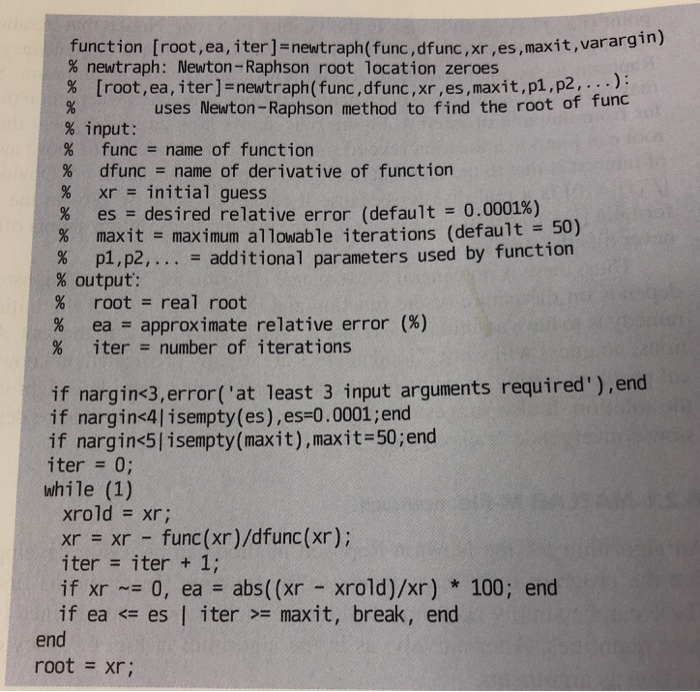
EXAMPLE 6.4 Newton-Raphson Bungee Jumper Problem | Problem Statement. Use the M-file function from Fig. 6.7 to determine the mass of the bungee jumper with a drag coefficient of 0.25 kg/m to have a velocity of 36 m/s after 4 s of free fall. The acceleration of gravity is 9.81 m/s? Solution. The function to be evaluated is To apply the Newton-Raphson method, the derivative of this function must be evalu- ated with respect to the unknown, m: (E6.4.2) EXAMPLE 6.4 Newton-Raphson Bungee Jumper Problem | Problem Statement. Use the M-file function from Fig. 6.7 to determine the mass of the bungee jumper with a drag coefficient of 0.25 kg/m to have a velocity of 36 m/s after 4 s of free fall. The acceleration of gravity is 9.81 m/s? Solution. The function to be evaluated is To apply the Newton-Raphson method, the derivative of this function must be evalu- ated with respect to the unknown, m: (E6.4.2)
Step by Step Solution
There are 3 Steps involved in it

Get step-by-step solutions from verified subject matter experts
 Study Help