







Question: According to given that image question; k-nearest neighbors algorithm with c++ (oop) programming. Please, could you support for solutions as soon as possible less time
According to given that image question;
k-nearest neighbors algorithm with c++ (oop) programming.
Please, could you support for solutions as soon as possible less time ?
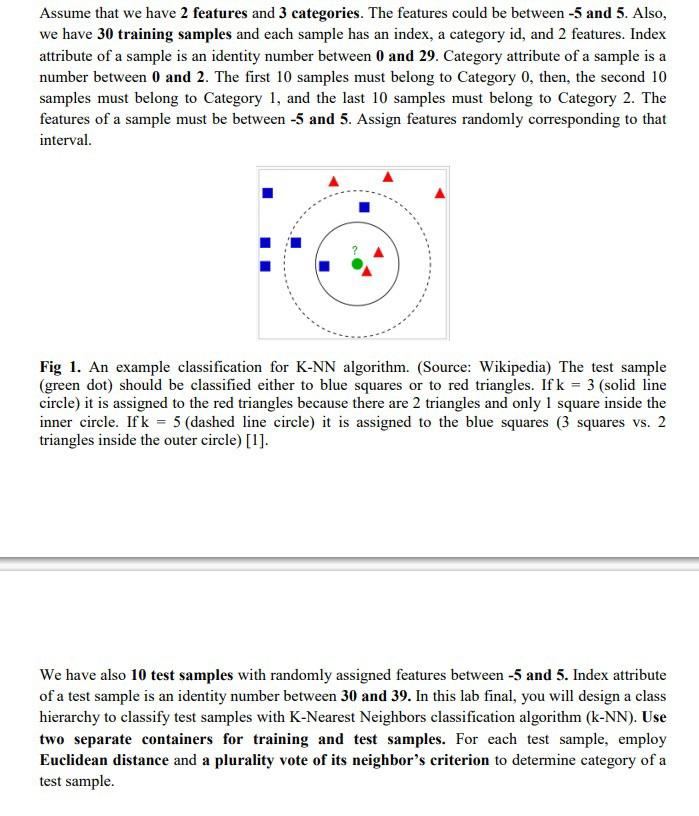
Assume that we have 2 features and 3 categories. The features could be between -5 and 5. Also, we have 30 training samples and each sample has an index, a category id, and 2 features. Index attribute of a sample is an identity number between 0 and 29. Category attribute of a sample is a number between 0 and 2. The first 10 samples must belong to Category 0, then, the second 10 samples must belong to Category 1, and the last 10 samples must belong to Category 2. The features of a sample must be between -5 and 5. Assign features randomly corresponding to that interval. : Fig 1. An example classification for K-NN algorithm. (Source: Wikipedia) The test sample (green dot) should be classified either to blue squares or to red triangles. If k = 3 (solid line circle) it is assigned to the red triangles because there are 2 triangles and only 1 square inside the inner circle. If k = 5 (dashed line circle) it is assigned to the blue squares (3 squares vs. 2 triangles inside the outer circle) [1]. We have also 10 test samples with randomly assigned features between -5 and 5. Index attribute of a test sample is an identity number between 30 and 39. In this lab final, you will design a class hierarchy to classify test samples with K-Nearest Neighbors classification algorithm (k-NN). Use two separate containers for training and test samples. For each test sample, employ Euclidean distance and a plurality vote of its neighbor's criterion to determine category of a test sample
Step by Step Solution
There are 3 Steps involved in it

Get step-by-step solutions from verified subject matter experts
 Study Help