







Question: According to the author what is Problem Solver Profiles (PSPs) . How the five different decision-making archetypes help you in improving decision-making and problem-solving skills?
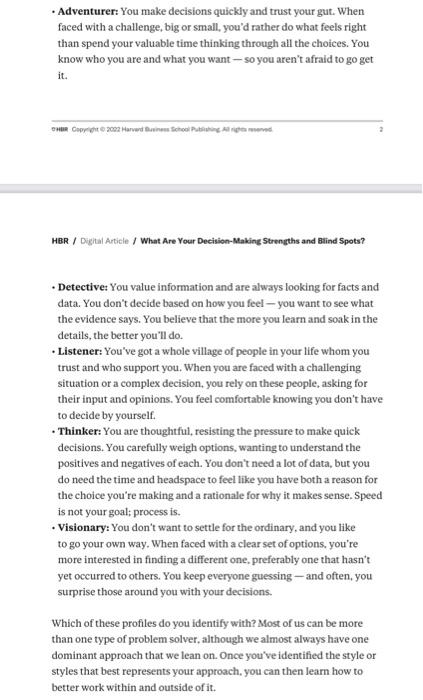
- Adventurer: You make decisions quickly and trust your gut. When faced with a challenge, big or small, you'd rather do what feels right than spend your valuable time thinking through all the choices. You know who you are and what you want - so you aren't afraid to go get it. HBR / Degital Article / What Are Your Decision-Making Strengths and Blind Spots? - Detective+ You value information and are always looking for facts and data. You don't decide based on how you feel - you want to see what the evidence says. You believe that the more you learn and soak in the details, the better you'll do. - Listener: You"ve got a whole village of people in your life whom you trust and who support you. When you are faced with a challenging situation or a complex decision, you rely on these people, asking for their input and opinions. You feel comfortable knowing you don't have to decide by yourself. - Thinker: You are thoughtful, resisting the pressure to make quick decisions. You carefully weigh options, wanting to understand the positives and negatives of each. You don't need a lot of data, but you do need the time and headspace to feel like you have both a reason for the choice you're making and a rationale for why it makes sense. Speed is not your goal; process is. - Visionary: You don't want to settle for the ordinary, and you like to go your own way. When faced with a clear set of options, you're more interested in finding a different one, preferably one that hasn't yet occurred to others. You keep everyone guessing - and often, you surprise those around you with your decisions. Which of these profiles do you identify with? Most of us can be more than one type of problem solver, although we almost always have one dominant approach that we lean on. Once you've identified the style or styles that best represents your approach, you can then learn how to better work within and outside of it. - Adventurer: You make decisions quickly and trust your gut. When faced with a challenge, big or small, you'd rather do what feels right than spend your valuable time thinking through all the choices. You know who you are and what you want - so you aren't afraid to go get it. HBR / Degital Article / What Are Your Decision-Making Strengths and Blind Spots? - Detective+ You value information and are always looking for facts and data. You don't decide based on how you feel - you want to see what the evidence says. You believe that the more you learn and soak in the details, the better you'll do. - Listener: You"ve got a whole village of people in your life whom you trust and who support you. When you are faced with a challenging situation or a complex decision, you rely on these people, asking for their input and opinions. You feel comfortable knowing you don't have to decide by yourself. - Thinker: You are thoughtful, resisting the pressure to make quick decisions. You carefully weigh options, wanting to understand the positives and negatives of each. You don't need a lot of data, but you do need the time and headspace to feel like you have both a reason for the choice you're making and a rationale for why it makes sense. Speed is not your goal; process is. - Visionary: You don't want to settle for the ordinary, and you like to go your own way. When faced with a clear set of options, you're more interested in finding a different one, preferably one that hasn't yet occurred to others. You keep everyone guessing - and often, you surprise those around you with your decisions. Which of these profiles do you identify with? Most of us can be more than one type of problem solver, although we almost always have one dominant approach that we lean on. Once you've identified the style or styles that best represents your approach, you can then learn how to better work within and outside of it
Step by Step Solution
There are 3 Steps involved in it

Get step-by-step solutions from verified subject matter experts
 Study Help