Question: According to the information written below, explain how this life-cycle management tool will improve the organization's sustainability? This should be an applied discussion-please write a
According to the information written below, explain how this life-cycle management tool will improve the organization's sustainability? This should be an applied discussion-please write a specific explanation.
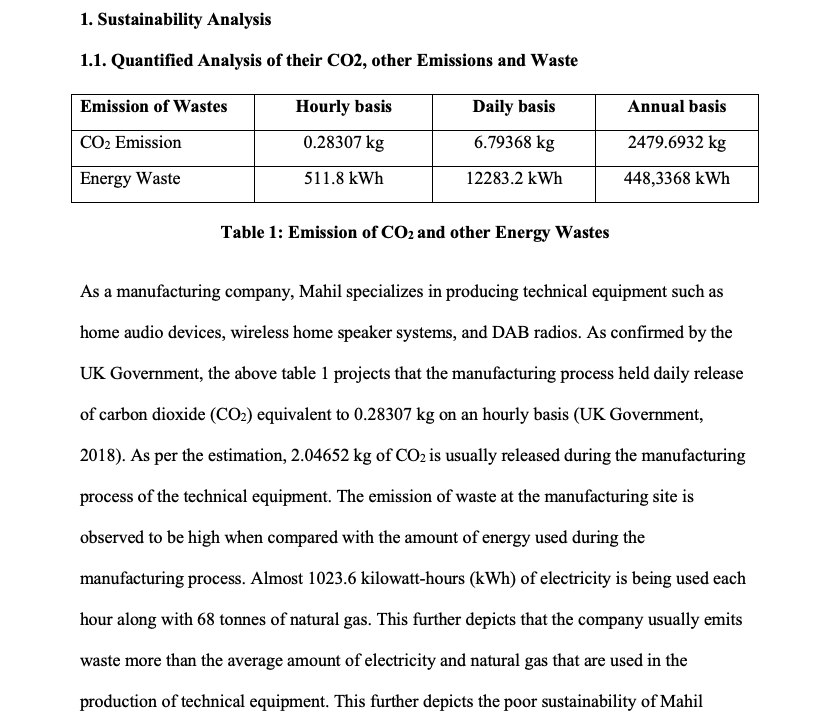
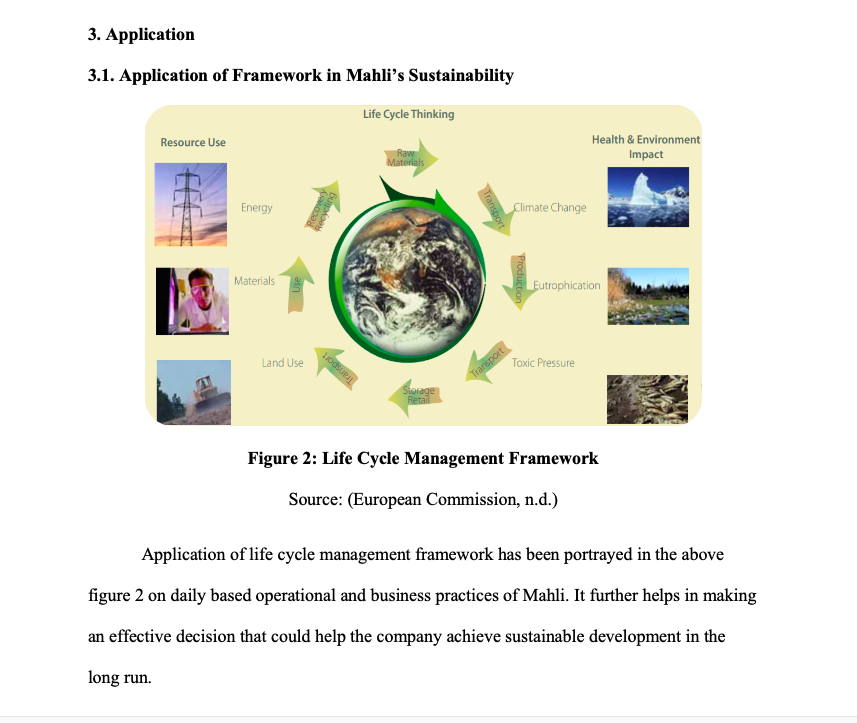
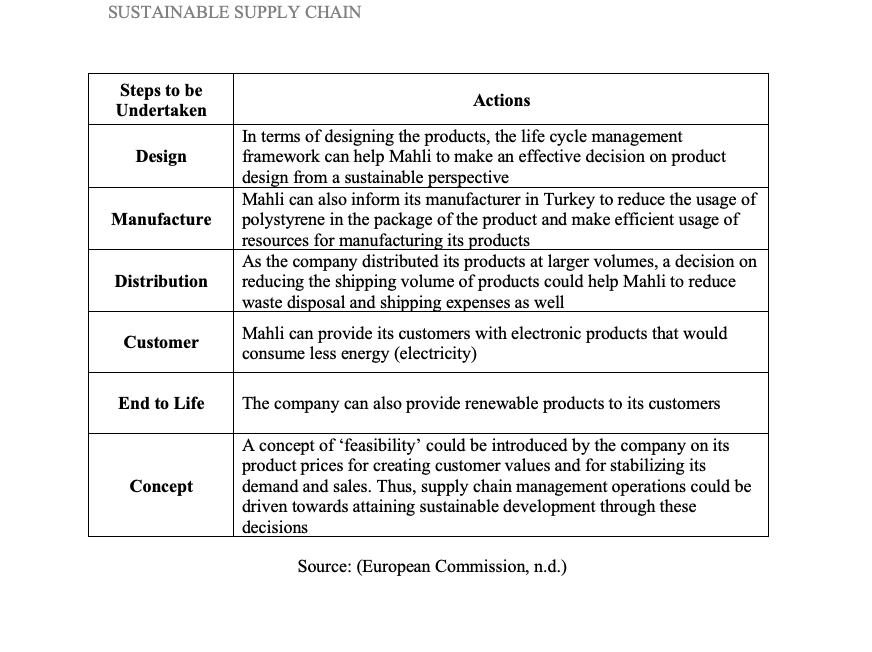
1. Sustainability Analysis 1.1. Quantified Analysis of their CO2, other Emissions and Waste Emission of Wastes Hourly basis Daily basis Annual basis CO2 Emission 0.28307 kg 6.79368 kg 2479.6932 kg 448,3368 kWh Energy Waste 511.8 kWh 12283.2 kWh Table 1: Emission of CO2 and other Energy Wastes As a manufacturing company, Mahil specializes in producing technical equipment such as home audio devices, wireless home speaker systems, and DAB radios. As confirmed by the UK Government, the above table 1 projects that the manufacturing process held daily release of carbon dioxide (CO2) equivalent to 0.28307 kg on an hourly basis (UK Government, 2018). As per the estimation, 2.04652 kg of CO2 is usually released during the manufacturing process of the technical equipment. The emission of waste at the manufacturing site is observed to be high when compared with the amount of energy used during the manufacturing process. Almost 1023.6 kilowatt-hours (kWh) of electricity is being used each hour along with 68 tonnes of natural gas. This further depicts that the company usually emits waste more than the average amount of electricity and natural gas that are used in the production of technical equipment. This further depicts the poor sustainability of Mahil 1.2. Discussion of Social Impacts Due to negligence on compliance of Waste Electrical and Electronic Equipment (WEEE) legislation under its operational activities i.e. manufacturing process of its products along with developing and implementing sustainable strategies on controlling the emission of CO2, electricity, and natural gases, Mahli's reputation have been greatly affected at the moment. Lack of compliance of WEEE has also delivered a negative impact on its relationship with its Page 3 SUSTAINABLE SUPPLY CHAIN suppliers, as it has become hostile. Poor ethical practices of the company's suppliers such as child labor practices, poor health of the workers, and low wage payment to the workers have Implementing the triple bottom line framework portrayed in the above figure 1 in the provided case study findings, it is observed that Mahli currently faces a major problem in stabilizing the business as well as social environment due to the lack of sustainable standard practices within its supply chain management. It has also resulted in poor business outcomes such as lack of Mahli's ability to generate profit or return on investments and the inability to make a business deal with the company's major automotive manufacturers. Positioning the company in the target market is currently hard for the company with respect to attaining an Implementing the triple bottom line framework portrayed in the above figure 1 in the provided case study findings, it is observed that Mahli currently faces a major problem in stabilizing the business as well as social environment due to the lack of sustainable standard practices within its supply chain management. It has also resulted in poor business outcomes such as lack of Mahli's ability to generate profit or return on investments and the inability to make a business deal with the company's major automotive manufacturers. Positioning the company in the target market is currently hard for the company with respect to attaining an increment in the product prices and competitiveness at the same time. As the company's manufacturing function is located in Turkey, a lower economy along with lower availability of labor and transport systems in the operating location could be portrayed as the social aspects that have greatly affected the company's sustainability. The absence of quality management systems (QMS) i.e. ISO 9001 certification in Turkey also falls under the major social factors that have created a negative impact on Mahli's ability to attain sustainability. 2. Benchmarking 3. Application 3.1. Application of Framework in Mahli's Sustainability Life Cycle Thinking Resource Use Health & Environment Impact Materials Energy Transpor Climate Change npoid Materials Eutrophication U Land Use odsue Toxic Pressure Transpor Figure 2: Life Cycle Management Framework Source: (European Commission, n.d.) Application of life cycle management framework has been portrayed in the above figure 2 on daily based operational and business practices of Mahli. It further helps in making an effective decision that could help the company achieve sustainable development in the long run. SUSTAINABLE SUPPLY CHAIN Steps to be Undertaken Actions Design Manufacture In terms of designing the products, the life cycle management framework can help Mahli to make an effective decision on product design from a sustainable perspective Mahli can also inform its manufacturer in Turkey to reduce the usage of polystyrene in the package of the product and make efficient usage of resources for manufacturing its products As the company distributed its products at larger volumes, a decision on reducing the shipping volume of products could help Mahli to reduce waste disposal and shipping expenses as well Mahli can provide its customers with electronic products that would consume less energy (electricity) Distribution Customer End to Life The company can also provide renewable products to its customers Concept A concept of 'feasibility' could be introduced by the company on its product prices for creating customer values and for stabilizing its demand and sales. Thus, supply chain management operations could be driven towards attaining sustainable development through these decisions Source: (European Commission, n.d.)









 Study Help