







Question: According to the notation that we have seen while covering the Tomography topic, a forward projection (FP) is defined as: P.(r) = FP{f(x,y)} L(r
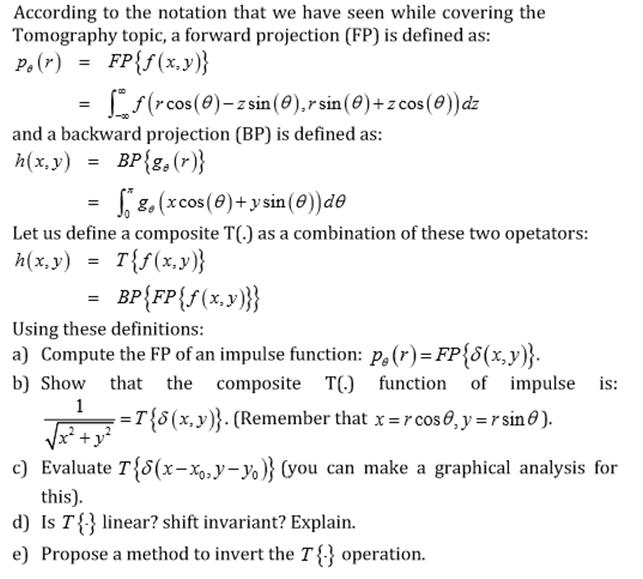
According to the notation that we have seen while covering the Tomography topic, a forward projection (FP) is defined as: P.(r) = FP{f(x,y)} L(r cos(0)-z sin (0),r sin(e)+z cos (0))dz and a backward projection (BP) is defined as: h(x,y) = BP{g, ()} S s.(xcos(0)+ysin (6))de Let us define a composite T(.) as a combination of these two opetators: h(x, y) T{f(x,y)} BP{FP{f(x.y}} Using these definitions: a) Compute the FP of an impulse function: p,(r)= FP{8(x, y)}. b) Show that the composite T() function of impulse is: =T{8(x,y)}. (Remember that x=r cos 0, y =r sin 6). c) Evaluate T{8(x-x,,y-yo)} (you can make a graphical analysis for this). d) Is T{} linear? shift invariant? Explain. e) Propose a method to invert the T{} operation.
Step by Step Solution
3.46 Rating (159 Votes )
There are 3 Steps involved in it
To solve this problem lets go through each part stepbystep a Compute the FP of an impulse function pthetar FP deltaxy Solution The forward projection ... View full answer

Get step-by-step solutions from verified subject matter experts
 Study Help