Question: According to the three pictures provided please answer the 2 question .Answer them in 700 words please help teachers . Take some help from google
According to the three pictures provided please answer the 2 question .Answer them in 700 words please help teachers . Take some help from google
Please read the case carefully and answer the question . Please make sure plagiarism should not come . Use your skills please and provide good answer teachers .
This is the question of subject Introduction to Business Case Analysis .
Questions -
- Describe the practice of showrooming and state its impact on BestBuy sales.
- Describe BestBuy competitive advantage over Amazon and state the impact of the millennial customer segment on the growth of Amazon.
CASE TOPIC - Best Buy: Creating a Winning Customer Experience in Consumer Electronics
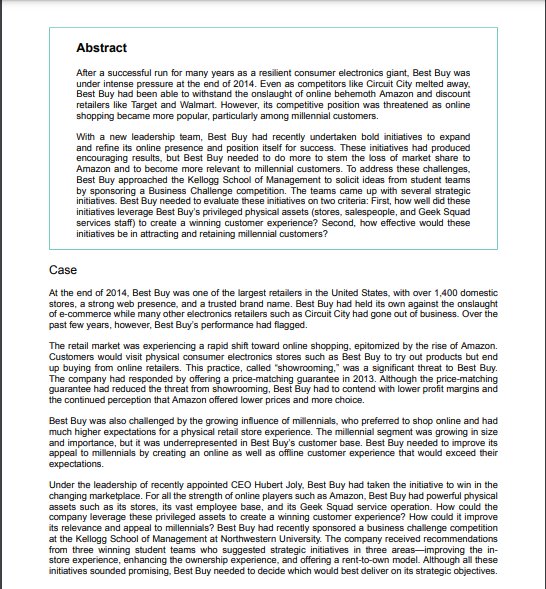
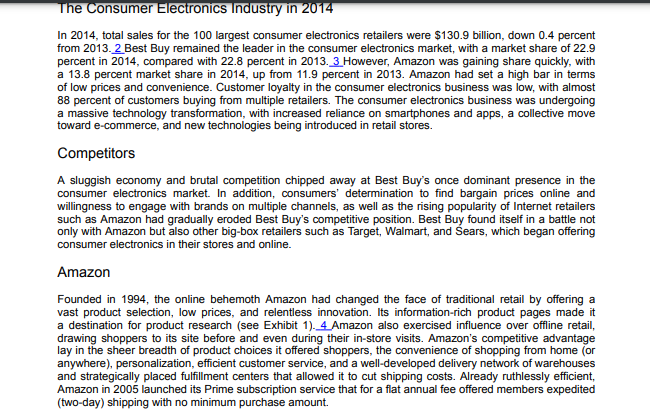
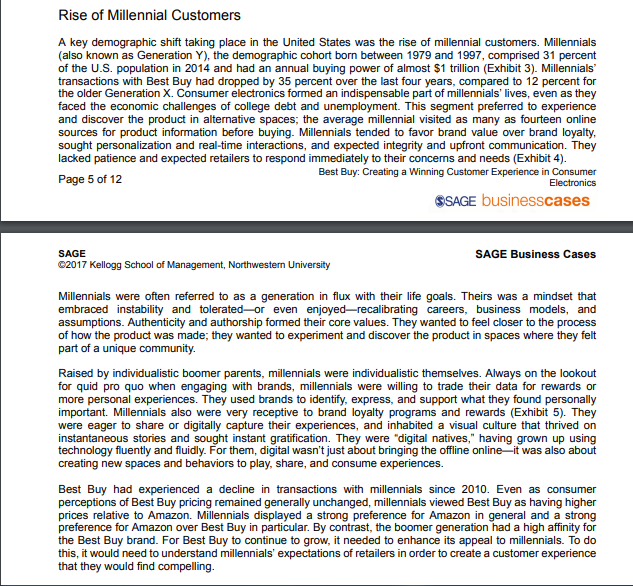
Abstract After a successful run for many years as a resilient consumer electronics giant, Best Buy was under intense pressure at the end of 2014. Even as competitors like Circuit City melted away, Best Buy had been able to withstand the onslaught of online behemoth Amazon and discount retailers like Target and Walmart. However, its competitive position was threatened as online shopping became more popular, particularly among millennial customers. With a new leadership team, Best Buy had recently undertaken bold initiatives to expand and refine its online presence and position itself for success. These initiatives had produced encouraging results, but Best Buy needed to do more to stem the loss of market share to Amazon and to become more relevant to millennial customers. To address these challenges, Best Buy approached the Kellogg School of Management to solicit ideas from student teams by sponsoring a Business Challenge competition. The teams came up with several strategic initiatives. Best Buy needed to evaluate these initiatives on two criteria: First, how well did these initiatives leverage Best Buy's privileged physical assets (stores, salespeople, and Geek Squad services staff) to create a winning customer experience? Second, how effective would these initiatives be in attracting and retaining millennial customers? Case At the end of 2014, Best Buy was one of the largest retailers in the United States, with over 1,400 domestic stores, a strong web presence, and a trusted brand name. Best Buy had held its own against the onslaught of e-commerce while many other electronics retailers such as Circuit City had gone out of business. Over the past few years, however, Best Buy's performance had flagged. The retail market was experiencing a rapid shift toward online shopping, epitomized by the rise of Amazon. Customers would visit physical consumer electronics stores such as Best Buy to try out products but end up buying from online retailers. This practice, called "showrooming," was a significant threat to Best Buy. The company had responded by offering a price-matching guarantee in 2013. Although the price-matching guarantee had reduced the threat from showrooming, Best Buy had to contend with lower profit margins and the continued perception that Amazon offered lower prices and more choice. Best Buy was also challenged by the growing influence of millennials, who preferred to shop online and had much higher expectations for a physical retail store experience. The millennial segment was growing in size and importance, but it was underrepresented in Best Buy's customer base. Best Buy needed to improve its appeal to millennials by creating an online as well as offline customer experience that would exceed their expectations. Under the leadership of recently appointed CEO Hubert Joly, Best Buy had taken the initiative to win in the changing marketplace. For all the strength of online players such as Amazon, Best Buy had powerful physical assets such as its stores, its vast employee base, and its Geek Squad service operation. How could the company leverage these privileged assets to create a winning customer experience? How could it improve its relevance and appeal to millennials? Best Buy had recently sponsored a business challenge competition at the Kellogg School of Management at Northwestern University. The company received recommendations from three winning student teams who suggested strategic initiatives in three areasimproving the in- store experience, enhancing the ownership experience, and offering a rent-to-own model. Although all these initiatives sounded promising. Best Buy needed to decide which would best deliver on its strategic objectives. The Consumer Electronics Industry in 2014 In 2014, total sales for the 100 largest consumer electronics retailers were $130.9 billion, down 0.4 percent from 2013. 2 Best Buy remained the leader in the consumer electronics market, with a market share of 22.9 percent in 2014, compared with 22.8 percent in 2013. 3. However, Amazon was gaining share quickly, with a 13.8 percent market share in 2014, up from 11.9 percent in 2013. Amazon had set a high bar in terms of low prices and convenience. Customer loyalty in the consumer electronics business was low, with almost 88 percent of customers buying from multiple retailers. The consumer electronics business was undergoing a massive technology transformation, with increased reliance on smartphones and apps, a collective move toward e-commerce, and new technologies being introduced in retail stores. Competitors A sluggish economy and brutal competition chipped away at Best Buy's once dominant presence in the consumer electronics market. In addition, consumers' determination to find bargain prices online and willingness to engage with brands on multiple channels, as well as the rising popularity of Internet retailers such as Amazon had gradually eroded Best Buy's competitive position. Best Buy found itself in a battle not only with Amazon but also other big-box retailers such as Target, Walmart, and Sears, which began offering consumer electronics in their stores and online. Amazon Founded in 1994, the online behemoth Amazon had changed the face of traditional retail by offering a vast product selection, low prices, and relentless innovation. Its information-rich product pages made it a destination for product research (see Exhibit 1). 4 Amazon also exercised influence over offline retail, drawing shoppers to its site before and even during their in-store visits. Amazon's competitive advantage lay in the sheer breadth of product choices it offered shoppers, the convenience of shopping from home (or anywhere), personalization, efficient customer service, and a well-developed delivery network of warehouses and strategically placed fulfillment centers that allowed it to cut shipping costs. Already ruthlessly efficient, Amazon in 2005 launched its Prime subscription service that for a flat annual fee offered members expedited (two-day) shipping with no minimum purchase amount. Rise of Millennial Customers A key demographic shift taking place in the United States was the rise of millennial customers. Millennials (also known as Generation Y), the demographic cohort born between 1979 and 1997, comprised 31 percent of the U.S. population in 2014 and had an annual buying power of almost $1 trillion (Exhibit 3). Millennials transactions with Best Buy had dropped by 35 percent over the last four years, compared to 12 percent for the older Generation X. Consumer electronics formed an indispensable part of millennials' lives, even as they faced the economic challenges of college debt and unemployment. This segment preferred to experience and discover the product in alternative spaces; the average millennial visited as many as fourteen online sources for product information before buying. Millennials tended to favor brand value over brand loyalty, sought personalization and real-time interactions, and expected integrity and upfront communication. They lacked patience and expected retailers to respond immediately to their concerns and needs (Exhibit 4). Page 5 of 12 Best Buy: Creating a Winning Customer Experience in Consumer Electronics SSAGE businesscases SAGE 2017 Kellogg School of Management, Northwestern University SAGE Business Cases Millennials were often referred to as a generation in flux with their life goals. Theirs was a mindset that embraced instability and toleratedor even enjoyedrecalibrating careers, business models, and assumptions. Authenticity and authorship formed their core values. They wanted to feel closer to the process of how the product was made; they wanted to experiment and discover the product in spaces where they felt part of a unique community. Raised by individualistic boomer parents, millennials were individualistic themselves. Always on the lookout for quid pro quo when engaging with brands, millennials were willing to trade their data for rewards or more personal experiences. They used brands to identify, express, and support what they found personally important. Millennials also were very receptive to brand loyalty programs and rewards (Exhibit 5). They were eager to share or digitally capture their experiences, and inhabited a visual culture that thrived on instantaneous stories and sought instant gratification. They were "digital natives," having grown up using technology fluently and fluidly. For them, digital wasn't just about bringing the offline online it was also about creating new spaces and behaviors to play, share, and consume experiences. Best Buy had experienced a decline in transactions with millennials since 2010. Even as consumer perceptions of Best Buy pricing remained generally unchanged, millennials viewed Best Buy as having higher prices relative to Amazon. Millennials displayed a strong preference for Amazon in general and a strong preference for Amazon over Best Buy in particular. By contrast, the boomer generation had a high affinity for the Best Buy brand. For Best Buy to continue to grow, it needed to enhance its appeal to millennials. To do this, it would need to understand millennials' expectations of retailers in order to create a customer experience that they would find compelling




