



Question: 4. We applied the Solow model to make predictions about the accumulation of capital per worker (hour) kt = Kt/Nt and output per worker
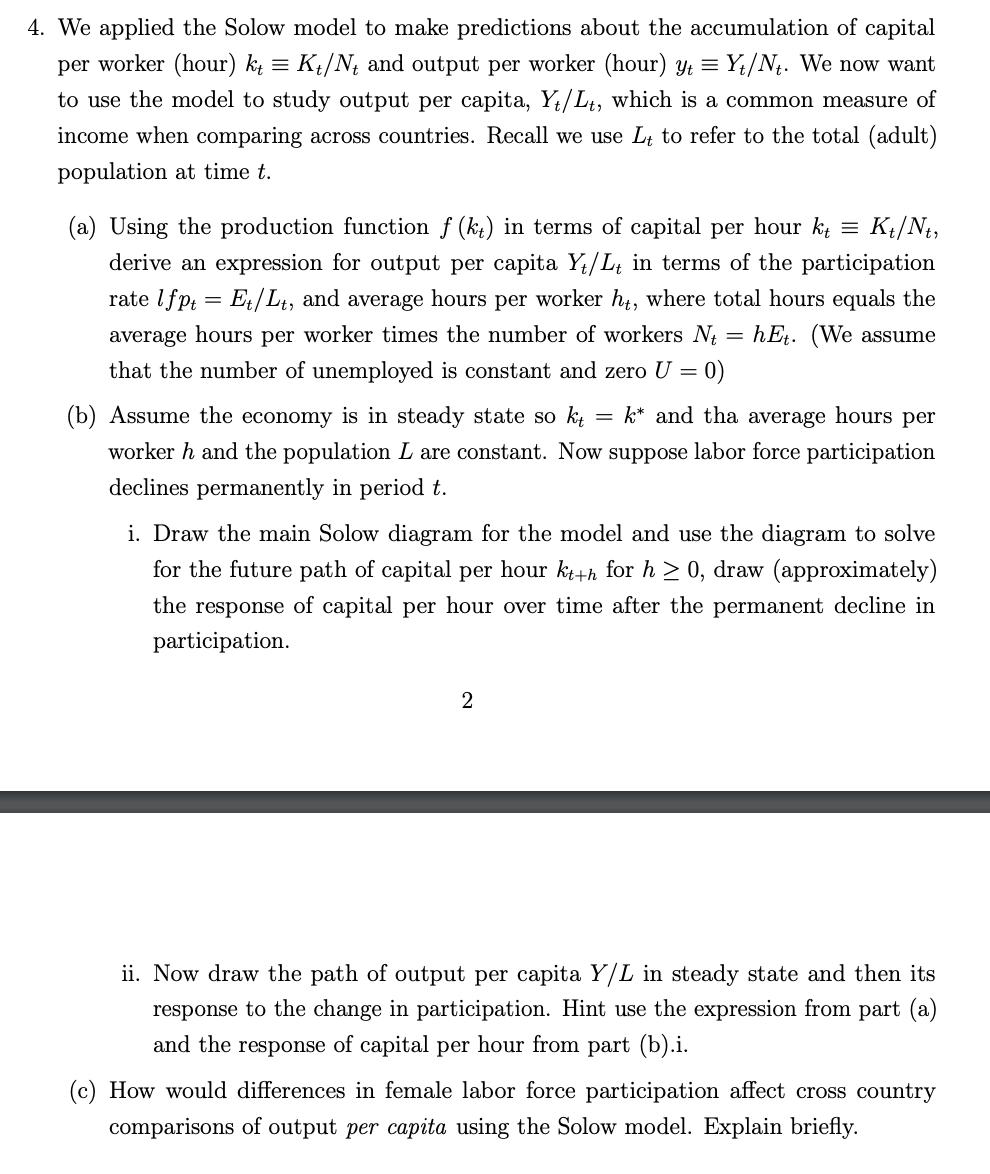
4. We applied the Solow model to make predictions about the accumulation of capital per worker (hour) kt = Kt/Nt and output per worker (hour) yt = Y/Nt. We now want to use the model to study output per capita, Yt/Lt, which is a common measure of income when comparing across countries. Recall we use Lt to refer to the total (adult) population at time t. (a) Using the production function f (kt) in terms of capital per hour kt Kt/Nt, derive an expression for output per capita Yt/Lt in terms of the participation rate lfpt = Et/Lt, and average hours per worker he, where total hours equals the average hours per worker times the number of workers N hEt. (We assume that the number of unemployed is constant and zero U = 0) (b) Assume the economy is in steady state so kt = k* and tha average hours per worker h and the population L are constant. Now suppose labor force participation declines permanently in period t. = i. Draw the main Solow diagram for the model and use the diagram to solve for the future path of capital per hour kt+h for h 0, draw (approximately) the response of capital per hour over time after the permanent decline in participation. 2 ii. Now draw the path of output per capita Y/L in steady state and then its response to the change in participation. Hint use the expression from part (a) and the response of capital per hour from part (b).i. (c) How would differences in female labor force participation affect cross country comparisons of output per capita using the Solow model. Explain briefly.
Step by Step Solution
3.45 Rating (158 Votes )
There are 3 Steps involved in it
Answer is option C bec... View full answer

Get step-by-step solutions from verified subject matter experts