







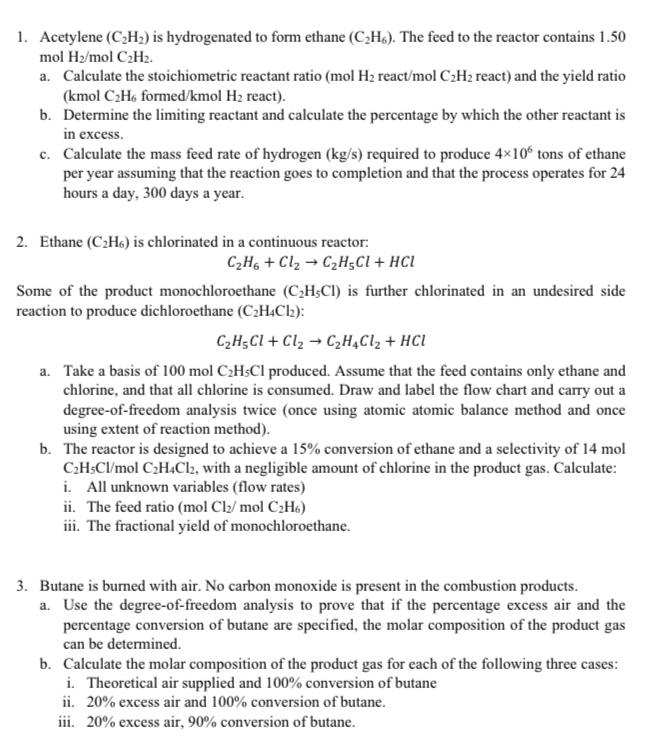
Question: Acetylene ( C 2 H 2 ) is hydrogenated to form ethane ( C 2 H 6 ) . The feed to the reactor contains
Acetylene is hydrogenated to form ethane The feed to the reactor contains mol
a Calculate the stoichiometric reactant ratio react react and the yield ratio formed react
b Determine the limiting reactant and calculate the percentage by which the other reactant is in excess.
c Calculate the mass feed rate of hydrogen required to produce tons of ethane per year assuming that the reaction goes to completion and that the process operates for hours a day, days a year.
Ethane is chlorinated in a continuous reactor:
Some of the product monochloroethane is further chlorinated in an undesired side reaction to produce dichloroethane :
a Take a basis of produced. Assume that the feed contains only ethane and chlorine, and that all chlorine is consumed. Draw and label the flow chart and carry out a degreeoffreedom analysis twice once using atomic atomic balance method and once using extent of reaction method
b The reactor is designed to achieve a conversion of ethane and a selectivity of mol with a negligible amount of chlorine in the product gas. Calculate:
i All unknown variables flow rates
ii The feed ratio molC
iii. The fractional yield of monochloroethane.
Butane is burned with air. No carbon monoxide is present in the combustion products.
a Use the degreeoffreedom analysis to prove that if the percentage excess air and the percentage conversion of butane are specified, the molar composition of the product gas can be determined.
b Calculate the molar composition of the product gas for each of the following three cases:
i Theoretical air supplied and conversion of butane
ii excess air and conversion of butane.
iii. excess air, conversion of butane.
Step by Step Solution
There are 3 Steps involved in it
1 Expert Approved Answer
Step: 1 Unlock

Question Has Been Solved by an Expert!
Get step-by-step solutions from verified subject matter experts
Step: 2 Unlock
Step: 3 Unlock
 Study Help