







Question: achieve.macmillanlearning.com Untitled Making Scatterplot Linea.. Bb https://learn-us-east-1-p.. G r2=0.8536 - Google Sear. Course Hero gnment Score: 22.2% Ly Give Up? Check Answer estion 2 of
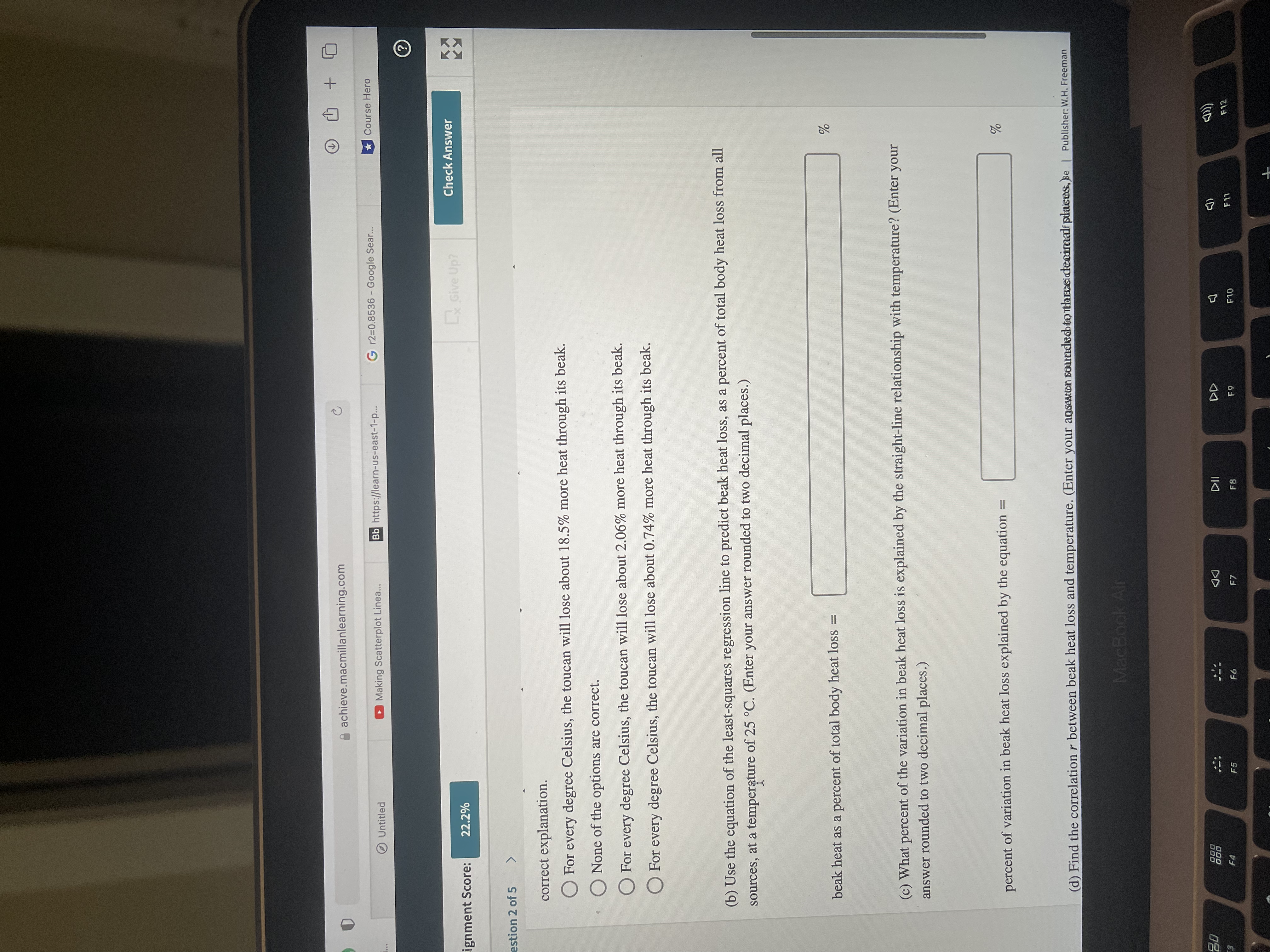
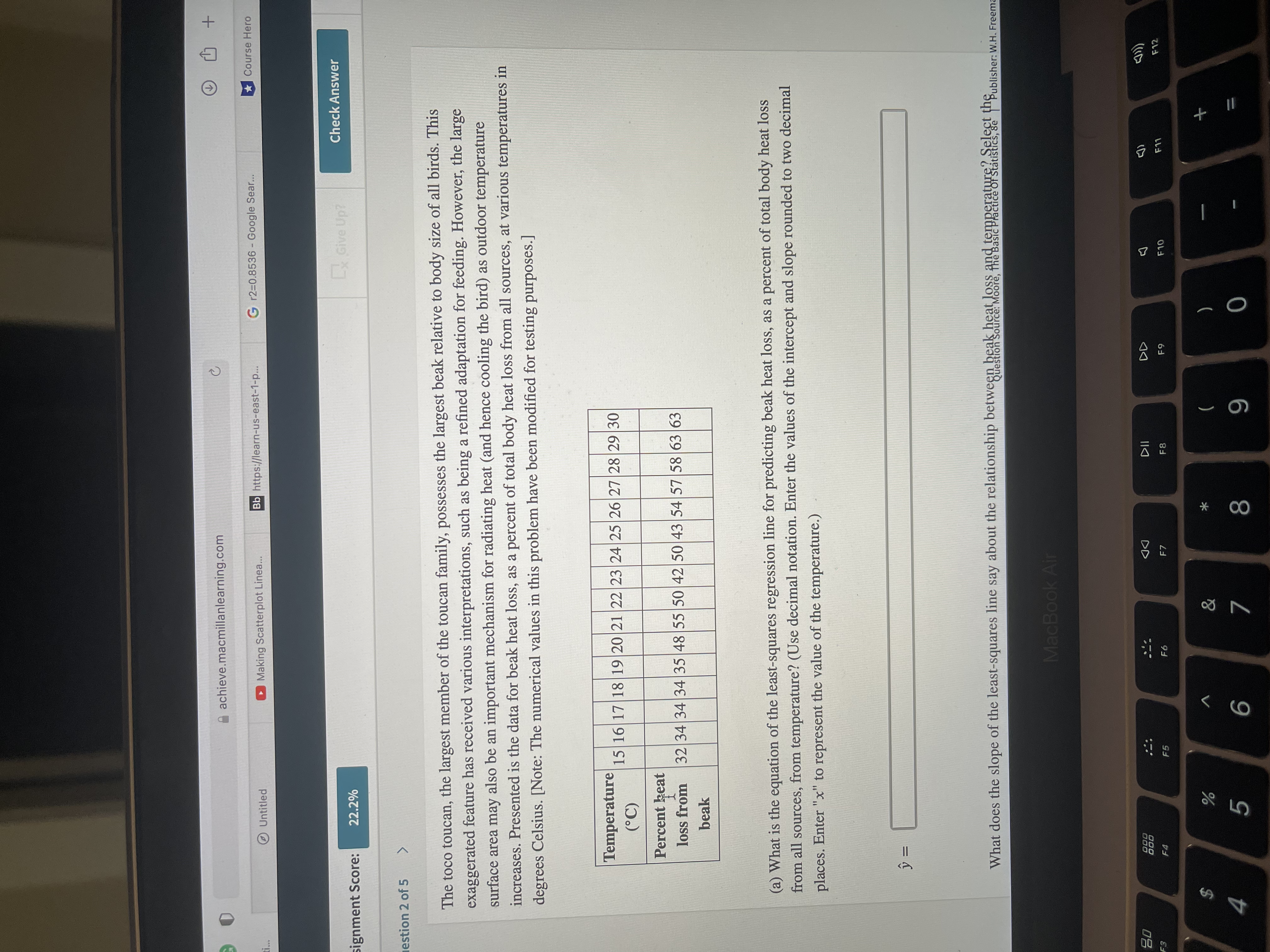
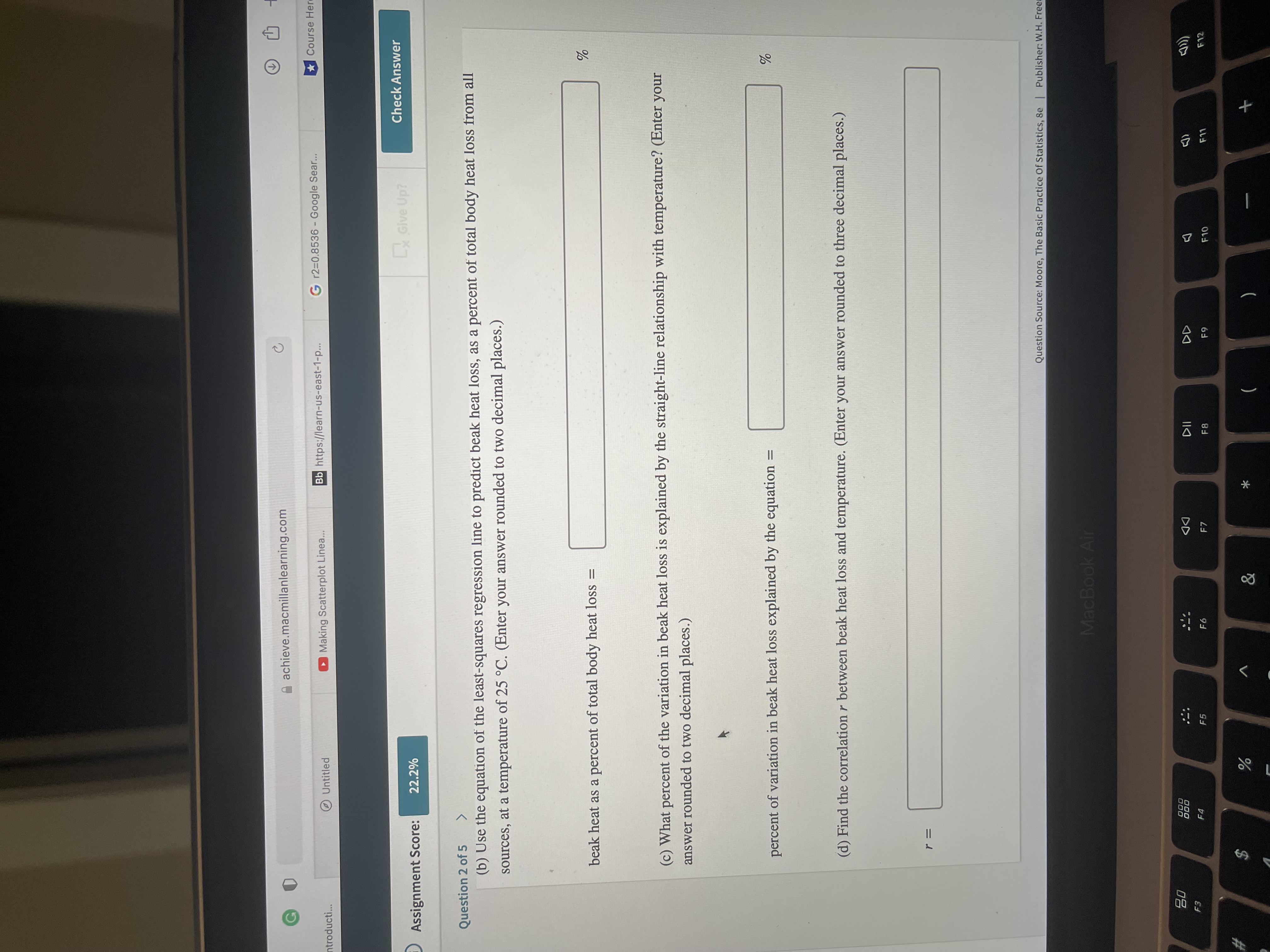
achieve.macmillanlearning.com Untitled Making Scatterplot Linea.. Bb https://learn-us-east-1-p.. G r2=0.8536 - Google Sear. Course Hero gnment Score: 22.2% Ly Give Up? Check Answer estion 2 of 5 > correct explanation. O For every degree Celsius, the toucan will lose about 18.5% more heat through its beak. O None of the options are correct For every degree Celsius, the toucan will lose about 2.06% more heat through its beak. O For every degree Celsius, the toucan will lose about 0.74% more heat through its beak. (b) Use the equation of the least-squares regression line to predict beak heat loss, as a percent of total body heat loss from all sources, at a temperature of 25 .C. (Enter your answer rounded to two decimal places.) beak heat as a percent of total body heat loss = (c) What percent of the variation in beak heat loss is explained by the straight-line relationship with temperature? (Enter your answer rounded to two decimal places.) percent of variation in beak heat loss explained by the equation = (d) Find the correlation r between beak heat loss and temperature. (Enter your ansaston soundeobto Th ideoamalf places, Be | Publisher: W.H. Freeman MacBook Air F12achieve.macmillanlearning.com + Untitled Making Scatterplot Linea... Bb https://learn-us-east-1-p. G r2=0.8536 - Google Sear.. Course Hero Ly Give Up? Check Answer ignment Score: 22.2% estion 2 of 5 > The toco toucan, the largest member of the toucan family, possesses the largest beak relative to body size of all birds. This exaggerated feature has received various interpretations, such as being a refined adaptation for feeding. However, the large surface area may also be an important mechanism for radiating heat (and hence cooling the bird) as outdoor temperature increases. Presented is the data for beak heat loss, as a percent of total body heat loss from all sources, at various temperatures in degrees Celsius. [Note: The numerical values in this problem have been modified for testing purposes.] Temperature 15 16 17 18 19 20 21 22 23 24 25 26 27 28 29 30 (.C) Percent heat loss from 32 34 34 34 35 48 55 50 42 50 43 54 57 58 63 63 beak (a) What is the equation of the least-squares regression line for predicting beak heat loss, as a percent of total body heat loss from all sources, from temperature? (Use decimal notation. Enter the values of the intercept and slope rounded to two decimal places. Enter "x" to represent the value of the temperature.) y = What does the slope of the least-squares line say about the relationship between beak heat loss " gaelpactderby Statistics de Publisher: W.H. Freema MacBook Air E6 * (b) Use the equation of the least-squares regression line to predict beak heat loss, as a percent of total body heat loss from all sources, at a temperature of 25 .C. (Enter your answer rounded to two decimal places.) beak heat as a percent of total body heat loss = (c) What percent of the variation in beak heat loss is explained by the straight-line relationship with temperature? (Enter your answer rounded to two decimal places.) percent of variation in beak heat loss explained by the equation = (d) Find the correlation r between beak heat loss and temperature. (Enter your answer rounded to three decimal places.) r = Question Source: Moore, The Basic Practice Of Statistics, 8e | Publisher: W.H. Free MacBook Air F10 F11 *
Step by Step Solution
There are 3 Steps involved in it

Get step-by-step solutions from verified subject matter experts
 Study Help