Question: Acknowle In the case below, the original source material is given along with a sample of student work. Determine the type of plagiarism by clicking
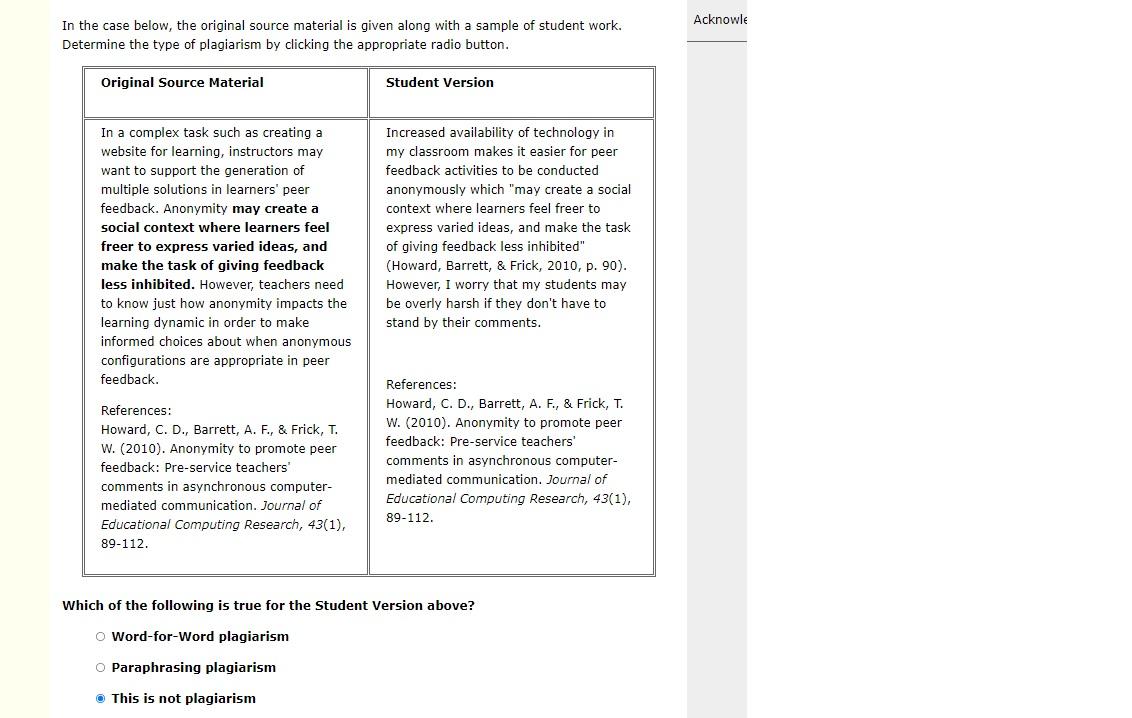
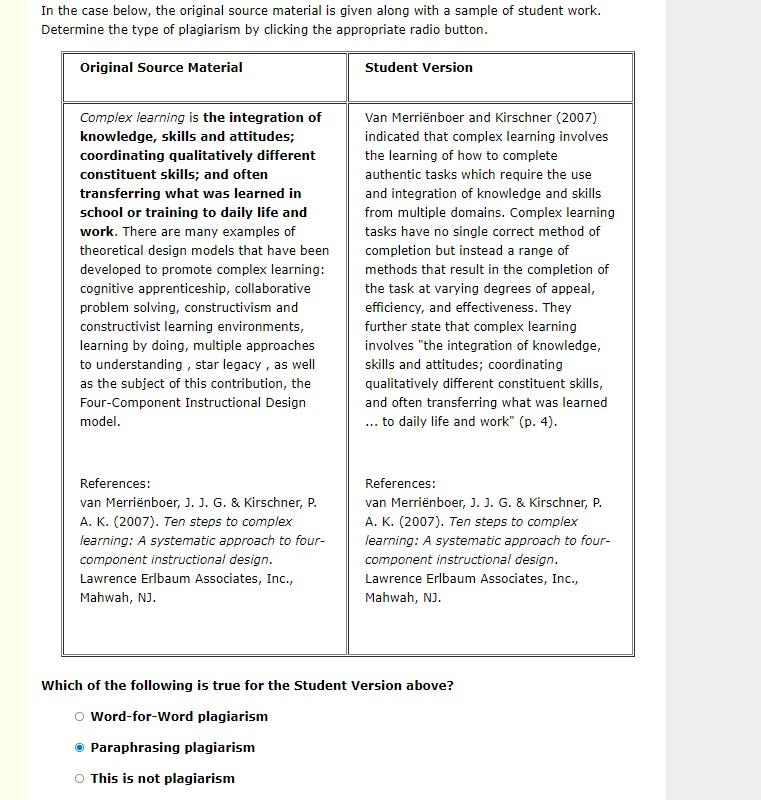
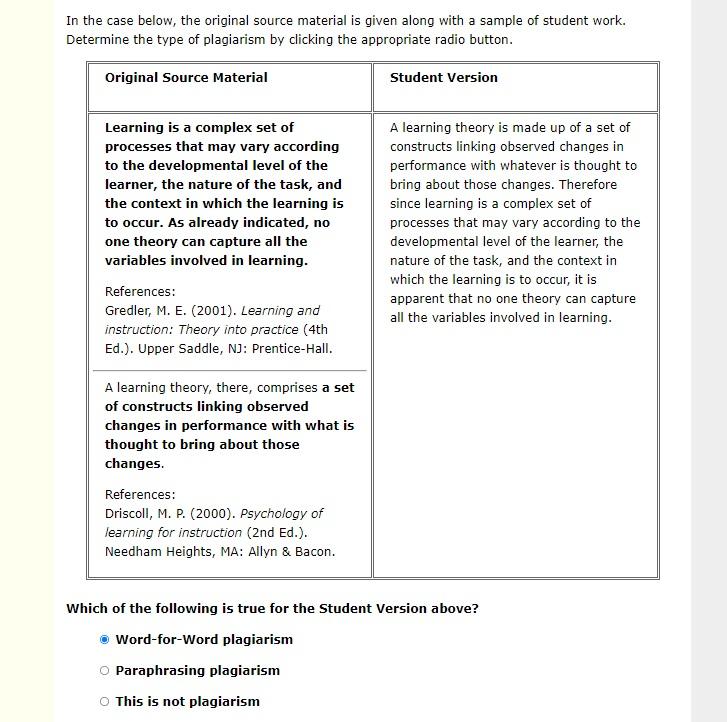
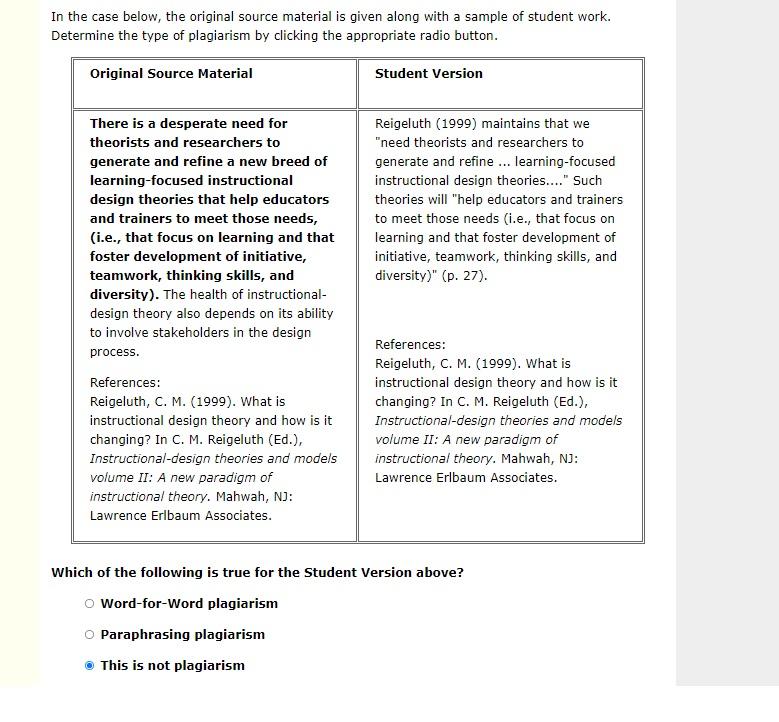
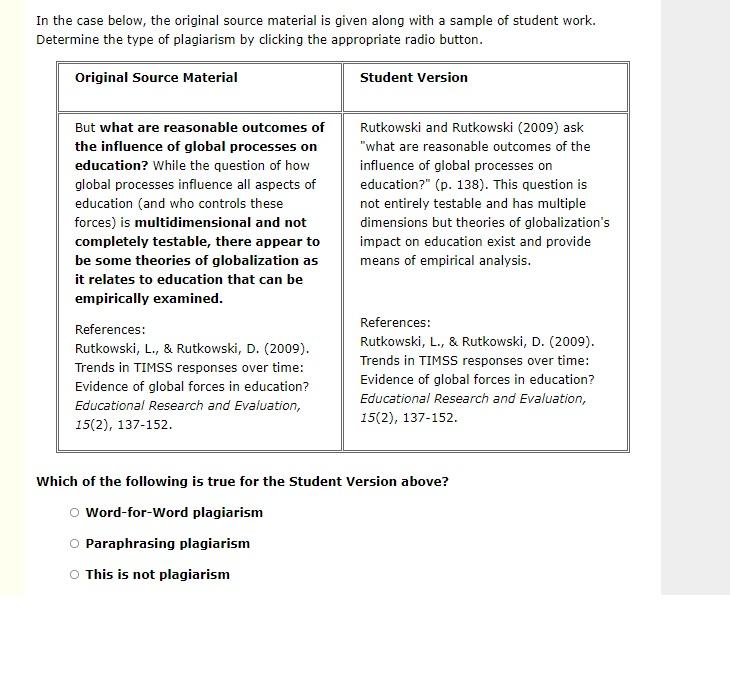
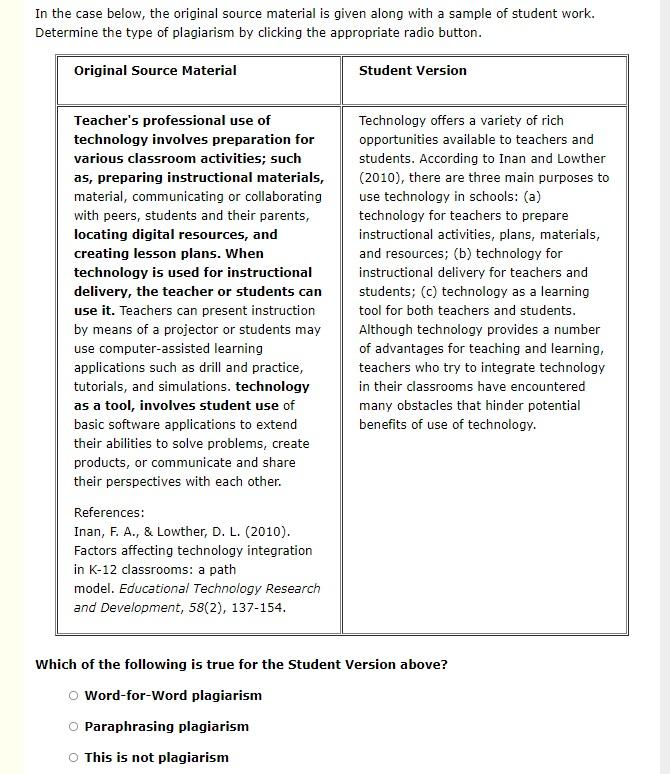
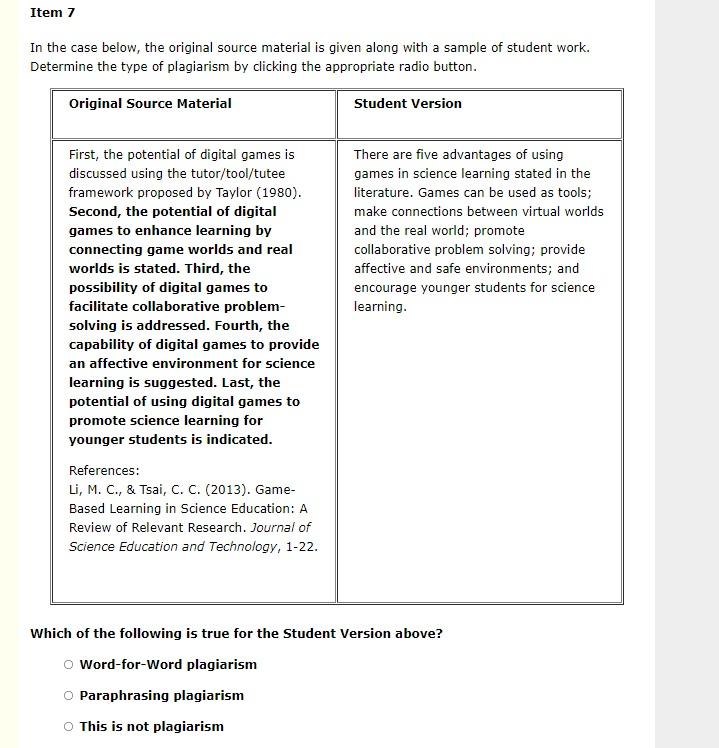
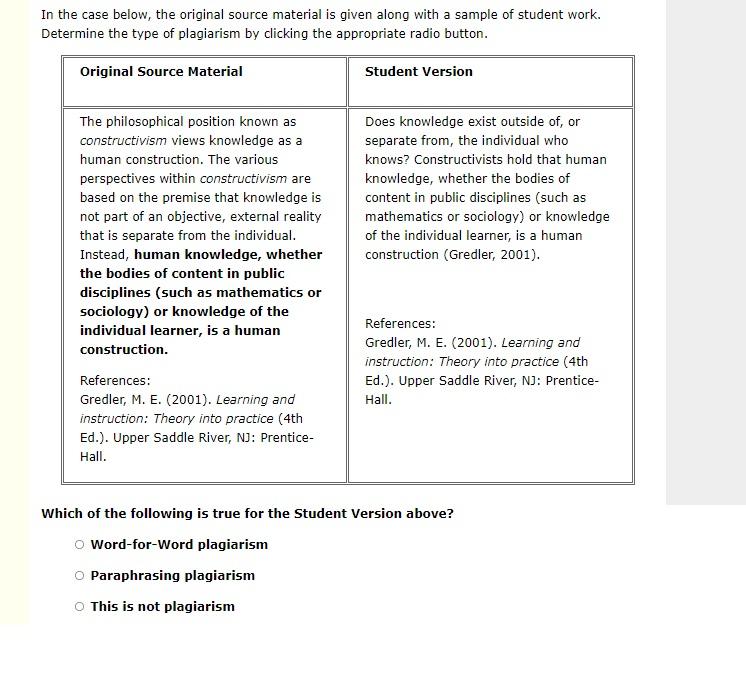
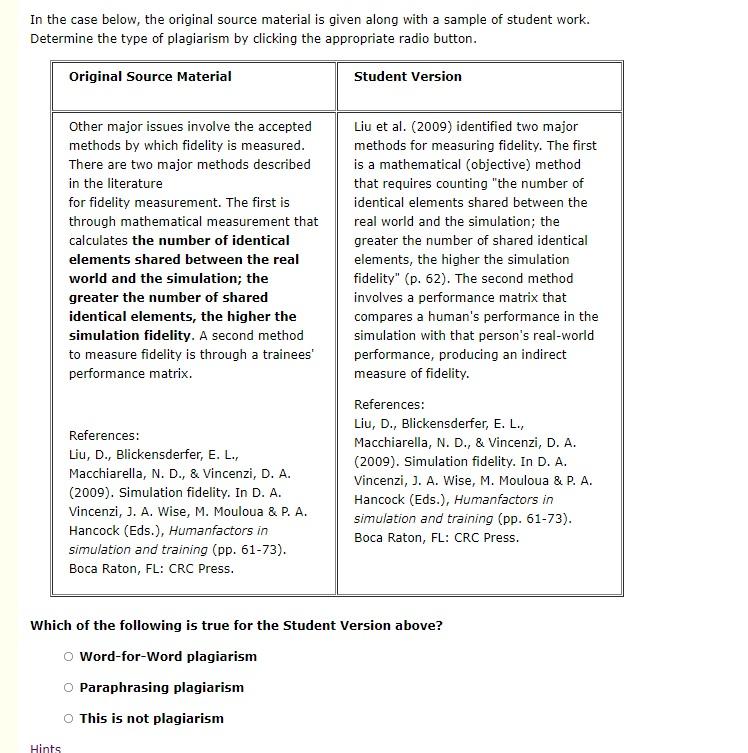
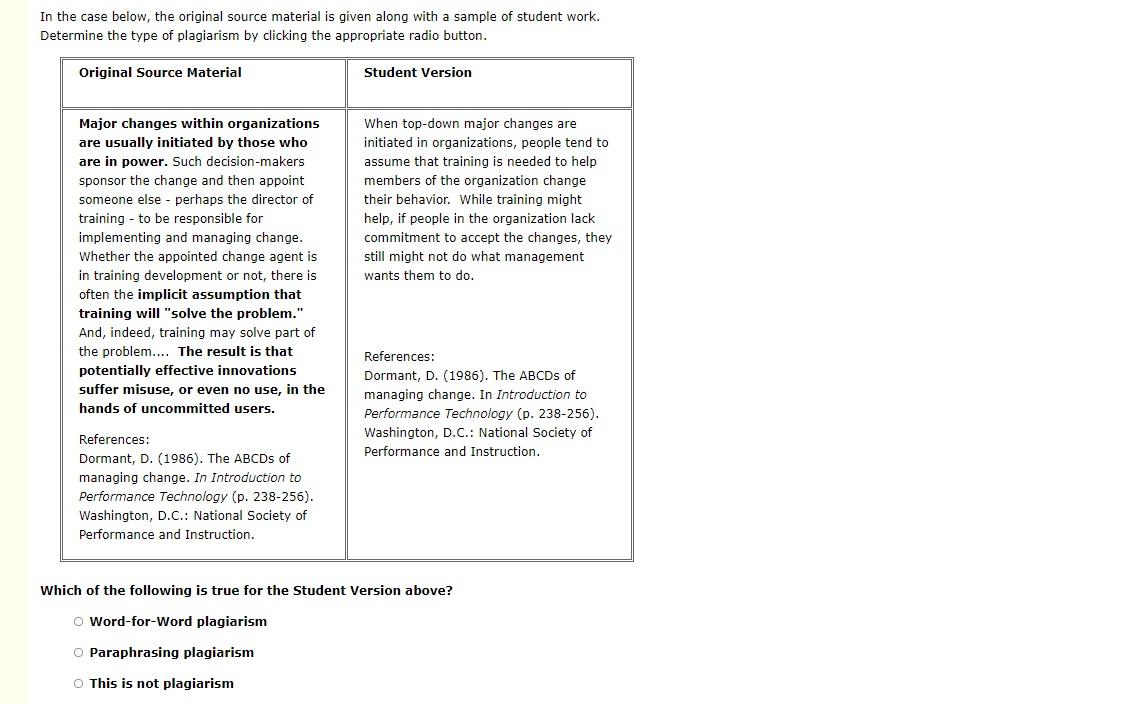
Acknowle In the case below, the original source material is given along with a sample of student work. Determine the type of plagiarism by clicking the appropriate radio button. Original Source Material Student Version In a complex task such as creating a website for learning, instructors may want to support the generation of multiple solutions in learners' peer feedback. Anonymity may create a social context where learners feel freer to express varied ideas, and make the task of giving feedback less inhibited. However, teachers need to know just how anonymity impacts the learning dynamic in order to make informed choices about when anonymous configurations are appropriate in peer feedback. Increased availability of technology in my classroom makes it easier for peer feedback activities to be conducted anonymously which "may create a social context where learners feel freer to express varied ideas, and make the task of giving feedback less inhibited" (Howard, Barrett, & Frick, 2010, p. 90). However, I worry that my students may be overly harsh if they don't have to stand by their comments. References: Howard, C. D., Barrett, A. F., & Frick, T. W. (2010). Anonymity to promote peer feedback: Pre-service teachers' comments in asynchronous computer- mediated communication. Journal of Educational Computing Research, 43(1), 89-112. References: Howard, C. D., Barrett, A. F., & Frick, T. W. (2010). Anonymity to promote peer feedback: Pre-service teachers' comments in asynchronous computer- mediated communication. Journal of Educational Computing Research, 43(1), 89-112. Which of the following is true for the Student Version above? O Word-for-Word plagiarism O Paraphrasing plagiarism This is not plagiarism In the case below, the original source material is given along with a sample of student work. Determine the type of plagiarism by clicking the appropriate radio button. Original Source Material Student Version Complex learning is the integration of knowledge, skills and attitudes; coordinating qualitatively different constituent skills, and often transferring what was learned in school or training to daily life and work. There are many examples of theoretical design models that have been developed to promote complex learning: cognitive apprenticeship, collaborative problem solving, constructivism and constructivist learning environments, learning by doing, multiple approaches to understanding, star legacy, as well as the subject of this contribution, the Four-Component Instructional Design model. Van Merrinboer and Kirschner (2007) indicated that complex learning involves the learning of how to complete authentic tasks which require the use and integration of knowledge and skills from multiple domains. Complex learning tasks have no single correct method of completion but instead a range of methods that result in the completion of the task at varying degrees of appeal, efficiency, and effectiveness. They further state that complex learning involves "the integration of knowledge, skills and attitudes; coordinating qualitatively different constituent skills, and often transferring what was learned ... to daily life and work (p. 4). References: van Merrinboer, J. J. G. & Kirschner, P. A. K. (2007). Ten steps to complex learning: A systematic approach to four- component instructional design. Lawrence Erlbaum Associates, Inc., Mahwah, NJ. References: van Merrinboer, J. J. G. & Kirschner, P. A. K. (2007). Ten steps to complex learning: A systematic approach to four- component instructional design. Lawrence Erlbaum Associates, Inc., Mahwah, NJ. Which of the following is true for the Student Version above? O Word-for-Word plagiarism Paraphrasing plagiarism This is not plagiarism In the case below, the original source material is given along with a sample of student work. Determine the type of plagiarism by clicking the appropriate radio button. Original Source Material Student Version Learning is a complex set of processes that may vary according to the developmental level of the learner, the nature of the task, and the context in which the learning is to occur. As already indicated, no one theory can capture all the variables involved in learning. References: Gredler, M. E. (2001). Learning and instruction: Theory into practice (4th Ed.). Upper Saddle, NJ: Prentice-Hall. A learning theory is made up of a set of constructs linking observed changes in performance with whatever is thought to bring about those changes. Therefore since learning is a complex set of processes that may vary according to the developmental level of the learner, the nature of the task, and the context in which the learning is to occur, it is apparent that no one theory can capture all the variables involved in learning. A learning theory, there, comprises a set of constructs linking observed changes in performance with what is thought to bring about those changes. References: Driscoll, M. P. (2000). Psychology of learning for instruction (2nd Ed.). Needham Heights, MA: Allyn & Bacon. Which of the following is true for the Student Version above? Word-for-Word plagiarism Paraphrasing plagiarism This is not plagiarism In the case below, the original source material is given along with a sample of student work. Determine the type of plagiarism by clicking the appropriate radio button. Original Source Material Student Version Reigeluth (1999) maintains that we "need theorists and researchers to generate and refine ... learning-focused instructional design theories...." Such theories will "help educators and trainers to meet those needs i.e., that focus on learning and that foster development of initiative, teamwork, thinking skills, and diversity)" (p. 27). There is a desperate need for theorists and researchers to generate and refine a new breed of learning-focused instructional design theories that help educators and trainers to meet those needs, (i.e., that focus on learning and that foster development of initiative, teamwork, thinking skills, and diversity). The health of instructional- design theory also depends on its ability to involve stakeholders in the design process. References: Reigeluth, C. M. (1999). What is instructional design theory and how is it changing? In C. M. Reigeluth (Ed.), Instructional-design theories and models volume II: A new paradigm of instructional theory. Mahwah, NJ: Lawrence Erlbaum Associates. References: Reigeluth, C. M. (1999). What is instructional design theory and how is it changing? In C. M. Reigeluth (Ed.), Instructional-design theories and models volume II: A new paradigm of instructional theory. Mahwah, NJ: Lawrence Erlbaum Associates. Which of the following is true for the Student Version above? O Word-for-Word plagiarism O Paraphrasing plagiarism This is not plagiarism In the case below, the original source material is given along with a sample of student work. Determine the type of plagiarism by clicking the appropriate radio button. Original Source Material Student Version Rutkowski and Rutkowski (2009) ask "what are reasonable outcomes of the influence of global processes on education?" (p. 138). This question is not entirely testable and has multiple dimensions but theories of globalization's impact on education exist and provide means of empirical analysis. But what are reasonable outcomes of the influence of global processes on education? While the question of how global processes influence all aspects of education (and who controls these forces) is multidimensional and not completely testable, there appear to be some theories of globalization as it relates to education that can be empirically examined. References: Rutkowski, L., & Rutkowski, D. (2009). Trends in TIMSS responses over time: Evidence of global forces in education? Educational Research and Evaluation, 15(2), 137-152. References: Rutkowski, L., & Rutkowski, D. (2009). Trends in TIMSS responses over time: Evidence of global forces in education? Educational Research and Evaluation, 15(2), 137-152. Which of the following is true for the Student Version above? o Word-for-Word plagiarism O Paraphrasing plagiarism This is not plagiarism In the case below, the original source material is given along with a sample of student work. Determine the type of plagiarism by clicking the appropriate radio button. Original Source Material Student Version Teacher's professional use of technology involves preparation for various classroom activities; such as, preparing instructional materials, material, communicating or collaborating with peers, students and their parents, locating digital resources, and creating lesson plans. When technology is used for instructional delivery, the teacher or students can use it. Teachers can present instruction by means of a projector or students may use computer-assisted learning applications such as drill and practice, tutorials, and simulations. technology as a tool, involves student use of basic software applications to extend their abilities to solve problems, create products, or communicate and share their perspectives with each other. References: Inan, F. A., & Lowther, D. L. (2010). Factors affecting technology integration in K-12 classrooms: a path model. Educational Technology Research and Development, 58(2), 137-154. Technology offers a variety of rich opportunities available to teachers and students. According to Inan and Lowther (2010), there are three main purposes to use technology in schools: (a) technology for teachers to prepare instructional activities, plans, materials, and resources; (b) technology for instructional delivery for teachers and students; (c) technology as a learning tool for both teachers and students. Although technology provides a number of advantages for teaching and learning, teachers who try to integrate technology in their classrooms have encountered many obstacles that hinder potential benefits of use of technology. Which of the following is true for the Student Version above? o Word-for-Word plagiarism Paraphrasing plagiarism This is not plagiarism Item 7 In the case below, the original source material is given along with a sample of student work. Determine the type of plagiarism by clicking the appropriate radio button. Original Source Material Student Version There are five advantages of using games in science learning stated in the literature. Games can be used as tools; make connections between virtual worlds and the real world; promote collaborative problem solving; provide affective and safe environments; and encourage younger students for science learning. First, the potential of digital games is discussed using the tutor/tool/tutee framework proposed by Taylor (1980). Second, the potential of digital games to enhance learning by connecting game worlds and real worlds is stated. Third, the possibility of digital games to facilitate collaborative problem- solving is addressed. Fourth, the capability of digital games to provide an affective environment for science learning is suggested. Last, the potential of using digital games to promote science learning for younger students is indicated. References: L, M. C., & Tsai, C. C. (2013). Game- Based Learning in Science Education: A Review of Relevant Research. Journal of Science Education and Technology, 1-22. Which of the following is true for the Student Version above? O Word-for-Word plagiarism O Paraphrasing plagiarism This is not plagiarism o In the case below, the original source material is given along with a sample of student work. Determine the type of plagiarism by clicking the appropriate radio button. Original Source Material Student Version Does knowledge exist outside of, or separate from, the individual who knows? Constructivists hold that human knowledge, whether the bodies of content in public disciplines (such as mathematics or sociology) or knowledge of the individual learner, is a human construction (Gredler, 2001). The philosophical position known as constructivism views knowledge as a human construction. The various perspectives within constructivism are based on the premise that knowledge is not part of an objective, external reality that is separate from the individual. Instead, human knowledge, whether the bodies of content in public disciplines (such as mathematics or sociology) or knowledge of the individual learner, is a human construction. References: Gredler, M. E. (2001). Learning and instruction: Theory into practice (4th Ed.). Upper Saddle River, NJ: Prentice- Hall. References: Gredler, M. E. (2001). Learning and instruction: Theory into practice (4th Ed.). Upper Saddle River, NJ: Prentice- Hall. Which of the following is true for the Student Version above? Word-for-Word plagiarism O Paraphrasing plagiarism This is not plagiarism In the case below, the original source material is given along with a sample of student work. Determine the type of plagiarism by clicking the appropriate radio button. Original Source Material Student Version Other major issues involve the accepted methods by which fidelity is measured. There are two major methods described in the literature for fidelity measurement. The first is through mathematical measurement that calculates the number of identical elements shared between the real world and the simulation; the greater the number of shared identical elements, the higher the simulation fidelity. A second method to measure fidelity is through a trainees' performance matrix. Liu et al. (2009) identified two major methods for measuring fidelity. The first is a mathematical (objective) method that requires counting "the number of identical elements shared between the real world and the simulation; the greater the number of shared identical elements, the higher the simulation fidelity" (p. 62). The second method involves a performance matrix that compares a human's performance in the simulation with that person's real-world performance, producing an indirect measure of fidelity. References: Liu, D., Blickensderfer, E. L., Macchiarella, N. D., & Vincenzi, D. A. (2009). Simulation fidelity. In D. A. Vincenzi, J. A. Wise, M. Mouloua & P. A. Hancock (Eds.), Humanfactors in simulation and training (pp. 61-73). Boca Raton, FL: CRC Press. References: Liu, D., Blickensderfer, E. L., Macchiarella, N. D., & Vincenzi, D. A. (2009). Simulation fidelity. In D. A. Vincenzi, J. A. Wise, M. Mouloua & P. A. Hancock (Eds.), Humanfactors in simulation and training (pp. 61-73). Boca Raton, FL: CRC Press. Which of the following is true for the Student Version above? O Word-for-Word plagiarism O Paraphrasing plagiarism This is not plagiarism Hints In the case below, the original source material is given along with a sample of student work. Determine the type of plagiarism by clicking the appropriate radio button. Original Source Material Student Version Major changes within organizations are usually initiated by those who are in power. Such decision-makers sponsor the change and then appoint someone else - perhaps the director of training - to be responsible for implementing and managing change. Whether the appointed change agent is in training development or not, there is often the implicit assumption that training will "solve the problem." And, indeed, training may solve part of the problem.... The result is that potentially effective innovations suffer misuse, or even no use, in the hands of uncommitted users. When top-down major changes are initiated in organizations, people tend to assume that training is needed to help members of the organization change their behavior. While training might help, if people in the organization lack commitment to accept the changes, they still might not do what management wants them to do. References: Dormant, D. (1986). The ABCDs of managing change. In Introduction to Performance Technology (p. 238-256). Washington, D.C.: National Society of Performance and Instruction. References: Dormant, D. (1986). The ABCDs of managing change. In Introduction to Performance Technology (p. 238-256). Washington, D.C.: National Society of Performance and Instruction. Which of the following is true for the Student Version above? O Word-for-Word plagiarism O Paraphrasing plagiarism This is not plagiarism









 Study Help