







Question: Activity 1: Both Waterfall (Predictive) and Agile(Adaptive) methdologies are built based upon core tenets. Describe one core tenet for Waterfall and one core tenet for
Activity 1:
Both Waterfall (Predictive) and Agile(Adaptive) methdologies are built based upon core tenets. Describe one core tenet for Waterfall and one core tenet for an Agile methdology of your choice and explain why you feel it is necessary for the methdology.
Activity 2:
Case Study Overview:
In conventional business and government megaprojects--such as hydroelectric dams, chemical-processing plants, or big-bang enterprise-resource-planning systems--the standard approach is to build something monolithic and customized. Such projects must be 100% complete before they can deliver benefits: Even when it's 95% complete, a nuclear reactor is of no use. On the basis of 30 years of research and consulting on megaprojects, the author has found two factors that play a critical role in determining success or failure: replicable modularity in design and speed in iteration. The article examines those factors by looking at well-known megaprojects, both successful ones, and cautionary tales.
Case Study Link
- Use the following link to access the assigned cases: https://hbsp.harvard.edu/import/961368
Paper Requirements:
Question 1: In the article Agility Hacks, they talk about processes that can be used to "tackle immediate challenges quickly". Using your knowledge of Project Management Processes, what is the impact to the organizaton by not using a "formalized process" and what do you feel is the different between an "agility hack" and a hybrid methdology
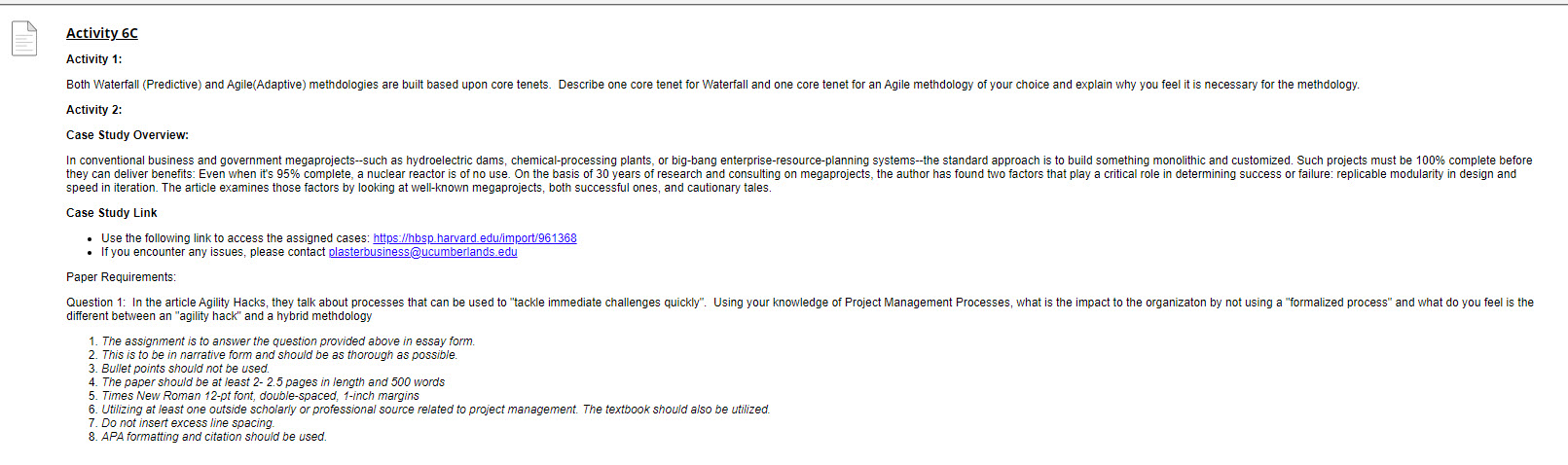
Activity 6C Activity 1: Both Waterfall (Predictive) and Agile(Adaptive) methdologies are built based upon core tenets. Describe one core tenet for Waterfall and one core tenet for an Agile methdology of your choice and explain why you feel it is necessary for the methdology. Activity 2: Case Study Overview: In conventional business and government megaprojects--such as hydroelectric dams, chemical-processing plants, or big-bang enterprise-resource-planning systems--the standard approach is to build something monolithic and customized. Such projects must be 100% complete before they can deliver benefits: Even when it's 95% complete, a nuclear reactor is of no use. On the basis of 30 years of research and consulting on megaprojects, the author has found two factors that play a critical role in determining success or failure: replicable modularity in design and speed in iteration. The article examines those factors by looking at well-known megaprojects, both successful ones, and cautionary tales. Case Study Link . Use the following link to access the assigned cases: https://hbsp.harvard edu/import/961368 . If you encounter any issues, please contact plasterbusiness@ucumberlands.edu Paper Requirements: Question 1: In the article Agility Hacks, they talk about processes that can be used to "tackle immediate challenges quickly". Using your knowledge of Project Management Processes, what is the impact to the organizaton by not using a "formalized process" and what do you feel is the different between an "agility hack" and a hybrid methdology 1. The assignment is to answer the question provided above in essay form. 2. This is to be in narrative form and should be as thorough as possible. 3. Bullet points should not 4. The paper should be at least 2- 2.5 pages in length and 500 words 5. Times New Roman 12-pt font, double-spaced, 1-inch margins 6. Utilizing at least one outside scholarly or professional source related to project management. The textbook should also be utilized. 7. Do not insert excess line spacing. 8. APA formatting and citation should be used
Step by Step Solution
There are 3 Steps involved in it

Get step-by-step solutions from verified subject matter experts
 Study Help