Question: ACTIVITY 1: DISCRETE AND CONTINUOS RANDPM VARIABLE esson The Concept of Random Variables A random variable is a variable whose value is unknown or a

ACTIVITY 1: DISCRETE AND CONTINUOS RANDPM VARIABLE
ACTIVITY 1: DISCRETE AND CONTINUOS RANDPMACTIVITY 1: DISCRETE AND CONTINUOS RANDPMACTIVITY 1: DISCRETE AND CONTINUOS RANDPM
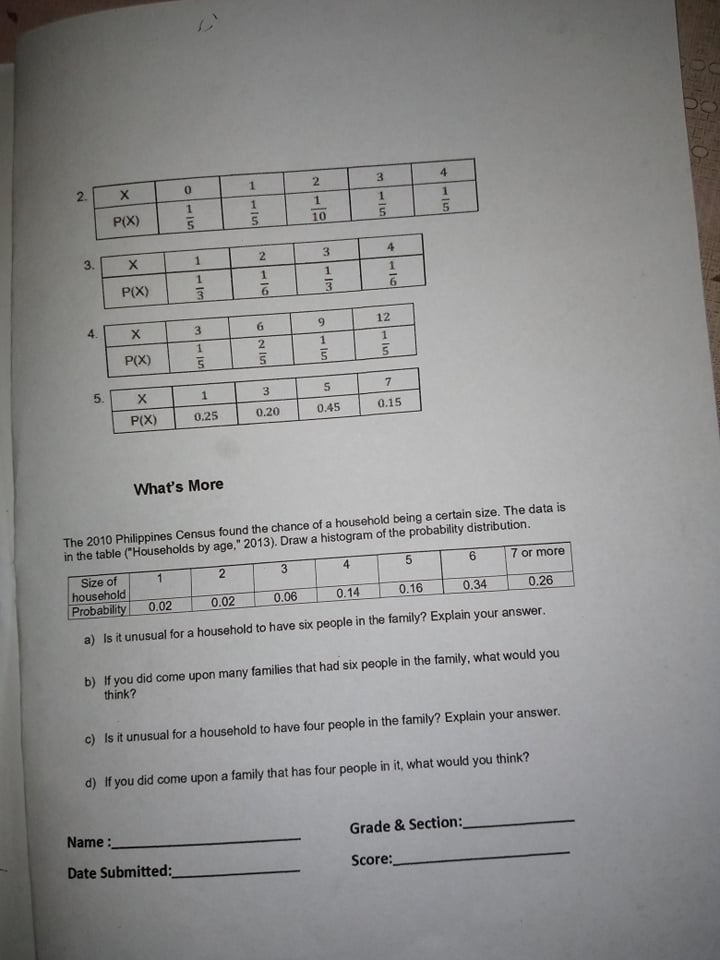
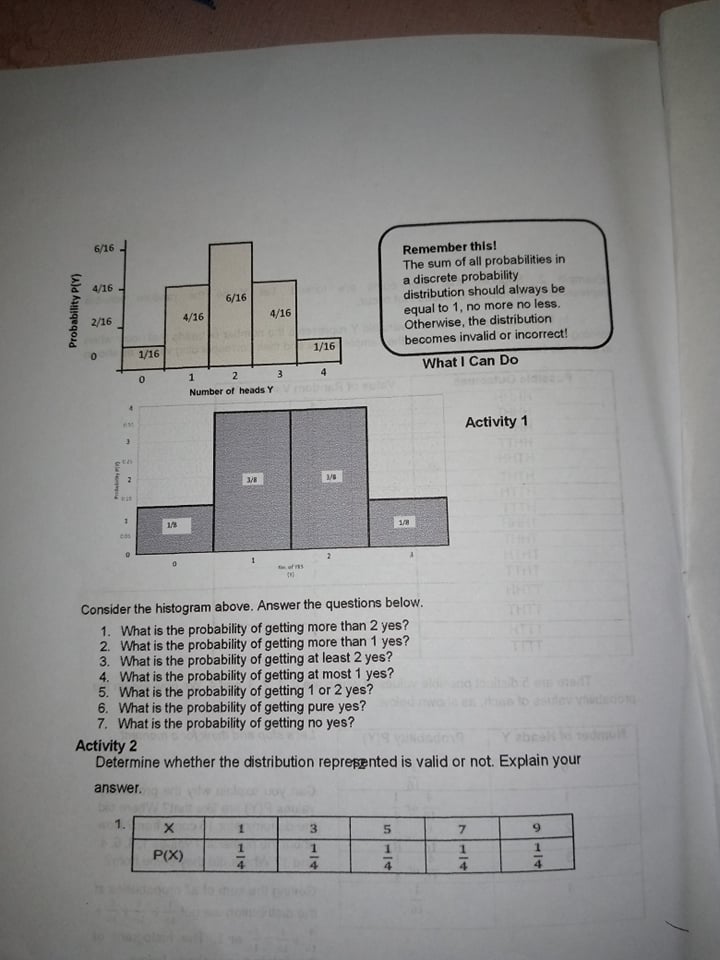
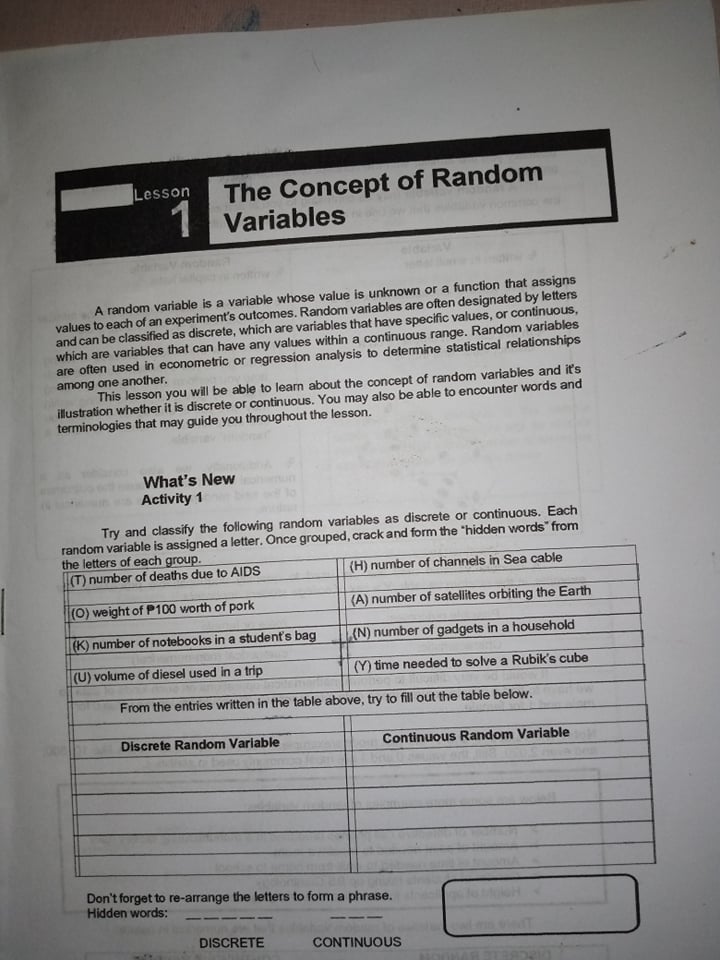
esson The Concept of Random Variables A random variable is a variable whose value is unknown or a function that assigns values to each of an experiment's outcomes. Random variables are often designated by letters and can be classified as discrete, which are variables that have specific values, or continuous, which are variables that can have any values within a continuous range. Random variables are often used in econometric or regression analysis to determine statistical relationships among one another. This lesson you will be able to learn about the concept of random variables and it's illustration whether it is discrete or continuous. You may also be able to encounter words and terminologies that may guide you throughout the lesson. What's New Activity 1 Try and classify the following random variables as discrete or continuous. Each random variable is assigned a letter. Once grouped, crack and form the "hidden words" from the letters of each group. (T) number of deaths due to AIDS (H) number of channels in Sea cable (O) weight of P100 worth of pork (A) number of satellites orbiting the Earth (K) number of notebooks in a student's bag (N) number of gadgets in a household (U) volume of diesel used in a trip (Y) time needed to solve a Rubik's cube From the entries written in the table above, try to fill out the table below. Discrete Random Variable Continuous Random Variable Don't forget to re-arrange the letters to form a phrase. Hidden words: DISCRETE CONTINUOUS2 X P(X) 3 X DI- N P(X) X 3 12 P(X) 5 X 1 3 5 7 P(X) 0.25 0.20 0.45 0.15 What's More The 2010 Philippines Census found the chance of a household being a certain size. The data is in the table ("Households by age," 2013). Draw a histogram of the probability distribution. Size of 2 5 6 7 or more household Probability 0.02 0.02 0.06 0.14 0.16 0.34 0.26 a) Is it unusual for a household to have six people in the family? Explain your answer. b) If you did come upon many families that had six people in the family, what would you think? c) Is it unusual for a household to have four people in the family? Explain your answer. d) If you did come upon a family that has four people in it, what would you think? Name : Grade & Section: Date Submitted: Score:6/16 - Remember this! The sum of all probabilities in 4/16 a discrete probability 6/16 distribution should always be Probability P[Y] 2/16 4/16 1/16 equal to 1, no more no less Otherwise, the distribution becomes invalid or incorrect! 1/16 1/16 What I Can Do 2 Number of heads Y Activity 1 Consider the histogram above. Answer the questions below. THE 1. What is the probability of getting more than 2 yes? What is the probability of getting more than 1 yes? WN What is the probability of getting at least 2 yes? FITT 4. What is the probability of getting at most 1 yes? . What is the probability of getting 1 or 2 yes? Whobid un wind? . What is the probability of getting pure yes? 7. What is the probability of getting no yes? Activity 2 Determine whether the distribution represented is valid or not. Explain your answer. X P(X)

Step by Step Solution

There are 3 Steps involved in it

1 Expert Approved Answer
Step: 1 Unlock blur-text-image

Question Has Been Solved by an Expert!

Get step-by-step solutions from verified subject matter experts

Step: 2 Unlock
Step: 3 Unlock

Students Have Also Explored These Related Mathematics Questions!