







Question: Activity 1: Electric Potential Directions: Solve the following problems. Identify the given quantities, required quantities, and equation used. Show B . complete solution then box
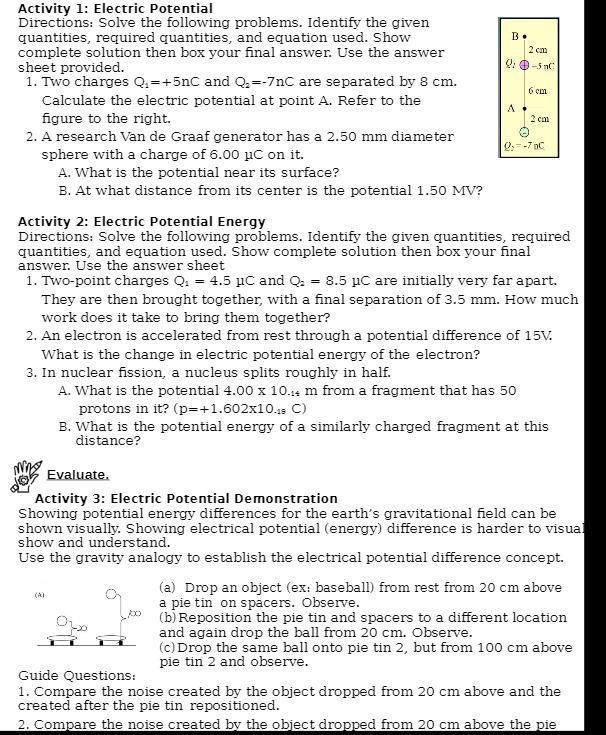
Activity 1: Electric Potential Directions: Solve the following problems. Identify the given quantities, required quantities, and equation used. Show B . complete solution then box your final answer. Use the answer 2 cm sheet provided. 1. Two charges Q,=+5nC and Q.=-7nc are separated by 8 cm. 6 em Calculate the electric potential at point A. Refer to the figure to the right. 2 cm 2. A research Van de Graaf generator has a 2.50 mm diameter 0. =-7 DC sphere with a charge of 6.00 pC on it. A. What is the potential near its surface? B. At what distance from its center is the potential 1.50 MV? Activity 2: Electric Potential Energy Directions: Solve the following problems. Identify the given quantities, required quantities, and equation used. Show complete solution then box your final answer. Use the answer sheet 1. Two-point charges Q. = 4.5 ]C and Q: = 8.5 pC are initially very far apart. They are then brought together, with a final separation of 3.5 mm. How much work does it take to bring them together? 2. An electron is accelerated from rest through a potential difference of 15V. What is the change in electric potential energy of the electron? 3. In nuclear fission, a nucleus splits roughly in half. A. What is the potential 4.00 x 10.: m from a fragment that has 50 protons in it? (p=+1.602x10.: C) B. What is the potential energy of a similarly charged fragment at this distance? Evaluate. Activity 3: Electric Potential Demonstration Showing potential energy differences for the earth's gravitational field can be shown visually. Showing electrical potential (energy) difference is harder to visual show and understand. Use the gravity analogy to establish the electrical potential difference concept. (AI (a) Drop an object (ex: baseball) from rest from 20 cm above a pie tin on spacers. Observe. (b) Reposition the pie tin and spacers to a different location and again drop the ball from 20 cm. Observe. (c) Drop the same ball onto pie tin 2, but from 100 cm above pie tin 2 and observe. Guide Questions: 1. Compare the noise created by the object dropped from 20 cm above and the created after the pie tin repositioned. 2. Compare the noise created by the object dropped from 20 cm above the pie
Step by Step Solution
There are 3 Steps involved in it

Get step-by-step solutions from verified subject matter experts
 Study Help