







Question: Activity 2. I'M EVERYWHERE! A spontaneous process is one that takes place without energy from an external source. For a chemical reaction to be
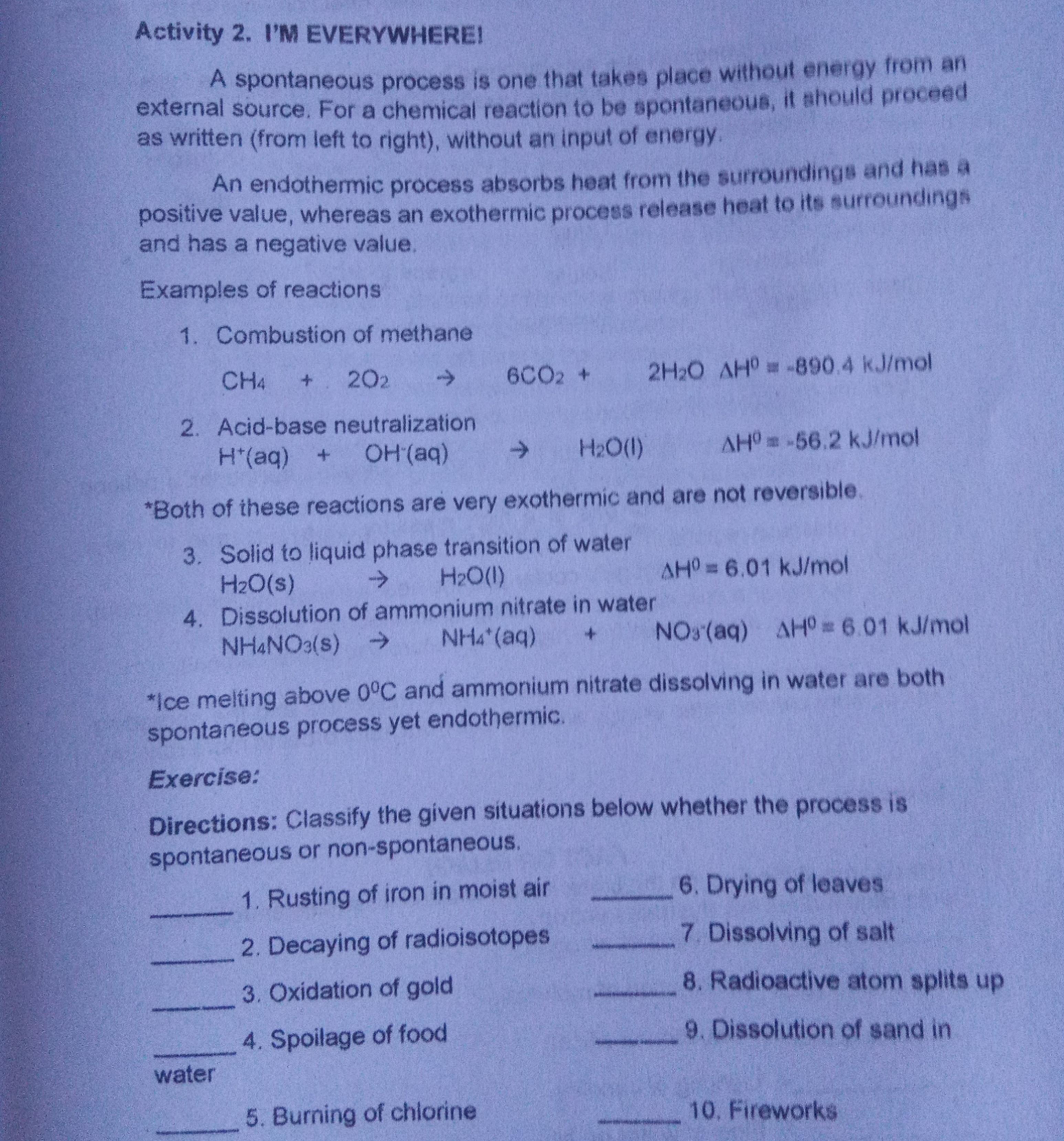
Activity 2. I'M EVERYWHERE! A spontaneous process is one that takes place without energy from an external source. For a chemical reaction to be spontaneous, it should proceed as written (from left to right), without an input of energy. An endothermic process absorbs heat from the surroundings and has a positive value, whereas an exothermic process release heat to its surroundings and has a negative value. Examples of reactions 1. Combustion of methane CH4 + 202 6CO2 + 2H2O AH -890.4 kJ/mol %3 2. Acid-base neutralization H(aq) + OH (aq) -> H2O(1) AH-56.2 kJ/mol *Both of these reactions are very exothermic and are not reversible. 3. Solid to liquid phase transition of water H2O(s) 4. Dissolution of ammonium nitrate in water NH&NO3(s) -> H2O(1) AHO 6.01 kJ/mol NHA (aq) NOs(aq) AHO= 6.01 kJ/mol *Ice melting above 0C and ammonium nitrate dissolving in water are both spontaneous process yet endothermic. Exercise: Directions: Classify the given situations below whether the process is spontaneous or non-spontaneous. 1. Rusting of iron in moist air 6. Drying of leaves 2. Decaying of radioisotopes 7. Dissolving of salt 3. Oxidation of gold 8. Radioactive atom splits up 4. Spoilage of food 9. Dissolution of sand in water 5. Burning of chlorine 10. Fireworks
Step by Step Solution
There are 3 Steps involved in it
1 Rusting of Iron Spontaneous 2 Decaying of Radioisotopes Spontaneous 3 Ox... View full answer

Get step-by-step solutions from verified subject matter experts
 Study Help