







Question: Activity 2: Motion with Balanced Forces b) After you start the sofa moving, what would you have to do now to keep it moving across
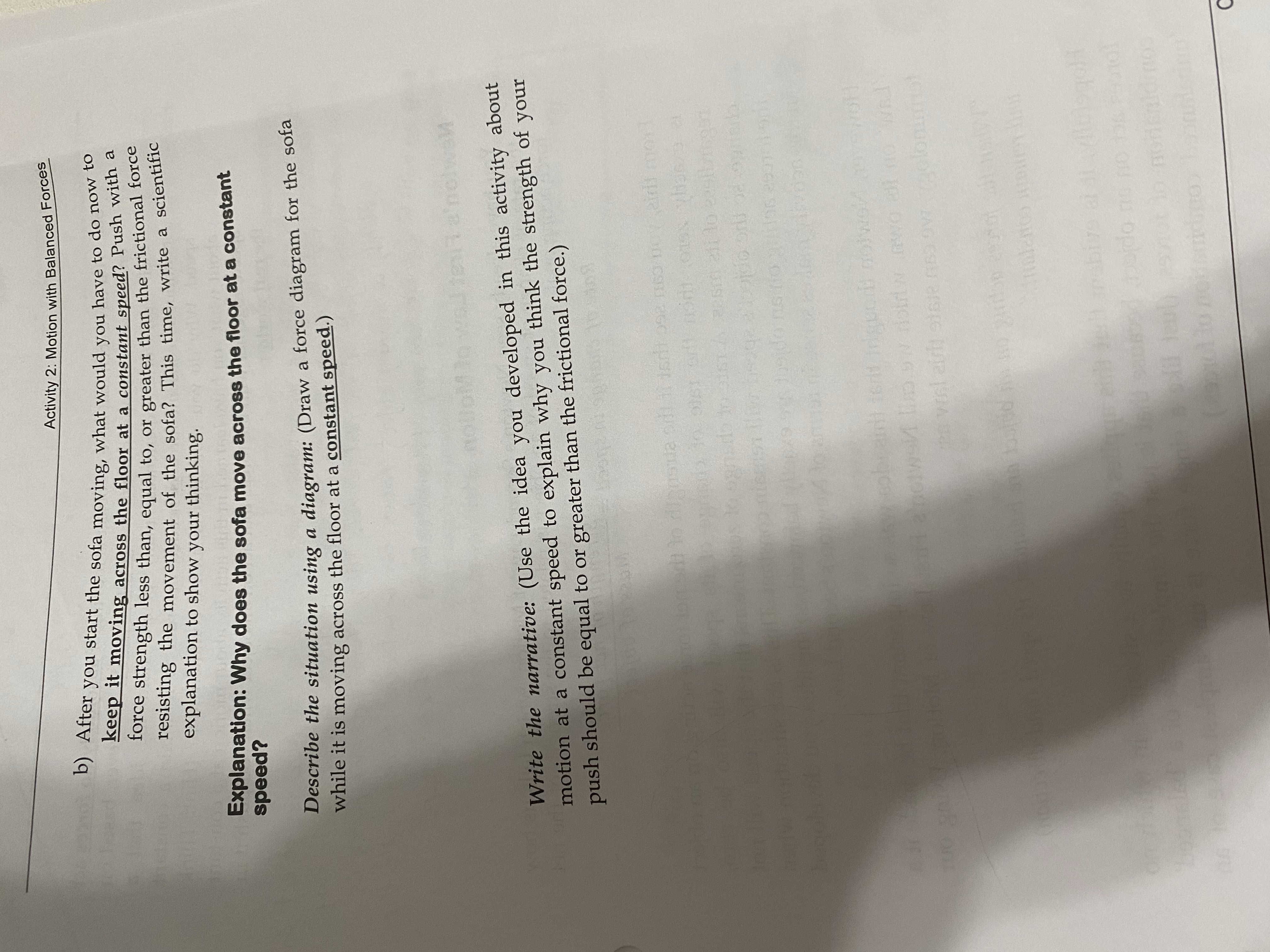
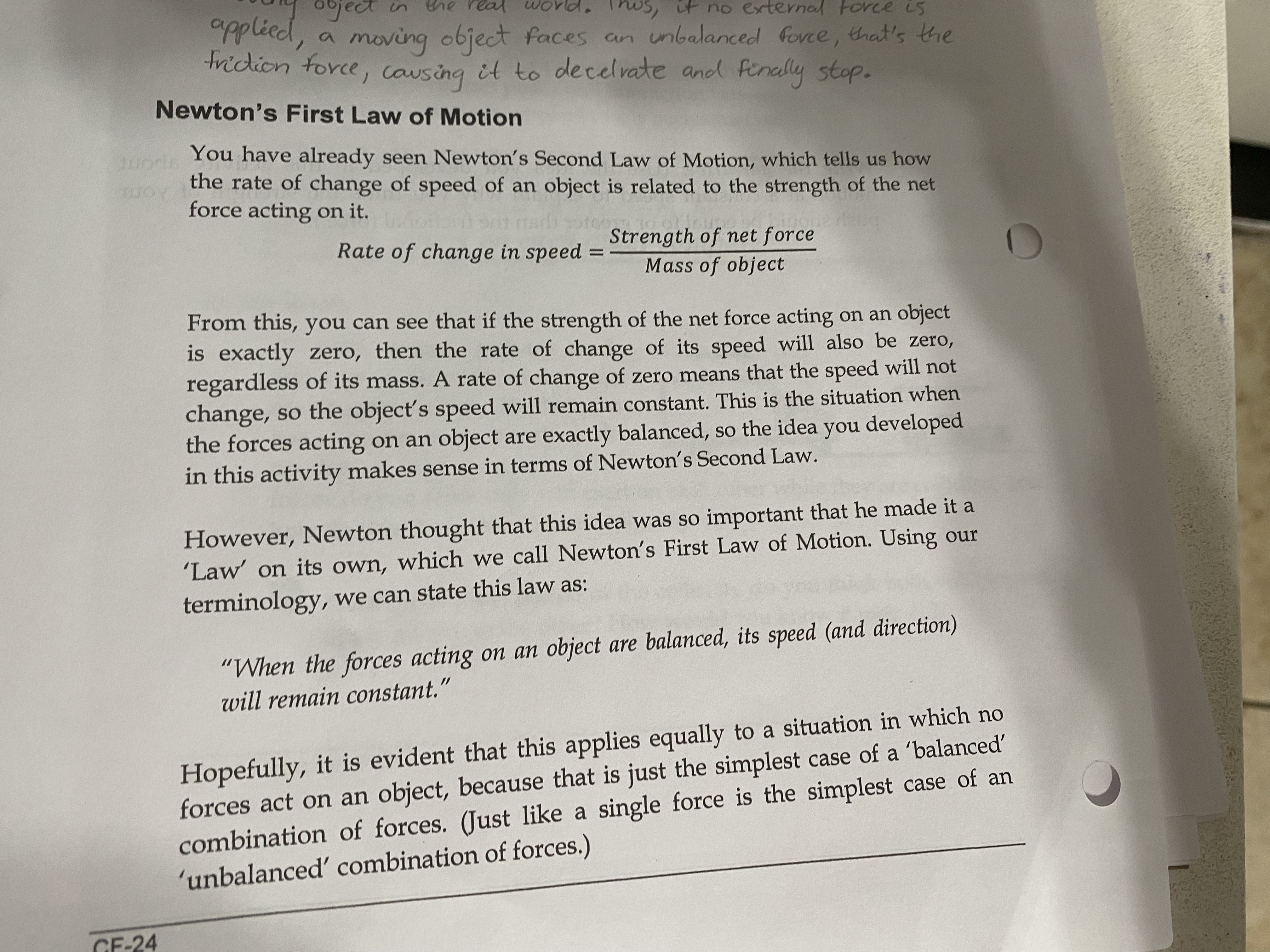
Activity 2: Motion with Balanced Forces b) After you start the sofa moving, what would you have to do now to keep it moving across the floor at a constant speed? Push with a force strength less than, equal to, or greater than the frictional force resisting the movement of the sofa? This time, write a scientific explanation to show your thinking. Explanation: Why does the sofa move across the floor at a constant speed? Describe the situation using a diagram: (Draw a force diagram for the sofa while it is moving across the floor at a constant speed.) Write the narrative: (Use the idea you developed in this activity about motion at a constant speed to explain why you think the strength of your push should be equal to or greater than the frictional force.)object in the real world. Pros, if no external force is applied, a moving object faces an unbalanced force, that's the tridion force, causing it to decelerate and finally stop. Newton's First Law of Motion You have already seen Newton's Second Law of Motion, which tells us how the rate of change of speed of an object is related to the strength of the net force acting on it. Rate of change in speed = - _Strength of net force ( ) Mass of object From this, you can see that if the strength of the net force acting on an object is exactly zero, then the rate of change of its speed will also be zero, regardless of its mass. A rate of change of zero means that the speed will not change, so the object's speed will remain constant. This is the situation when the forces acting on an object are exactly balanced, so the idea you developed in this activity makes sense in terms of Newton's Second Law. However, Newton thought that this idea was so important that he made it a 'Law' on its own, which we call Newton's First Law of Motion. Using our terminology, we can state this law as: "When the forces acting on an object are balanced, its speed (and direction) will remain constant." Hopefully, it is evident that this applies equally to a situation in which no forces act on an object, because that is just the simplest case of a 'balanced' combination of forces. (Just like a single force is the simplest case of an 'unbalanced' combination of forces.) CF-24
Step by Step Solution
There are 3 Steps involved in it

Get step-by-step solutions from verified subject matter experts
 Study Help